Showing posts with label Pandolfini. Show all posts

28 March 2024

Cutting Off

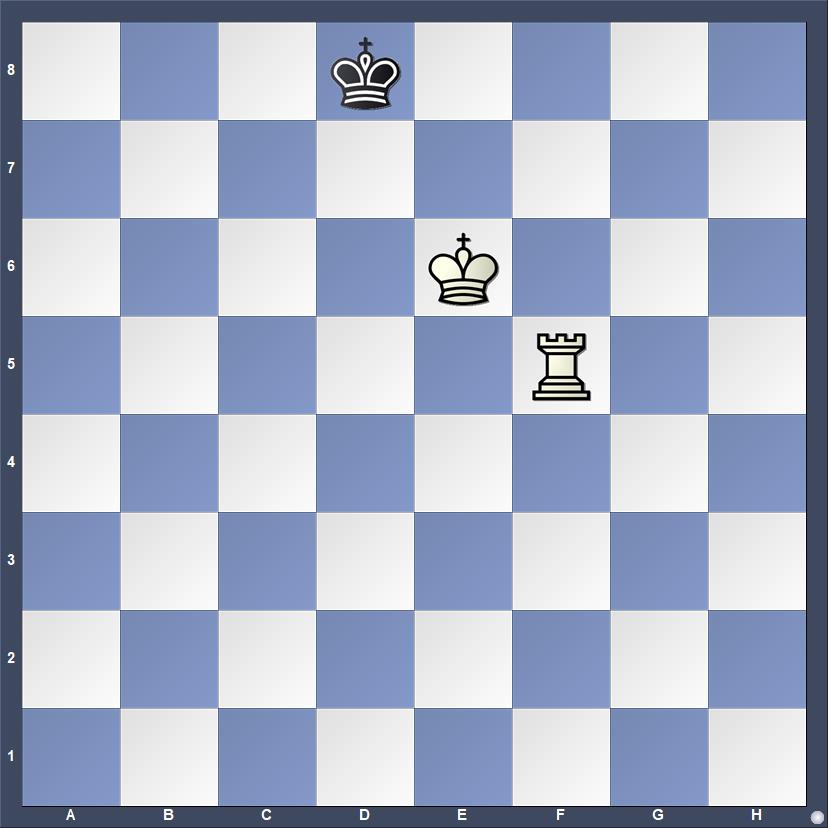
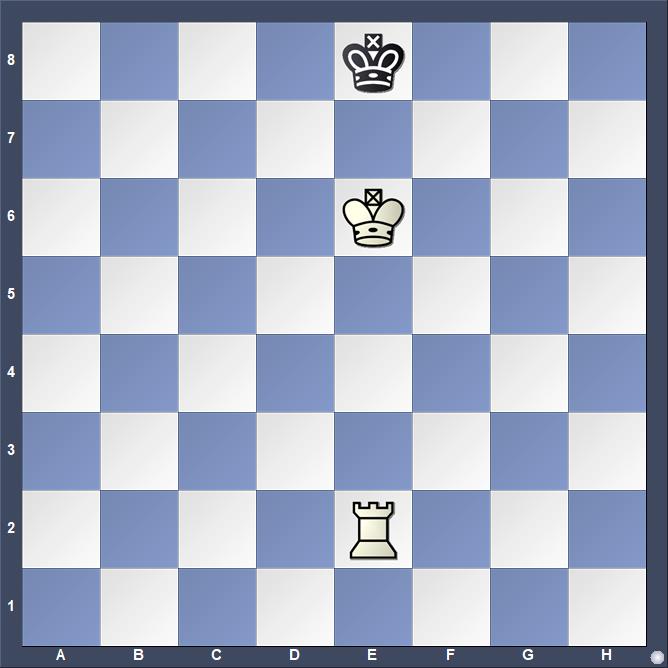
Young chess players are quick to attack pieces directly. Learning to anticipate the opponent's plans and prevent them does not come naturally. In my experience, young beginning players must be shown this simple mate in two many times before the idea of cutting off sinks in.

White to move
It is an ancient exercise that I first recall seeing and beginning to use with students while perusing Bruce Pandolfini, Pandolfini's Endgame Course. With a group of students who are finishing the Pawn Award and beginning to work towards the Knight Award, I prefaced this position with two others from this week's online play.

These positions are more difficult for beginners, so we spent some time on them.

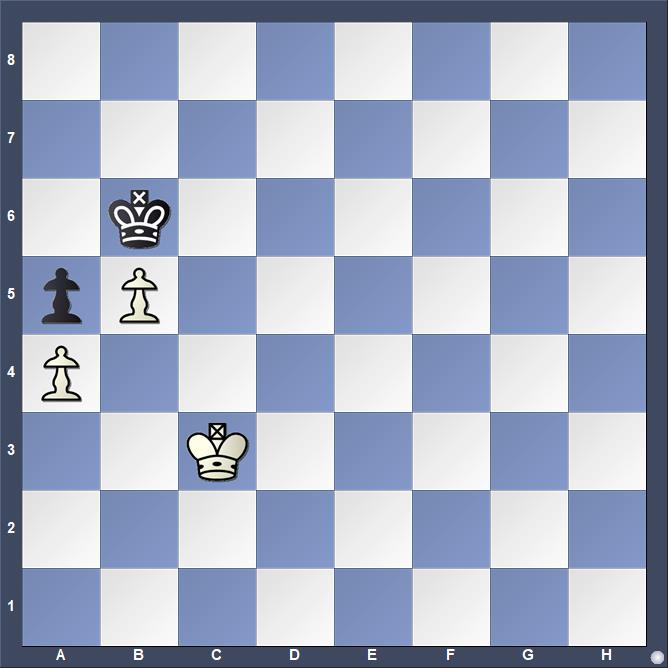
Black to move
Facing a threat to my a-pawn that would upset the material equilibrium, I confined White's king to the first rank with a checkmate threat.

43...Bg3

White failed to find the most stubborn defense, played 44.Rd6? and resigned while I was contemplating how to remove the rook. After 44.Re8+ Kh7 45.Rf8, there is no checkmate threat. Nonetheless, Black is winning a pawn after 45...Rd3 46.Kf1 (46.Rf3 Rxf3 47.gxf3 Be5 is worse, and White's a-pawn still falls) 46...Rxa3.

The second illustration shows the same cutting off idea with a piece on g3, although Black had many ways of winning.

Black to move
24...Qg3 (24...f4 is best) 25.Rf1 Re1 26.Qc4 Rxf1 27.Qxf1 Re1 and White resigned.

My intent was to show these two positions from recent online play, then have the students solve the mate in two from Pandolfini. Hopefully, the idea of restricting the opponent's choices, rather than direct and often futile checks, will sink in.

Continuing the theme of cutting off, I found several instructive exercises in László Polgár, Chess Endgames. This study by Nikolai Antonovich Kopaev was the first.

White to move
White must find a sequence of "only" moves. Alternatives draw. This exercise and those that follow in Polgár's massive book build endgame technique.


28 October 2022

Problem of the Week

Elementary checkmates

Several years ago, I developed the habit of posting a portion of each week's chess lessons for youth players on Chess Skills. These were labeled with "Problem of the Week". After a few years, I stopped doing these posts weekly, but would post one from time to time. I seem to be slipping back towards the regular habit.

My students this week in the after school club were presented with some checkmate positions.

On Tuesday I presented the first ten moves of a game that I played online the day prior, then asked students to work out the forced checkmate in five. Although the position differs slightly, the five move sequence is identical to one found in Vladimir Vukovic, The Art of Attack in Chess (1965).

Stripes,J. -- Internet Opponent [C10]
Live Chess Chess.com, 17.10.2022

1.e4 e6 2.d4 d5 3.Nc3 dxe4 4.Nxe4 Nf6 5.Bd3 Nxe4

5...Nbd7 has been my choice with Black.

6.Bxe4 Bd6

Both 6...c5 and 6...Nd7 are better.

7.Nf3 0-0 8.Bxh7+?

In this instance, the classic bishop sacrifice leads only to equality with best play.

8...Kxh7 9.Ng5+
Black to move
9...Kg8??

9...Kg6 was necessary 10.h4 Kf6 is best 11.Nh7+ Ke7 12.Nxf8 Kxf8 is best with equality.

10.Qh5+- Re8

Moves into forced checkmate

Black's woes are illustrated by the computer's suggested alternatives:
10...Bb4+ 11.c3; or
10...Qxg5 11.Bxg5

White to move

On Thursday, I first presented a situation that led to a draw in the previous Saturday's youth tournament. After more than a dozen moves, a young player with rook and knight against a lone king admitted inability to force checkmate. I asked a few students to show how they would find checkmate from this position.

White to move
After students showed their methods, I reviewed the process of keeping the Black king in an ever shrinking box. Then I presented a common exercise that Bruce Pandolfini has in his Pandolfini's Endgame Course (1988), 27.

White to move
Any rook move begins the process of delivering checkmate by force in three moves.

White has a mate in three with the rook on any square marked in yellow.

The real challenge was in solving a puzzle that dates from the mid-fifteenth century (before the bishop and queen gained the power they have now). 
White to move
Checkmate must be delivered in 12 moves or less. The rook can only move once was a stipulation of the problem. This problem shows that chess players know how to use opposition and outflanking more than 570 ago.


10 July 2022

To Know a Position

Two pawns against one when the stronger side has one that is both passed and protected is generally a win. There are exceptions when the pawns are too close to the edge of the board with one of the pawns (stronger or weaker side) on its starting square. Having a pawn on a rook file also limits the stronger side's chances. The position of the kings often proves critical.

This position, ending no. 107 in Pandolfini's Endgame Course (1988), also arises while playing through examples 8 and 9 in José R. Capablanca, Chess Fundamentals (1921). Josef Kling and Bernhard Horwitz, Chess Studies, or the Endings of Games (1851) presents a study that reaches this position after the first two moves.

White to move
Sacrificing the forward pawn allows White to win Black's pawn after a few moves using opposition and outflanking maneuvers, resulting in a standard position that Bruce Pandolfini covers earlier in the book (endgames 60-62).

The diagram position is important enough in Lev Alburt's view that it appears in Chess Training Pocket Book: 300 Most Important Positions and Ideas (1997). Alburt writes that to become a strong tournament player one needs to know only 12 key pawn endings, promising that the right 12 are in the book (9). A similar position appears in Rashid Ziyatdinov, GM-RAM: Essential Grandmaster Knowledge (2000), but did not make the cut for Thomas Engqvist, 300 Most Important Chess Positions (2018).

Lest there be any doubt about the practical value of understanding how White should play, consider the ending from Polgar,I.--Ciocaltea,V., Baja 1971, which is presented in C.G. Van Perlo, Van Perlo's Endgame Tactics, new, improved and expanded edition (2014).

White to move
54.Kg3

54.Kg5 fails to make progress, Van Perlo notes.

54...Kf7 55.Kf3 Ke7 56.Ke3 Kd7 57.Ke4 Ke6

White to move
Flip the side to move, remove White's f-pawn and place a Black pawn on f6, and the position is identical to one that appeared at the Spokane Chess Club in April 2005 between two of the group's strongest players. Black pushed the unopposed pawn and the game was dead drawn, yet the game continued for many moves more because the weaker side has very little time left on the clock.

58.g5!

"Depriving the black king of some vital squares in the tempo battle" (Van Perlo 25).

58...Kd6 59.f5 Ke7 60.f6+

Now White has a passed pawn.

60...Kf7 61.Ke5 Kf8

We have reached the position at the top of this post.

62.f7

Black resigned.

We can move the initial position right or left, up or down. In most cases, the stronger side has an easy win.  Sacrifice of the forward pawn is the easiest method when the blocked pawn is on the fifth rank, but this fails when the pawn is further back.

Two key positions are analyzed in Johann Berger, Theorie und Praxis der Endspiele (1890), referencing the earlier work of George Walker, A New Treatise on Chess (1841).

No. 483
Das Spiel ist leicht zu gewinnen
It is an easy win, regardless of who has the move, Berger explains.

No. 484
Weiss gewinnt nur mit dem Zuge.
White wins only with the move.

Mark Dvoretsky, Dvoretsky's Endgame Manual, 5th ed. (2020) offers one full page of analysis with one winning and two drawing positions, plus a well-known 1921 study by Nikolai Grigoriev earlier in the chapter. Grigoriev's study, "underscore[s] that a system of corresponding squares certainly does not have to always be 'straight line', as with the opposition. Each case demands concrete analysis" (23). Alex Fishbein, King and Pawn Endings (1993) offers two positions, both of which are Grigoriev compositions. Reuben Fine, Basic Chess Endings (1941) has seven diagrams over a little more than three pages. Karsten Müller and Frank Lamprecht, Fundamental Chess Endings (2001) offer two positions from games, one winning and one drawing. Comparable positions do not appear in Jeremy Silman, Silman's Complete Endgame Course (2007), unfortunately.

Paul Keres, Practical Chess Endings (1974) offers the most thorough discussion with 11 diagrams over six pages. He begins with Berger's no. 483 (see above).

After nine moves in Keres' analysis, the following position is reached.

White to move
"White would spoil everything with 10.b6?" Keres notes (34).

10.Kd5! Kc7 11.Ke6 Kb6 12.Kd6

This outflanking idea is another standard technique.

12...Kb7 13.Kc5

Keres then turns to the most important technique for endgame book authors: shifting the position. Shift everything up on rank and White can no longer win because of the same stalemate threat noted after 10.b6? Shift one square down, and White still wins. Two squares down and it matters who has the move. White must have the move to win.

Moving the position one file to the right and one rank up, White wins, even when Black has the move.

Black to move
1...Kd6 2.Ke4 Ke6 3.Kf4 Kd6 4.Kf5 Kc7 5.Ke6 Kc8

White to move
6.c7!

The pawn must be sacrificed, as we should know from Capablanca and Pandolfini.

Continuing the shift to the right and this time down a rank, Keres sets the kings in a manner optimal for Black. After a few moves, the following position is reached.

White to move
To secure the win, White must use threats of moving to either side of the mass of pawns to perform the opposition and outflanking maneuvers.

6.Kc1!

Working out the rest is good training. Keres book is helpful, too. It was when I reached this position in my reading yesterday morning that I started playing against Stockfish from this position and then many other variations with the same arrangement of pawns across the range of possibilities.

Shift the starting position one rank down and this resource no longer exists for White.

Knowing a position well is knowing an arrangement of pieces that may be, in fact, many hundreds of possible positions. Some of these have arisen in my games in the past and can be expected to do so again. 


13 February 2022

Two Old Books (and one new)

Koltanowski, George, and Milton Finkelstein. Checkmate! The Patterns of the Winning Mating Attacks and How to Achieve Them. New York: Doubleday and Co., 1978.
Tal, Mikhail, and Victor Khenkin. Tal’s Winning Chess Combinations: The Secrets of Winning Chess Combinations Described and Explained by the Russian Grandmaster Mikhail Tal, trans. Hanon W. Russell. New York: Simon and Schuster, 1979.


Checkmate! (1978) and Tal’s Winning Chess Combinations (1979) are remarkably similar in approach. Each takes an individual piece and offers game conclusions where that piece delivers the check that is mate. Then, individual chapters concern certain groups of pieces: both texts have chapters on two rooks, rook and bishop, rook and knight, two bishops, two knights, and queen and knight. Tal and Khenkin* continue this scheme with queen and bishop, queen and knight, and three pieces. In contrast, Koltanowski and Finkelstein offer chapters on certain patterns—Boden’s Mate, Epaulettes Mate, Long Diagonal Mates, Greco and Damiano Mates, and a chapter on double check. These pattern-oriented chapters are followed by chapters arranged by the piece that is sacrificed to set-up checkmate. There are additional chapters on pawn promotion, drawing resources, and how masters use checkmate threats.

There is a difference in the expectation of the target audience evident in advice about how to read the books. Koltanowski and Finkelstein repeatedly suggest that a reader should set up the position on a board and play through the moves in order to plant the patterns into memory. Tal and Khenkin, in contrast, suggest that readers study the book without a chess board to improve visualization skills, using a chess board "when you're really stymied" (14).

Legall’s Mate appears in both books. Tal and Khenkin have it in the chapter on three pieces, while Koltanowski and Finkelstein place it under queen sacrifices. These books differ on the game score of Legall — St. Brie, as well as the date. Tal’s Winning Chess Combinations has the game played in 1787 when Legall was 85 years old (351). Checkmate! states that the opening trap was first recorded about 1750, but does not explicitly state the game was played then (197-198). Koltanowski’s penchant for dubious stories makes its appearance here in the claim, “Légal was one of the first players to record his games” (197). If he recorded his games, what happened to them? Today, we cannot even be certain of the moves in the sole surviving example of Legall's play.

Checkmate!

Checkmate! was brought to my attention in response to my assertion in the Facebook group Chess Book Collectors that the best books for teaching checkmate patterns are George Renaud and Victor Kahn, The Art of the Checkmate; and Victor Henkin, 1000 Checkmate Combinations (see below). My claim provoked some interesting discussion. One commenter identified Checkmate! as a book that helped him learn these skills. Bruce Pandolfini also commented that Milton Finkelstein "was a wonderful chess teacher". On the strength of such recommendations, I found a copy and bought it.

The chapters in Checkmate! typically begin with some elementary illustrations and an impressive combination from master play. The authors describe conditions and rules for executing the checkmate in question, often producing numbered lists. For instance, the "four conditions necessary for mate with a rook":
1. The enemy king lacks escape squares.
2. A rook can attack it on a rank or a file.
3. The rook is immune from capture.
4. The rook check cannot be blocked by the interposing of a protected piece or pawn. (41)
The bulk of each chapter consists of exercises with a number of blanks on which a student can write the moves--workbook style. The introduction of each exercise typically offers clues, and in some cases the final position is shown. The book contains a bit over 550 exercises in total. Answers are in the back of the book. Here is an example from the chapter, "Boden's Mate", that is simple when you know the pattern, but has vexed many of my students over the years (151).

White to move

Often there are historical anecdotes about a player whose combination is featured. These anecdotes in Checkmate! are entertaining, but unreliable. We learn, for instance, that Akiba Rubinstein was confined to Berlin during World War I, "went bankrupt and then developed a persecution mania that broke his powers of concentration" (47). A more credible work, Akiba Rubinstein: Uncrowned King (1994) by John Donaldson and Nikolay Minev, places Rubinstein in Warsaw, limited to a playing local opponents in that city and in Lodz. Donaldson and Minev offer crosstables and games from the war period. They also note that Rubinstein married in 1917 and had a son born in 1918, both events taking place in German occupied Warsaw (254). There should be no question that Rubinstein's postwar play was inconsistent, as suggested by Koltanowski and Finkelstein, but they leave the impression that he did not play at all after the war. In fact, he won several strong tournaments in the 1920s. His performance in St. Petersburg in 1914 suggests that inconsistency cannot be wholly pinned on difficulties during the war years.

Historical errors are distracting, but do not destroy the book's pedagogical value for learning checkmate patterns. Nor do the errors in Checkmate! make the book unique. The list of errors that could be produced from thorough fact checking of Renaud and Kahn also would be lengthy (see "Pillsbury's Mate").

One of the simple illustrations of a final check by a rook in Checkmate! is identical in concept to one that I use often with my beginning students, and with which I became acquainted through Bruce Pandolfini, Pandolfini's Endgame Course (1988).

White to move

Classifying and organizing checkmate patterns is not a simple matter. In my own efforts, guided by half a dozen books and a few websites, I separated the dovetail and swallowtail checkmates from epaulette, listing all three as checkmates with the queen. Renaud and Kahn use the term Guéridon for the two bird mates and include this pattern with epaulette. Koltanowski and Kinkelstein lump them together under epaulette mate, but do not limit the pattern to a final check with the queen. This position credited to a Russian player surnamed Usachev illustrates (67-68).

Black to move

1...Bc3 2.Ke2

Black could avoid checkmate at the cost of a rook, the authors note. Stockfish shows that both rooks will disappear if Black plays the superior move 2.Kc1. After 2.Ke2, Black has a mate in two that starts with a queen sacrifice and ends with a knight check. Four White pieces occupy the king's escape squares, serving as ornament rather than protection.

Checkmate! includes a substantial number of checkmate examples. Had I acquired it when it was first published during my teen years and devoted myself to working through the book, I may have become a much stronger player.

Unfortunately, whatever the merits of the book, the authors were ill-served by their publisher. The very first diagram in the text is wrong (2). It appears that the image negative was flipped before printing--there is a dark square in the lower-right corner. Black's 4...K-K4 is an illegal move as there is a pawn on that square. The mismatch between the original position and the final position showing checkmate with a pawn alerts the attentive reader to the problem, so the error can be overcome. The publisher also exercised poor quality control over the printing process. Too much ink was allowed to flow, creating many pages where the dark squares are so dark that the Black pieces on them nearly disappear. Many pages have crystal clear diagrams, but a large percentage are dark and even blurred from inattention by the printer. These problems will be even worse in the Ishi Press reprints, which are notorious for poor print quality. 

Tal's Winning Chess Combinations

My Facebook assertion in favor of the value of Henkin, 1000 Checkmate Combinations was grounded in study of Tal and Khenkin, Tal's Winning Chess Combinations, which I have found quite good. My view also stems from superficial examination of the newer translation in Kindle format. Others have assured me that the newer edition is a better translation of The Last Check (more on that below).

Tal's Winning Chess Combinations is more challenging than Checkmate! This position from Adams -- Torre, New Orleans 1920 (given as 1921 in the text) and the winning idea is richer than most of the combinations in Koltanowski and Finkelstein (19).** 

White to move

White offered his queen for six consecutive moves in the effort to divert Black's queen from the defense of e8. The idea reappears as exercise 8 (37) from Guldin -- Bagdatev (1963), a position I remember from Lev Alburt, Chess Training Pocket Book, 2nd ed. (2000).

The initial example in each chapter of Checkmate! is usually comparable, but the rest of each chapter is less demanding. It did not take me more than ten minutes to blaze through the 13 exercises in the rook chapter, and every example was a forced checkmate. In many of the examples in Tal's Winning Chess Combinations, mate threats can be parried with significant sacrifice, still leading to a lost game.

Tal's Winning Chess Combinations also has a clearer demarcation between the instructive section and the exercises. Each chapter begins with diagrams showing the elementary pattern, and then proceeds through instructive and entertaining examples. Most chapters repeat this sequence with more checkmate patterns and game fragments. The object is showing a range of possibilities with the piece or pieces in question. As in Checkmate!, Tal's Winning Chess Combinations presents game endings where a queen did not deliver the final check in an epaulette mate.

This one is presented as Korchnoy -- Petrosyan 1965 (281).

White to move

White has a forced checkmate in four moves with a queen sacrifice on the second.

The bulk of the book is devoted to instructive examples. An idea is presented, then a few position, then a variations on the idea and more illustrations. The Adams -- Torre position above is the ninth instance of a combination exploiting a weak back rank in the chapter on the rook. This chapter begins with a simple illustration of a back rank checkmate. The instructive portion offers fifteen combinations to divert defenders from protecting the vulnerability. Diversion is combined with a second threat in some combinations. Further examples offer other tactical ideas, such as "line interference" in Reti -- Bogoljubow 1924 (22).

White to move
After 24.Bf7+ Kh8 25.Be8, Black resigned.

Tal's Winning Chess Combinations is notable for how it builds understanding of many possibilities related to a simple pattern. Applying what we know from backrank checkmates, the author notes that kings can be hemmed in by their own pieces on a file as well as rank. Even a file away from the edge of the board can become a deadly corridor. Goldenov -- Zakharian 1960 is a memorable example (34).

Black to move
1...g4 2.Kf4 Ra5 3.e5 Ra4+ 4.e4 Ra3 and White resigned.

Tal and Khenkin's chapter on the rook offers 45 instructive positions and then 17 exercises at the end of the chapter for the reader to solve. This abundance contrasts with a total of 13 exercises following four instructive examples in Koltanowski and Finkelstein. Checkmate!, however, offers 25 chapters to the 14 in the other text. The total of 271 exercises in Tal's Winning Chess Combinations are far fewer than more than 550 found in Checkmate!, but many offer greater challenge. On balance, I prefer Tal's Winning Chess Combinations, but expect to lift some examples from Checkmate! while creating worksheets for my students.

The New Book

Henkin, Victor. 1000 Checkmate Combinations, trans. Jimmy Adams and Sarah Hurst. London: Batsford Chess, [2011] 2022.


1000 Checkmate Combinations is a newer translation of the same Russian book as Tal’s Winning Chess Combinations. As such, the two books have considerable overlap. However, the differences are extensive. Both books have the same fourteen chapters, although the sequence differs. Each chapter offers a series of instructive game fragments and studies and then conclude with exercises at the end of the chapter. Tal’s Winning Chess Combinations has a total of 271 exercises, but the newer translation expands these to 456. 1000 Checkmate Combinations was published just over ten years ago, but has been out of print most of that time, although a Kindle edition was available. It was brought back into print in February 2022.

I cannot assess the quality of the translation. I lack both the resources (a copy of the Russian edition of The Last Check) and the competence (knowledge of Russian). However, I prefer the recent Batsford edition for several reasons. Tal's Winning Chess Combinations blurs the lines between Khenkin's work and Tal's contribution. 1000 Checkmate Combinations explicitly states that the book is Henkin's work. The title page reveals that Victor Henkin owns the text copyright. Batsford also asserts copyright ownership. The publisher owns all rights in the 1979 translation by Hanon Russell; there is no mention of the authors on the copyright page.

Tal’s Winning Chess Combinations begins with an Introduction: “Don’t Reinvent the Wheel”, co-authored by Tal and Khenkin (9-14). 1000 Checkmate Combinations has “Don’t Reinvent the Bicycle” by Tal (5-6) followed by “Before You Open the Book” by Henkin (7-9). The joint introduction in the earlier translation contains most of the content presented in the two introductions in the later text. In addition to clarifying authorship, the most notable differences are that Tal ended his introduction in the Batsford edition with a quote from Richard Réti, Masters of the Chessboard. This quote is absent from Russell’s translation. Russell also inserts Legall’s game into the introduction, while Adams and Hurst do not.

In Tal's introduction to the Batsford edition, we find:
There hasn't been a book like this before in our chess literature. The author has done an enormous amount of work selecting and systematizing the material. An experienced master, who in the recent past himself participated in competitions and had a reputation as a staunch tactician, he has retained a particular taste for the last check. (6)
This text is absent from Tal's Winning Chess Combinations. 1000 Checkmate Combinations is clearly the work of Henkin, lauded by Tal. Henkin's authorship is attested in Vladimir Barsky, A Modern Guide to Checkmating Patterns (2020), which is dedicated to Viktor Khenkin, whose pioneering organization in The Last Check is the model for Barsky's text.

Tal's Winning Chess Combinations presents a decisive mating combination played by Vera Menchik against George Thomas in 1932, and then imitated by David Bronstein against Paul Keres 18 years later (32-33). In both books this combination follows Capablanca -- Raubitschek 1906, to which it is comparable. 1000 Checkmate Combinations adds Tal -- Andersson 1976, where Tal's threats to bring about Menchik's combination provoked a series of exchanges that simplified into an ending with queen against knight and rook (25).

White to move
After the immediate 25.Qh6, the combination falters because Black's resources with 25...Rg8 and 26...Nf8 hold the position together. Tal first set out to remove the knight.

25.Bb6 Rc8 26.Qh6 Rg8 27.Rd4!

Henkin writes, "So Ulf Andersson gives up his queen for rook and bishop, which, however, doesn't save the game" (25).

27...Nxb6 28.Rxd5 Nxd5 29.Rf3

With Tal renewing the mating threat, Anderrson is forced to exchange rooks.

29...Rc3 30.Rxc3 Nxc3 31.Qe3 b4 32.Qa7 Rf8 33.Qc5 Rb8 34.Qd6 1-0

This long combination with checkmate threats parried, but still leading to a decisive advantage is a characteristic of Henkin's work. Both translations of his work bring this out, but the more recent text does so in greater abundance.

Detailed comparison of the first chapter of both books shows that the 45 positions in Tal and Khenkin expands to 62 in 1000 Checkmate Combinations. I count five in the older translation that are missing from the newer edition. My count of 15 in the Batsford edition that are absent from Tal's Winning Chess Combinations reveals there is something askew with my counting (15+5 > 17). But there is no doubt that the newer edition has more material. The 1979 text has three sets of basic patterns followed by examples from games and studies. The Batsford edition has four. Above, I credit Tal's Winning Chess Combinations with showing corridor mates on files as well as ranks. The idea is there, but is is made more explicit in the section found only in the newer book.
Mating situations in which the rook delivers a linear blow can also arise on the files. In these cases it is as if the board does a 90-degree turn. (20).
At the end of the chapter on rooks, the exercises have expanded from 17 to 43 in 1000 Checkmate Combinations.

Although many passages in the two books make it abundantly clear that they are derived from the same Russian text, the language employed differs. The familiar term luft is found in Russell's translation, but becomes "the little window" in the work of Adams and Hurst. Diversion becomes deflection. Line interruption becomes interference.

Some readers will object to the small size of the diagrams in 1000 Checkmate Combinations. They are indeed small at 35 mm. Only a few books have smaller diagrams, such as the training positions in Antonio Gude, Fundamental Checkmates (2016), measuring 34 mm. Other chess books typically have diagrams from 40-50 mm, and the main part of Gude's book comes in at 45 mm. Diagrams in Tal's Winning Chess Combinations are 41 mm. They are 43 mm in Checkmate!

In the Kindle edition of Henkin, the figurines in the notation are a larger font than the text. I have found this ebook difficult to read, but the print text is a delight, even with the small diagrams. At least the diagrams are very clear with appropriate shading of the dark squares and clear pieces.


Notes

*Both Khenkin and Henkin appear as the spelling of this writer's name in different places. I favor the spelling used by the book under discussion. Vladimir Barsky dedicates A Modern Guide to Checkmating Patterns (2020) to Viktor Lvovich Khenkin and offers The Last Check as the English title of the Russian work upon which both Tal's Winning Chess Combinations and 1000 Checkmate Combinations are based. Barsky's book follows the general outline of these two, but with far less instructive material. Rather the instruction is provided as exercises. While Khenkin is the spelling on the cover and title page of Tal's Winning Chess Combinations, games played by the author are presented in the text with the spelling Henkin.

**In all likelihood, this game was analysis, possibly by the alleged victim of the combination as instruction for the alleged victor. See Edward Winter, "Adams v Torre -- A Sham?" Chess Notes (updated 14 December 2021).

31 January 2021

Advice for Beginners

Interest in chess is growing. Social isolation during the COVID-19 pandemic and then the popularity of Queen's Gambit on Netflix have created a notable increase in requests for advice from beginners looking to play chess well. There are many books, videos, and websites that are useful. Advice is even more plentiful, but not all of it is useful. There are many approaches to learning chess that have proven helpful. What works for one person may not work for another. 

I was a beginner with almost no understanding of strategy or tactics for about eight years, then I starting reading chess books, and improved rapidly. My interest in chess grew, too. I've sustained this interest more than 45 years. In "My First Chess Book" (2012), I wrote about the beginnings of this growth in skill. The book featured there, 1000 Best Short Games of  Chess (1955), is out of print, but there are many similar books. It is possible to learn a lot about chess, as I did, studying hundreds of miniatures (short games of 25 moves or less).* These short games taught me how to attack the opponent's king. Playing through fantasy variations of these games on a chess board developed tactical skills.

I use a lot of short games in my teaching, as they can be useful. In more than two decades of coaching beginners, and watching them grow into tournament players, I have learned a lot about the development of chess skill. I am convinced that chess enthusiasts should build a foundation of knowledge that starts at the end of the game and works backwards towards the beginning.

A game of chess is commonly described as having three phases--the opening, the middlegame, and the ending. Why not begin with the opening? Studying short games taught me the opening and checkmates, but not the middlegame, and not technical endgames with few pieces. Nevertheless, I improved. There are merits to starting at the beginning, and there are chess teachers who advocate doing so. However, I believe there is a better way.

I recommend starting with Jose Capablanca, Chess Fundamentals (1921).** This book was first published one hundred years ago, but in my opinion remains the single best book for a new player. It covers all aspects of the game, and does so in the sequence that offers the best chance of success.
Chess Fundamentals was published after Jose R. Capablanca became World Champion as a consequence of defeating Emanuel Lasker in a championship match. He followed this book with A Primer of Chess (1935), which some readers have considered as an improvement. The two books follow a similar pattern, and in some cases repeat the same information, especially in the beginning. A Primer of Chess offers instruction on the basic rules, which is absent from Chess Fundamentals. 

Chess Fundamentals begins with some elementary checkmates--rook and king, two bishops and king, and queen and king. A Primer of Chess has these plus checkmate with two rooks. After these simple checkmates, both books offer the foundation of understanding of pawn promotion with clear analysis of two positions with a single pawn and the two kings. Capablanca then moves on to pawn endings with two pawns against one. It is at this point that Primer and Fundamentals diverge. Capablanca saw them as companion volumes.

After pawn endings, Capablanca offers middlegame positions. In Chess Fundamentals, these first middle game positions are checkmate exercises. One side can force checkmate through a combination, often requiring an initial sacrifice of material. The middlegame positions at this point in A Primer of Chess are not forced checkmates, but emphasize gaining a material advantage. Chess Fundamentals offers general principles of the opening with some illustrations of simple opening systems at the end of the first chapter. A Primer of Chess restates these principles, offering different examples.

The beginning of the second chapter of Chess Fundamentals explains the author's program, which also expresses the main reason for my enthusiasm for the book.
We shall now go back to the endings in search of a few more principles, then again to the middle-game, and finally to the openings once more, so that the advance may not only be gradual but homogeneous. In this way the foundation on which we expect to build the structure will be firm and solid.
Capablanca, Chess Fundamentals (1921), 35.
He develops his explanation in the later A Primer of Chess, explaining, "handling of a few pieces is easier than the of a larger number", as rationale for starting with simple checkmates and endings (25). He suggests that the student should create similar endings and try to solve them using the principles discussed. These days, it is possible to play these positions against a chess engine, which assures that the line you have worked out to be winning does, in fact, win. Moreover, Capablanca's book is not perfect. In a few cases, he might have missed a nuance because he had no option to check his analysis with software. I note one such error in "A Capablanca Error".

I see the principal benefit of Chess Fundamentals as starting players on a path that constantly cycles through a process of endings, then middlegames (both tactics and planning), and then openings. Whole games, miniatures and longer games complete this process. Checkmate is the foundation, as that is the object of the game. I use this cyclical process in my teaching, and my ultimate camp workbook (200 pages of my best chess lessons over some fifteen years of teaching) carries this pattern forward. This workbook is available through Amazon: Five Days to Better Chess (2017).

Other Suggestions


When beginners ask for advice, a common recommendation is Bobby Fischer Teaches Chess. This little paperback dates from the 1960s and is the work of Stuart Margulies and Donn Mosenfelder. They developed a system they called "programmed instruction", which engages the reader with questions, answers appearing on the next page. The book is not a comprehensive approach that covers all aspects of the game, as does Capablanca's, but it does an exceptional job with basic checkmates.

Bruce Pandolfini, Beginning Chess (1993) offers 300 exercises for players new to the game. Pandolfini is a National Master and considered by many chess coaches and players to be America's premier chess coach. Several of his books have been vital to my growth as a player, and as a teacher. All of the exercises in Beginning Chess have ten pieces or fewer, and so fully implement Capablanca's sage advice. The exercises teach fundamental tactical ideas like forks, pins, skewers, and so on (see "Tactical Motifs: A List"). I found such success one day working with a couple of young players and this book that I had an inclination to get copies into the hand of all my students. At the time, I was running after school chess clubs in two schools with more than fifty elementary students receiving weekly instruction, as well as supervised playing time. I did not have the resources to purchase fifty copies of Pandolfini's book, but I did have access to the photocopiers at the two schools. I started creating worksheets with exercises that I composed, based on ideas in Pandolfini's book (simple idea, ten pieces or fewer), and adding a bit of elementary endgame work. After several years of success with these worksheets, I compiled them into a Kindle book (Essential Tactics: Building a Foundation for Chess Skill) and also make the worksheets available to other chess teachers and learners.

Learning checkmate patterns is essential to success in chess. In my view, the best single book on the subject is The Art of the Checkmate (1953) by Georges Renaud and Victor Kahn (see "Checkmate Patterns"). Renaud and Kahn show the patterns in the context of whole games, show some positions where a checkmate threat can be parried, but still might lead to advantage for the player making the threat, and has exercises at the end of each chapter. This book is now available in an algebraic edition. Murray Chandler's popular How to Beat Your Dad at Chess (1998) offers less instruction, and no exercises, but the abundance of diagrams is an aid to younger readers.

For study of whole games, beginning players often gain more from the study of games by past masters than study of contemporary players. There are fewer subtleties in these older games. The games of Gioachino Greco (seventeenth century) and Paul Morphy (nineteenth century) are particularly useful. The Index at the right will lead you to several examples of their games. A notion that individual chess players progress through the same stages as chess history (recapitulation theory) is advocated by Max Euwe, The Development of Chess Style (1968). Richard Reti, Masters of the Chess Board (1930) is an older book that supports this notion somewhat, while Willy Hendriks, On the Origin of Good Moves (2020) critiques recapitulation theory, while taking the reader through the same chess history is an instructive way (see "On the Origin: Reading Journal"). Even more beneficial that these books might be using websites to play through rapidly many games of these old masters on the screen. The website chessgames.com is ideally suited for this mode of learning.


Footnotes

*The term miniature in chess is also used to describe studies with few pieces. The book Genrikh Moiseyevich Kasparian, 888 Miniature Studies (Belgrade: BeoSing, 2010) consists not of short games, but of composed positions with few pieces. Former World Chess Champion Garry Kasparov extolls such studies in his Master Class.

**Unfortunately, there are many editions of Capablanca's classic and some of them have been butchered.  My copy of Chess Fundamentals was printed in 1934. It is written in English descriptive notation, which puts it out of reach of today's beginners. A readily available algebraic edition was "improved" by Nick de Firmian (see Edward Winter's review on Chess Notes, where Winter accuses de Firmian of butchering a classic). The best edition in algebraic is the 1994 Cadogan edition (Cadogan is now Everyman Chess). Beware, however, that the Kindle version listed there is not the same edition. Rather, someone copied and pasted the original 1921 edition (available free from Project Gutenberg) into a file that they uploaded to Amazon. See "Ebook Scam" for more information on the Kindle versions of this text.

30 May 2017

Making my Point

In "Bishop and Knight Checkmate," I offered some mild criticism of Kevin at thechesswebsite.com. In his YouTube video teaching checkmate with bishop and knight and repeats the phrase, "it doesn't really matter," as he emphasizes general concepts. He communicates to his viewers that moves grounded in calculation or memorized patterns are less important than general concepts.

There are three steps or phases in this checkmate.

1) centralize and drive the king to the edge,
2) drive the king from wrong corner to right corner,
3) checkmate.

General principles--centralizing ones pieces and coordinating them--do prevail in the first phase, but failure to calculate runs risks. Last night, I spent a few minutes continuing my practice of this checkmate. I started from one of the exercises that I created for my series, Essential Tactics. Two books containing these exercises are available through Amazon: the eBook Essential Tactics: Building a Foundation for Chess Skill contains the exercises and solutions; the paperback Essential Tactics: The Worksheets is designed for teachers wishing to use my worksheets with their students.

White to move

The tactic here is a simple skewer that wins the Black queen by promoting the pawn to a queen or bishop. Naturally, promotion to a queen is the sensible and correct move, unless one is seeking practice checkmating with bishop and knight.

In the course of my practice, I made many moves that tablebases reveal to be the best possible. Often there are several different moves that lead to checkmate in the minimum number of moves. However, I made several moves that were short of perfection. One move added six to the number required to bring about checkmate. Two missteps of this magnitude would have awarded the computer a draw by the fifty-move rule.

Stripes,J -- Stockfish for iPad
29.05.2017

1.h8B+ Kc5 2.Bxb2 Kb4 3.Nf3 Kc5 4.Kg2 Kb4 5.Kf2 Kc5 6.Ke3 Kb4 7.Bd4 Kb5 8.Ne5 Ka6 9.Ke4 Kb7 10.Kd5 Kc7 11.Kc5

11.Nc4 is better. Why? The knight needs to prepare to move to c7 in order to evict the king from a8. The king wants to move to c6. But, perhaps these plans are getting a bit ahead of the position. Black's king is not yet on the edge. These squares are vital for the second phase; the game is still in phase one. It is not easy to determine why 11.Nc4 is best. Tablebases indicate that it is the only move leading to checkmate in 23 moves, while 11.Kc5 is one of seven options that lead to checkmate n 24 moves.

11...Kb7

White to move

12.Ng6

12.Kd6 is one of three choices that lead to checkmate one move faster than 12.Ng6. I thought that I had found a clever route to d5, where the knight can reach c7. But, again, this stage of the game is still the first step--driving the king to the edge.

12...Kc7 13.Ne7 Kd7 14.Nd5 Ke6

White to move

We see the consequences of carelessness. My efforts to prematurely play the second phase have unnecessarily extended the first. Now, I have a single move that keeps matters under control. I failed to execute it.

15.Kc6

15.Ne3 leads to checkmate in another 20 moves. With my move, I  am further from the finish of this game than I was on move 11. There is a principle of piece coordination that might have helped me to see my way through the fog: keep the knight on the same color square as the bishop.

15...Kf5 16.Nc3

16.Nf6 takes away e4 and g4 from the king. Black's king is forced to the edge after the subsequent moves 16...Kf4 17.Kd5 Kf3 18.Ke5 Kg3 19.Ke4 Kg2 20.Kf4.

16...Kg4 17.Kd5 Kf4 18.Ke6 Kg5 19.Ke5 Kg4 20.Ke4 Kg3 21.Be3 Kg2

White to move

22.Kf4

22.Ne2 forces the king to the edge, and prepares to move the knight to g3, where it evicts the king from h1. My move also forces the king to the edge. This was the correct point in phase one to think about optimal piece placement during the second phase.

22...Kh3 23.Kf3 Kh4 24.Kf4

I should have recognized the position after 24.Ne4. 24...Kh5 25.Kf4 Kg6 26.Ng5 Kg7 27.Bc5.

24...Kh3 25.Ne4 Kh2 26.Kf3 Kh1

White to move

Now, I feel that I understand what I am doing. Having extensively practiced phase two over the past few days, it has become routine.

27.Ng3+ Kh2 28.Bf2 Kh3 29.Bg1 Kh4 30.Ne4 Kh5 31.Kf4 Kg6 32.Ng5 Kg7 33.Bc5 Kf6 34.Bd6 Kg6 35.Be7 Kh5

White to move

36.Kf5

36.Nf7 is faster per the method I had learned from Bruce Pandolfini. 36...Kg6 37.Ne5+ Kh5 38.Kg3. It is good to remain flexible.

36...Kh4 37.Bd6 Kh5 38.Bg3 Kh6 39.Ne6 Kh5 40.Ng7+ Kh6 41.Kf6 Kh7 42.Kf7 Kh6 43.Bf4+ Kh7 44.Ne6 Kh8 45.Bg5 Kh7 46.Nf8+ Kh8 47.Bf6# 1–0

Checkmate with knight and bishop took me 45 moves after the last capture. I can do better. Surely, it does matter how one plays the pieces during the first phase of this checkmate. That was my criticism of Kevin. My own errors last night make my point.

28 May 2017

Bishop and Knight Checkmate

Forcing checkmate with a bishop and knight requires piece coordination and foresight. It is the most difficult of the elementary checkmates. I remember being on the weaker side in a game on the Internet Chess Club in the late 1990s. I told my opponent, "I think this is a draw." He was convinced that it was a win, but he tried to checkmate me in the wrong corner. The game was drawn by the fifty-move rule. After the game, I looked it up. He was right and I was wrong.

Shortly after that game, I learned the checkmate through study of several key positions in Bruce Pandolfini, Pandolfini's Endgame Course (1988). Occasionally, in blitz games or against Chessmaster, I would underpromote a pawn so that I could execute this checkmate. Those instances were usually simple, as only a few moves were needed for checkmate.

I required students to demonstrate it for the Rook Award when I first created my youth chess awards. When I was teaching it regularly, I could perform it reasonably fast, but not easily. Ten years ago, however, I was persuaded by Jeremy Silman to drop it from my awards. It is excluded from Silman's Complete Endgame Course (2007) because it almost never occurs in actual play. In its place in my awards are the Philidor and Lucena rook endgame positions. There should be no question that rook endgames occur frequently and are of immense practical value. The Philidor and Lucena positions also are easier to teach.

Last year in a blitz game at the Spokane Chess Club, I underpromoted and then struggled to execute the checkmate. It had been several years since I practiced this checkmate regularly and my skills had atrophied. Success came well after the fifty-move mark. Last week, I tried the checkmate using Chess.com's "Drills" feature. Again, I struggled. To repair my deficiency, I went to YouTube and watched a video by NM Elliott Neff and another by IM Daniel Rensch. Both of these videos are excellent. After watching these videos, I succeeded with the drill quickly and easily. But, the next morning, I struggled again. Something about the knight's W pattern eluded me. Had I been more attentive during the last two minutes of Neff's video, I might have understood it better.

White to move
The W

Through the past few days, I have watched eight or ten videos, reread the relevant portions of Pandolfini's Endgame Course, and read the bishop and knight section of Karsten Muller and Frank Lamprecht, Fundamental Chess Endings (2001). I also have played out dozens of positions against Stockfish on my iPad. I have been in the diagram position above in game after game. I have played this position so often that my hand is learning the moves.


Transition to the Lock

For many years, I have had a vague memory of Pandolfini's Endgame 22, "Transition to the Lock".

White to move

1.Bg5 Ke8 2.Ng6

2.Ke6 is an easier system to remember.

2...Kf7 3.Ne5+ Ke8 4.Kc7

Black to move

When I was failing, I was always aiming at this position, but the bishop and knight swapped places in my memory. As a consequence, Black was able to shuffle the king between e7 and e8 and White failed to make progress. With these two minor pieces in their correct positions, the finish is easy.

4...Kf8 5.Kd7 Kg8 6.Ke8?!

6.Bh6 was the correct move.

6...Kg7 7.Ke7 Kg8

White to move

8.Bh6 Kh7 9.Bf8 Kh8 10.Kf7 Kh7

White to move

11.Nd7 Kh8 12.Bg7+ Kh7 13.Nf6#.


The Drill

Chess.com's drill employs the position that tablebases have identified as the one requiring the most moves to checkmate. This position is among those listed in the appendix in Fundamental Chess Endings. The engine Chess.com uses is less accurate than Stockfish on my iPad, or so it seems. With optimal play on both sides, this position leads to checkmate in 33 moves. Neither I nor the computer played the best moves.

There are three steps in the process:

1) centralize and drive the king to the edge,
2) drive the king from wrong corner to right corner,
3) checkmate.

White to move

Among the videos that I watched this week, some were better than others. One that is okay, but not to be recommended, is Kevin's from thechesswebsite.com. Through the first phase, he keeps repeating, "it doesn't matter," or similar phrases. I disagree. While slight inaccuracies in the first phase will not be the determining factor in success or failure, they can add up. When you have 50 moves to execute a checkmate that requires 33, an inaccuracy that requires four or five moves to correct can be repeated twice. The third time could be fatal. The inaccuracies through the first eleven moves here, however, add only one or two moves each to the final solution. Had the computer been more stubborn, however, checkmate might have occurred on move 40.

Stripes,J -- Computer
Chess.com, 26.05.2017

1.Ka7 Kd8 2.Bg6 Kc7 3.Nf3 Kc6 4.Bd3

Better is either 4.Be4+ or 4.Ka6.

4...Kc5 5.Kb7 Kd6 6.Kb6 Ke7

6...Kd5 resists longer.

7.Kc6 Kf6

7...Ke6 resists longer.

8.Kd5

8.Kd6 is better. Centralization is a good general concept, but should not supplant concrete analysis.

8...Kf7

8...Ke7 is more stubborn.

9.Ke5 Ke7

9...Kg7

10.Bf5

10.Bc4 is more accurate.

10...Kf8

10...Kf7

11.Kf6 Kg8

White to move

Black's king is on the edge and seeking refuge in the corner where checkmate is impossible without a dark-squared bishop. White's king is optimally placed, as is White's bishop. The knight must go to f7 to evict the king. In Neff's video, the knight gets to f7 via g5. Objectively, there is no difference between g5 and d5, but as a practical matter, it is worth remembering that the knight wants to be on the center square that is two spaces diagonally from the wrong corner. In some cases, the knight might take up this position before the bishop is posted on its ideal diagonal.

12.Ne5 Kh8 13.Nf7+ Kg8 14.Bg6

Here, in his video, Kevin states that the bishop "improves its position" ("Chess Endgames -- Bishop and Knight, Part 1"). Nonsense. The point of the bishop's move is to lose a tempo without altering the position.

14...Kf8 15.Bh7 Ke8

We have reached the position with the colored W near the top of this post. The letter W highlights the route the knight will take through the course of the second phase. Rensch offers a useful principle, "lead with the knight, follow with the king."

16.Ne5 Kd8 17.Ke6 Kc7

White to move

This was the point where I failed on the second day, earlier this week. As panic set in, I struggled to find a route to Pandolfini's position (after move 4 in "Transition to the Lock"). But, there is another lock available.

18.Nd7 Kb7

White to move

19.Bd3

This move completes the lock by covering the squares highlighted in yellow.

19...Kc6 20.Bc4 Kc7 21.Bd5

21.Bb5 pursues Pandolfini's "transition to the lock", which also works.

21...Kd8 22.Kd6

Black to move

We have a sitiuation identical in all its particulars to one that existed two squares to the right after evicting Black's king from the wrong corner. Here, the same maneuver as before drives the king back in the direction we wish.

22...Ke8 23.Be6

Losing a tempo.

23...Kd8 24.Bf7

Denying Black's return to the e-file.

24...Kc8 25.Nc5

The knight reaches the third point of the W. White repeats the process--knight moves, king follows, bishop either loses a tempo or cuts off the escape.

25...Kd8 26.Nb7+ Kc8 27.Kc6 Kb8 28.Kb6 Kc8 29.Be6+ Kb8

White to move

Now, the third and final phase. It is checkmate in four. White's only difficulty is easily solved. The knight must check the king on g8 without blocking the bishop's control of the long diagonal. Two squares are available: d7 and a6. However, d7 would allow the king to return to c8. If we had this position with Black to move, then the bishop could check first and the knight deliver checkmate from d7.

30.Nc5 Ka8 31.Bd7 Kb8 32.Na6+ Ka8 33.Bc6# 1–0

01 May 2017

The Polgar Brick: eBook Edition

A Review

Chess: 5334 Problems, Combinations, and Games by László Polgár contains 306 checkmate in one, 3412 checkmate in two, 744 checkmate in three, and then 600 miniature studies. These miniatures (game of 25 moves or less) are sorted into six groups. Each group contains 100 games that featured a sacrifice on one of a pair of squares--f3.f6, g3/g6, h3/h6, f2/f7, g2/g7, and h2/h7. I described one of the ways that I found this section useful in "Building Upon Morphy". Following the miniatures section are 144 simple endgames and then 128 combinations from the Polgár sisters, Susan, Sophia, and Judit. Susan and Judit are Grand Masters, and Judit was in the FIDE top ten a few years ago. Sophia, who was more interested in art than chess, is an International Master.

The book was first published by Könemann in 1994 under the title Chess in 5333+1 Positions. The "+1" in the original title reflects the distinctiveness of the final position, an artistic checkmate in two composition by Sophia. In 2006, Black Dog & Leventhal brought out a new edition that is approximately half the size--same thickness, but 6 x 9 inches instead of the large 8 x 12 format. I have the Könemann paperback edition, which I bought for $25 in 1998. The smaller edition is still a large book, although considerably lighter than the original. At some point, this book acquired the nickname "Polgár Brick" in several social media forums. Both editions are 1104 pages.

The Black Dog & Leventhal edition added an introduction by Bruce Pandolfini, while eliminating front matter in languages other than English. The Könemann edition has the table of contents, Polgár's forward, and other material in ten languages.

It is a useful book for self-study and useful to chess teachers, but it is awkward to carry in a backpack. Last week, I bought the Kindle eBook edition for $2.99 and now have the book on my iPhone and iPad. Hence, I always have it with me unless I am swimming.

Fifteen years ago, I spent 20-30 minutes per day with this large book during my morning coffee. I would solve each exercise looking at the diagram and write down my answer on a piece of paper. Then, I would check the answers in the back of the book and record the percentage that I got correct. When this percentage was below 90, I would rework the problems a few days later. Over the course of a few months, I solved the first 1596 problems. Since then, the book has mostly sat on a bookshelf alongside other neglected books. Occasionally, I would pull it off the shelf when looking for some instructive checkmate exercises for students or to work through some of the book's miniatures.

Even strong players capable of solving difficult tactics problems could benefit from working through the checkmate in one exercises. The first 156 contain a minimum number of pieces. Beginning with number 157, the board is crowded with pieces. How many can you solve as fast as you turn the page? I found that I could solve the first 156 instantly, but then slowed down. Some took a few seconds; others were as easy as those with few pieces. Solving these exercises quickly and repeatedly should improve board vision and pattern recognition.

Some of the ckeckmate in two exercises are challenging, depending on your skill level. But, they are intended by Polgár to require only a few minutes and to build the reader's confidence. Naturally, the checkmate in three are more challenging, but still not horrendously difficult.

In the print edition, there are six problems per page. The eBook presents one per page. In the solutions, the composer is indicated if is was not Polgár. For the checkmate in one (naturally) and the checkmate in two, only one move is given. The solutions to the checkmate in three are carried out to checkmate. In the eBook, the problem number is a hyperlink to the solution and the number above the solution links back to the problem.

Only a few of the first 4462 positions are from real games. The 600 miniatures, of course, are all real games, as are 127 of the 128 from the Polgár sisters.

The eBook edition extends the usefulness of this book. It is certainly much easier to carry, as noted above. There are a few formatting issues, but these serve only as distractions and do not mar the book's usefulness. Some of the solutions seem to be in a larger font, for example. In the bibliography at the end of the book, the Russian language sources listed are in a smaller font than the other texts.

Now that I have the eBook, I expect to make much more extensive use of the miniatures section. Last fall, I carried the mammoth book to a chess lesson with a student so that we could look at a few of the miniatures together. Then, it sat on the floor of my car for most of the winter. No longer. The book need not leave my house, and I will always have it during chess lessons. I rarely do not have my iPad and never leave my home without my phone.

Print Edition First Miniature
In the book, the miniatures contain the early moved of the game, then a diagram with the critical position. Underneath the diagram is the conclusion of the game. This is the same structure that one finds in the Encyclopedia of Chess Miniatures (2015). Ideally, the student would look at the diagram and solve the position without looking at the continuation below. This exercise is most easily accomplished by covering the moves below with a scrap of paper.


eBook Edition First Miniature
In the eBook edition, the initial moves and diagram are on one page, and the game's conclusion is on the next page. That structure makes it more useful as a training tool than the print edition and the cost is slightly more than 10% of the publisher's list price.

If you do not have this book, it might be time to download the free Kindle app and enter the world of chess eBooks. There are many exceptional chess books in this format. Few are as good of a bargain as the Polgár brick. Do be careful, however, there are chess eBooks that are complete rubbish. Some are even written by people who do not know how to play chess (see "Kindle Chess Books").