Showing posts with label history. Show all posts

02 December 2024

The Grob for Beginners

Beginners should not play the Grob.

Some may object to such a prohibition. Asserting it brings to memory my negative reaction to reading, “I cringe whenever I see 1600-players wheeling out the King’s Indian Attack” (3) in John Donaldson, A Strategic Opening Repertoire (1998). As a sub-1600 player with affection for the Reti Opening when I read this twenty years ago, Donaldson’s harsh words about the KIA seemed aimed at me, too. He states, "everyone should start with 1.e4 and 1.d4 and play classical chess at the beginning of his career” (3). My problem was that I had been playing chess thirty years and was still C-Class. Having learned the moves at age eight and started playing seriously at 15, I was hardly at the beginning of my chess career in my 40s. I thought I should be able to play openings that interested me.

My initial negative response to Donaldson's words were temporary. I agree with him. In fact, I find the so-called "recapitulation theory of chess development" useful pedagogically, even if it does not hold up as a description of most player biographies. See "On the Origin: Reading Journal" (2020). In several forum posts, I have offered the advice that a beginner should only play openings found among the games of Gioachino Greco--with White, that's the Italian, King's Gambit, and Queen's Gambit.

Beginning a game of chess with 1.g4 is clearly risky. The move has gone by many names, but today is most commonly called the Grob in honor of Swiss International Master Henri Grob (1904-1974) who advocated the opening in Angriff (1942) and employed it in correspondence games. The notorious criminal Claude Bloodgood (1937-2001) also employed it in correspondence chess and authored The Tactical Grob (1976).

A few days ago, a beginner played the Grob against me. The beginner in question favors 1.g4 and 1.Nf3 and was under 1200 after nearly 12 years and more than 8000 games on chessdotcom, although the player’s peak rapid rating is 1368.

Chessdotcom does not keep Explorer up-to-date. This data reflects a small portion of the player's games. Nonetheless, it serves to suggest that the Grob has not served him well.

One might object to the term “beginner” for someone who has been active on a chess playing site more than ten years. Although I use that term for everyone under 1200, regardless of how long they have been playing, I also have more than a few losses to such players.* Perhaps novice is a better term. This opponent, 1308 at this writing, is in the top 8% of players in chessdotcom’s pool. From another point of view, the player might be considered quite strong. Certainly he or she should have a plus score against those near the average rating on the site (the average rapid rating on the site today is 618).

Perhaps my advice should be modified somewhat. For a 1200 rated player, the Grob is not an ideal choice for developing the skills needed to rise above 1400. Nor is it a particularly good choice against a player rated hundreds of points higher. The Grob immediately gives Black a slight advantage. Nonetheless, it can be useful against an unprepared player who overestimates this slight advantage.

Here, then, is the game.

Internet Opponent — Stripes, J. [A00]
Live Chess Chess.com, 29.11.2024

1.g4 c6

My reply is not common and is not my usual response, but I have played it once before. I was thinking of a partially remembered line in Bloodgood's book where this move was played a few moves later. Bloodgood shows that it fails as an effort to protect d5 in that line.

Twelve years ago, I had the White side of this position. That game continued 2.e4 d5 3.exd5 cxd5 4.Bg2 Nc6 5.d4 g6 6.c3 Bg7 7.Qb3 Nf6 8.g5 and I won the d-pawn, eventually converting the advantage.

2.a3

This move does nothing for White's position.

2...e5 3.Nc3

In Bloodgood's line, both c4 and Qb3 are commonly combined with placing the bishop on the long diagonal. This move interferes with White's normal plans. The evidence so far is that White has chosen an offbeat opening, but has not taken the time to learn the principal ideas behind the initial move.

4...d5

White to move

Black has a strong center.

4.g5

White has a plus score on Lichess with this sacrifice.

4...Qxg5 5.d4

Perhaps many of those games on Lichess were played by players oblivious to the discovery.

5...Qh5!?

5...Qe7 is played more often here, but I like discouraging the move that White should have begun with.

6.dxe5 Bc5?!

Why not 6...Qxe5? Now, I'm trying to provoke 7.e3 to exchange queens. But also, 1.g4 weakens the e1-h4 diagonal, and I'm speculating that I might be able to use that. That I was able to shows that White's tactical sense needs considerable work--something that develops more rapidly when most games begin 1.e4.

White to move

7.Nf3

7.Bf4! secures the pawn and prepares Bg3, putting an end to my kingside fantasies. As with any opening, the board position makes demands to which the players must attend. My speculative sixth move looks silly if White responds appropriately.

7...Bg4 8.Rg1?? Bxf3-+ 9.exf3

Black to move

9... Qxh2

This fork picks up the e-pawn with tempo.

10.Rg2 Qxe5+ 11.Be2 Nd7 12.Rg5?

12.f4 at least chases the queen back instead of provoking Black to threaten checkmate.

12...Qh2 13.Bf1

13.Qd3 avoids immediate checkmate.

13...Qxf2# 0-1

If you are a novice or even stronger and want to play the Grob, at least do yourself the favor of looking at Bloodgood's pamphlet, The Tactical Grob. Also be aware that trotting out this opening against a much higher rated player means that you could be playing someone who knows the opening better than you.

*As many as 1/3 of them showed evidence of using assistance. 10% have been banned.

04 November 2024

Halloween Gambit: Early History

For more than a century, the line known today as the Halloween Gambit was an entertaining option in casual play, but received minimal attention. Wikipedia notes that it appeared in a brief note in an 1888 publication as Gambit Müller und Schulze (not the names of specific people, but rather anyone or everyone). The article relies for historical details upon a article by Tim Krabbe for Chess Cafe (March 2000) and now hosted elsewhere. Krabbe's article is entertaining and the central facts are verifiable. He was prompted to write it after losing to a Crafty clone on ICC named Brause. Brause was the work of Steffen Jacob who coined the name The Halloween-Attack in the Four Knight's Game.

Although Krabbe goes back as far as Oskar Cordel, Führer durch die Schachtheorie: Ausführliche Tabelle der Spiel-Eröffnungen auf Grundlage neuester Forschung (1888), there were at least two games published in magazines prior to Cordel's text. Cordel notes that the opening had been played in Leipzig and a game played there in 1874 is the oldest in ChessBase Mega 2024.
The annotation in Deutsche Schachzeitung (July 1874) of the game between an unnamed player who played the gambit against Johannes Minckwitz, editor of the publication, offers what remains today an apt assessment of the gambit: it is unsound, but in practical play White gets a dangerous attack.

I offer the original annotations, which were in German, translations, and some of my own comments.

NN -- Minckwitz,Johannes [C47]
Leipzig, 02.05.1874

1.e4 e5 2.Nf3 Nc6 3.Nc3 Nf6 4.Nxe5

Dieses Opfer ist zwar incorrect, gewährt jedoch einen im practischen Spiele sehr gefährlichen Angriff. This sacrifice is indeed incorrect, but grants a very dangerous attack in the practical game.

4...Nxe5 5.d4

Black to move
5...Ng6

5...Nc6 is the principal alternative.

6.e5 Ng8 7.Bc4 Bb4 8.0–0 Bxc3 9.Qf3 Qe7 10.bxc3 Nh6 11.a4 Nh4 12.Qe4


Black to move
12... d5

Schwarz ist hierzu genöthigt, da er sonst auf keine Weise zur Entwickelung gelangen kann.
Black is compelled to do this, because otherwise he cannot achieve development in any way.

13.Bxd5 c6 14.Bxc6+!

Diese Fortsetzung fällt zu Gunsten von Schwarz aus. Die Combinationen sind sehr interessant.
This sequel is in Black's favor. The combinations are very interesting.

14...bxc6 15.Qxc6+ Qd7 16.Qxa8 0–0

White to move
17.Bxh6

This move gives Black opportunities. Better would be 17.Ba3 or 17.Rb1.

17...Bb7 18.Qxa7 Ra8 19.Qb6

19.Qc5 Qg4

19...Ra6?
White to move
 20.Qb5??

20.e6!! Qd5 21.exf7+ Kf8 22.Qb4+ Kxf7 23.f3 and White should prevail. The move played walks into a mate in four, which Minckwitz finds.

20...Nf3+ 0-1 

21.gxf3 Rg6+
21.Kh1 Rxh6 22.h3 Rxh3+

Ten years later, the second game in the database was played and published. It was part of a blindfold exhibition in St. Petersburg. Ernst Falkbeer provided annotations.

The White player is not well-known. Sarah Cohen (aka batgirl) described him as a strong amateur in "The Prince of Mingrelia, Part 1" on chess.com. The game was published in a Vienna newspaper: Wiener Hausfrauen-Zeitung (1885), which I was able to find online.

De Marcovan,M - NN [C47]
Blindfold Exhibition M de Marcovan St Petersburg, 1884
[Falkbeer,Ernst Karl]

1.e4 e5 2.Nf3 Nc6 3.Nc3 Nf6 4.Nxe5

Ein ganz neues und geniales Opfer des Blindspielers, um die Partie interessanter zu machen.
A completely new and ingenious sacrifice of the blind player to make the game more interesting.

4...Nxe5 5.d4 Ng6 6.e5 Ng8 7.Bd3 d6 8.f4 dxe5 9.fxe5

Black to move
9...Bb4

Augenscheinlich darf die Dame den Bauer auf d4 nicht schlagen, weil sie sonst durch 9...Qxd4 10.Bb5+ verloren ginge.
Apparently, the queen must not capture the pawn on d4, otherwise she will pass through (discovered attack) 9...Qxd4 10.Bb5+ was lost.

10.0–0! Qxd4+ 11.Kh1 Bxc3 12.bxc3 

Black to move
12...Qxc3

Schwarz hätte den Bauer auf c3 nicht schlagen, sondern die Dame nach 12...Qd8 zurückziehen sollen.
Black should not have captured the pawn on c3, but should have withdraw the queen with 12...Qd8.

13.Qf3

Ausgezeichnet gespielt. Weiß droht jetzt zu gleicher Zeit das direkte Schach auf f7 und das Abzugsschach, respektive den Gewinn der Dame durch 14.Lb5+.
Excellently played. White is now threatening direct check on f7, or winning the queen by 14.Bb5+.

13...Qxe5

Es war schon gar nichts mehr zu machen.
There was nothing more to be done.

Wenn die Dame den Turm nahm, so folgte 13...Qxa1 14.Qxf7+ Kd8 und dann 15.Bg5+
If the queen took the rook, then 13...Qxa1 14.Qxf7+ Kd8 and then Bg5+.

14.Qxf7+ Kd8 15.Bxg6 hxg6

White to move
16.Bg5+

Ein schönes Endspiel dieser reizenden kleinen Partie.
A beautiful endgame of this charming little game.

16...Ne7 17.Rad1+ Bd7

Weiß setzt in zwei Zügen matt:
White mates in two moves:

18.Qf8+ Rxf8 19.Rxf8# 1-0


21 October 2024

Greco’s Study Method

This position appears in Checkmates and Tactics (2019), a book that consists of exercises that I have used with scholastic players since 2006. It is doubtful that my creation of this exercise from a game credited to Gioachino Greco is original. The small selection of games credited to Greco that are found in ChessBase, chessgames.com, and other aggregations are well-enough known that others undoubtedly have put this position before their students.

White to move

Digging deeper into Greco’s output through Professor Hoffman, The Games of Greco (1900) and William Lewis, Gioachino Greco and the Game of Chess (1819), shows that Greco had improved upon Black’s play in some variations on the game that led to this position.

Those improvements were the subject of my chess lesson with some students earlier this month. Greco’s variations in this and other games lead one to suspect that he methodically sought to improve the defense in the short miniatures by which he is principally remembered. But, as I have noted in prior posts, these variations—better games—are absent from databases, although present in the books by Lewis and Hoffman.

Further study since presenting the lesson to my students has revealed that the exercise in Checkmates and Tactics was presented to Giacomo Buoncompagno, the Duke of Sora, by “an exceptional player” (more than likely Giulio Cesare Polerio). A Spanish manuscript kept in the Biblioteca Riccardiana in Florence dated in the last quarter of the sixteenth century presents the position and a comment about its presentation to the duke. Two Italian manuscripts (Elegantia and Regole) from the same time period offer the game, but only Riccardiana has the story.

The sixteen move game, thus, should be considered the work of Polerio, not Greco. It would take much time and travel to examine these manuscripts, but others have done so. Their work has been compiled into a useful table: "Openings and Games of the Classical Era of Modern Chess," in Peter J. Monté, The Classical Era of Modern Chess (2014), 439-530; the game in question here appears on 503.

At some point in Rome, Greco had access to some manuscripts containing Polerio’s work and made copies. In his 1620 manuscript dedicated to an unnamed cardinal of Casa Orsini, Greco wrote that Black had an alternate defense in this game. Improvements to Black’s play appear in four manuscripts a few years later—Grenoble (1624), Paris (1625), Orleans (undated), and Godolphin (undated, but possibly 1623).

As I have repeatedly emphasized on Chess Skills, Greco's games are poorly known because his best work does not appear in databases. In this case, Greco is credited with a composition by Polerio that he criticized and improved in his own work.

Here, then, is Greco's main (best) game from this opening with Polerio's and Greco's other work as variations.

Greco, Gioachino
Analysis, London? c.1623

1.e4 e5 2.f4 exf4 3.Nf3 g5 4.Bc4

4.Nc3 c6 5.Bc4 h6 6.d4 d6 7.h4 Bg7 is the sequence in Polerio's mss--see move 15.

4...Bg7 5.d4 d6 6.Nc3 c6 7.h4 h6 8.hxg5 hxg5 9.Rxh8 Bxh8

The last move in Primo, an undated Greco manuscript (likely 1619). Greco notes that Black remains with a pawn up.

10.Ne5

Several posters on chessgames.com have noted that this move is an error, giving Black a clear advantage

10...dxe5 11.Qh5 Qf6 12.dxe5 Qg7

12...Qg6 offers Black chances, too, but the text is better.

13.e6 Nf6

13...Bxe6 is suggested on chessgames.com

14.exf7+

This position appears as a diagram in Lewis 1819

Black to move

Having inherited this miniature from Polerio's writings, Greco sought to improve Black's defensive efforts. He offers two better moves for Black--Ke7 and Kd8 and carries each forward with a plausible line.

a) 14...Ke7

14...Kf8?? leads to the diagram at the top of the article.

15.Bxf4 Nxh5
15...gxf4 16.Qc5# appears in Polerio's manuscripts.
15...Ke7 is still possible 16.Bxg5+-.

16.Bd6# Is the line in the databases and the main game in Hoffman and Lewis.

15.Qe2 Be6

Black has better moves, such as Bg4, but most of Greco's line offers the best moves for both sides.

16.Bxe6 Kxe6

So far, Black is slightly better, but White has active play against a vulnerable king.

17.Qc4+ Ke7 18.Qb4+ Kxf7 19.Qxb7+ Nbd7 20.Qxa8

Three of Greco's extant manuscripts end here, as do Lewis and Hoffman. David Levy & Kevin O'Connell, Oxford Encyclopedia of Chess Games, Vol. 1 1485-1866 (1981) makes the contents of Hoffman accessible in algebraic notation. Francis Beale, The Royall Art of Chesse-Play (1656) also ends here.

Perhaps Greco thought that the win of the rook was sufficient for the line. However, he extended analysis five moves longer in what became one of his more obscure manuscripts. According to Monté, the manuscript was believed to have been dedicated to Sir Francis Godolphin. Tassilo von der Lasa acquired it in 1856 and still had it in 1897, but after his death, its whereabouts became unknown until Alessandro Sanvito found it in a collection in Poland.

Black to move

20...Qh6 21.Qxa7 Qh1+ 22.Ke2 Qxg2+ 23.Qf2 Qxf2+

23...f3+ Black is slightly better.

24.Kxf2

Only now White is better, although what Greco thought is not clear. As the Godolphin manuscript would likely have been created in London, and is the most length analysis, a date of 1623 seems plausible.

With such a game, modern chess players armed with the latest Stockfish might still find faults in his analysis, but it should be clear that his strength exceeds the conclusions that are drawn when we associate him with Polerio's unacknowledged work.

Variation b is more clearly dated to 1624.
 
b) 14...Kd8

In this line, Greco's analysis is less precise. Although 14...Ke7 appears to give Black an advantage, with best play 14...Kd8 is equal.

White to move

15.Qxg5

A nice deflection!

15...Qxg5 16.f8Q+ Kd7?

An error.

16...Kc7=

17.Qxh8

17.Bxf4!! Stockfish 17...Qxf4 18.Rd1+ Nd5 19.Qxf4

17...Qxg2 18.Qxf6 f3

White to move
Black has threats, but White has a forced mate. Neither side plays the best moves in the conclusion of this variation.

19.Qf7+

19.Be6+!

19...Kd6

19...Kd8 is more stubborn.

20.Bf4+

20.e5+ Kc5 21.Be3+ Kb4 22.a3+ Ka5 23.b4# appears in Antonius van der Linde, De Kerkvaders der Schaakgemeente (1875).

20...Kc5 21.Na4+ Kb4

21...Kd4 22.c3+ Kxe4 23.Nc5# variation in Greco

22.Bd2+ Kxa4 23.b3+ Ka3 24.Qe7+ Kb2 25.Qe5+ Ka3

25...Kxc2 26.Rc1# variation in Greco

26.Bc1+ Kb4 27.c3#

This line and variations appears in two Paris manuscripts: Grenoble (1624) and Paris (1625), as well as the undated Orleans manuscript that appears to be copied from the Paris ms. While less precise, I could see extracting some checkmate exercises for my students from this variation.

01 February 2024

Maczuski -- Kolisch 1863

On Tuesday, I showed a short game to my young students that is the source for exercise 19 in Checkmates and Tactics (2019), a book that presents 150 exercises that I developed in 2006 for scholastic chess players. While doing so, my ignorance grated. I knew nothing about the players, although the name of the losing player was familiar enough that I thought I should know more.

While printing the game score before club, it surprised me that only two games played by Ladislav Maczuski appeared in ChessBase Mega (online was no different). This paltry selection was surprising particularly because the game data indicated it was part of a four game match between the players. ChessBase has 151 games played by Ignatz Kolisch, plus two consultation games. Maczuski's performance in the game against a strong master suggests that he should be better known. Kolisch was "one of the world's leading players from 1859 to 1867", according to David Hooper and Kenneth Whyld, The Oxford Companion to Chess (205).

It is not surprising that chessgames.com has more information than almost any where else that I searched. Edward Winter's Chess Notes is also useful. Note 2335 has an 1876 game played by Maczuski as part of a blindfold simul that does not appear in databases. Note 11728 recommends Fabrizio Zavatarelli, Ignaz Kolisch The Life and Chess Career (2015) for "a detailed discussion". Chessgames.com led me to the first publication of the game and a second the next month. ChessBase referenced David Levy and Kevin O'Connell, The Oxford Encyclopedia of Chess Games, Vol. 1 1485-1866 (1981), which also references Schachzeitung (1864). Levy and O'Connell get the date wrong, an error carried forward in ChessBase.

I know more than I did on Tuesday and know how to learn a bit more should I manage to acquire a copy of Zavatarelli's book.

Here is the game.

Maczuski,Ladislav -- Kolisch,Ignaz [C45]
Match Kolisch--Maczuski +2-2=0 Paris (1), 03.1863

1.e4 e5 2.Nf3 Nc6 3.d4 exd4 4.Nxd4 Qh4

The fifth most popular reply wins a pawn, but often a great cost

5.Nc3

5.Nb5 is an alternative 5...Bb4+ 6.N1c3 Ba5 7.Be2 a6 (7...Qxe4? 8.Nxc7+ Kd8 9.Nxa8 Qxg2 10.Bf3+-) 

5...Bb4 6.Qd3!?

6.Be2 and 6.Ndb5 are more frequently played

Black to move

6...Nf6 7.Nxc6

Also possible: 7.Nf5 Qxe4+ 8.Qxe4+ Nxe4 9.Nxg7+ Kf8 (9...Kd8) 10.Nh5 (10.Bh6 Nxc3 11.Nf5+ Ke8 12.a3 Ba5 13.b4 Bb6) 10...Nxc3 11.Bh6+ Ke7 12.Bg7 Ne4+ 13.c3 with equal chances.

7...dxc6 8.Bd2 Bxc3 9.Bxc3 Nxe4

9...0-0 seems prudent, but White does not yet have full compensation for the pawn with the line played.

10.Qd4

Black to move
10...Qe7

10...Bf5 has also been played here 11.Qe5+ Qe7 12.Qxe7+ Kxe7 13.Bxg7 Rhg8 14.Bd4 (14.Bh6 may be better) 14...Rad8 15.c3 c5 16.Be3 b6  and Black won in 60 moves Trabert,B (2285)--Tomescu,V (2436) Montecatini Terme 1999.

11.0-0-0 Qg5+??

A terrible blunder.

11...Nxc3 12.Qxg7 Nxa2+ 13.Kb1 Rf8 with a slight edge for Black, who went on to win in 65 moves Rizovic,S--Minic,M Vrnjacka Banja 2006.

White to move
This position could make a good exercise.

12.f4! Qxf4+

Black could also play 12...Qe7, but the game is lost in any case.

13.Bd2 Qg4

13...Qh4 14.Re1 0-0 15.Rxe4+-
13...Qf6 also prevents checkmate.

White to move
This position appears in my Checkmates and Tactics book. My students have been solving it, or failing to solve it nearly twenty years.

14.Qd8+ Kxd8 15.Bg5+

The game as it appears in La Nouvelle Régence (image above) would seem to indicate that the last move was not played.

15...Ke8 16.Rd8# 1-0


23 July 2023

Chess Set Inquiries

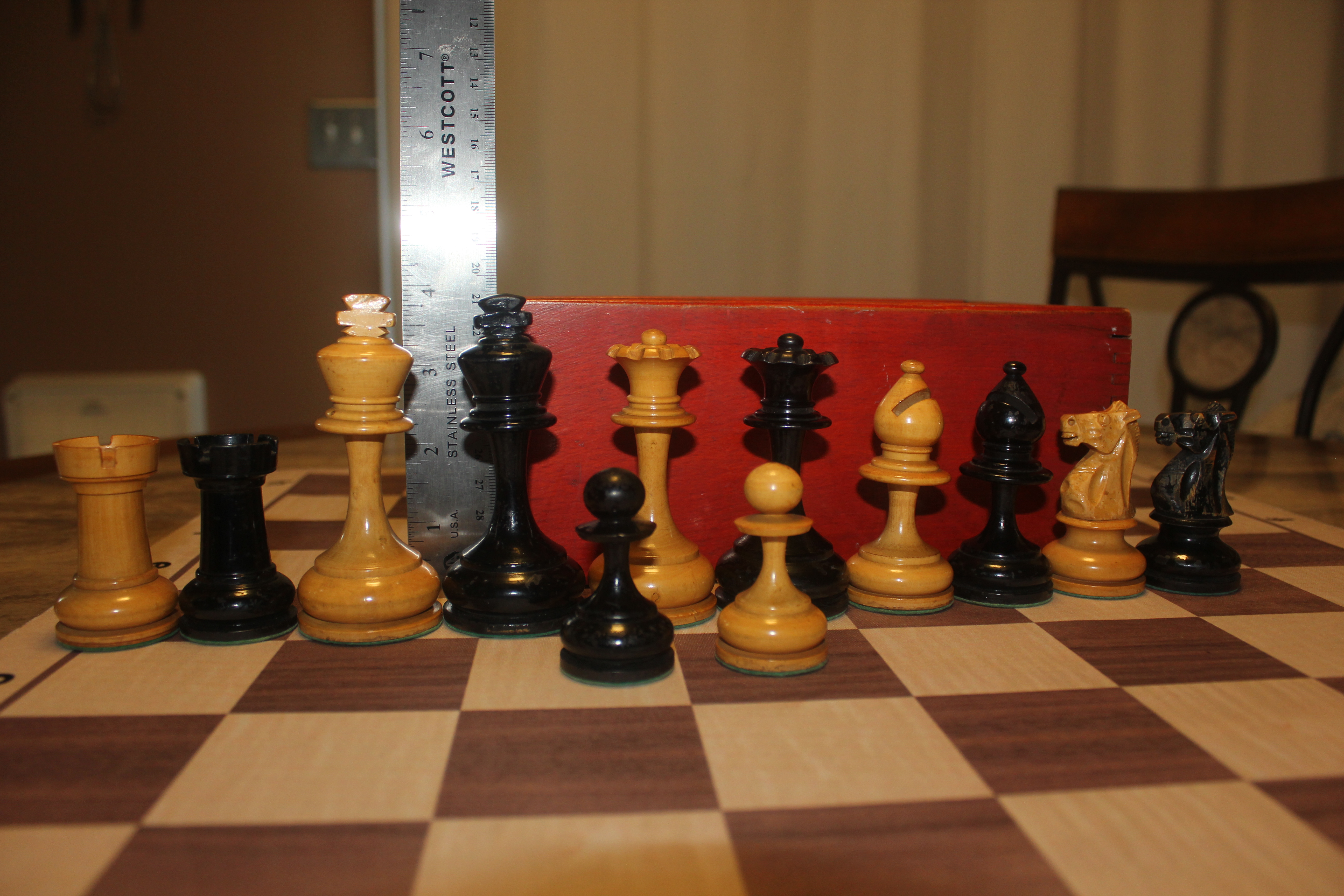
Two chess sets in my possession have raised questions. When were they made? By whom?

After several years of attending estate sales at Owen’s Auction and seeing many chess sets, I bid on one. It  differed somewhat from familiar sets, but remained within the general Staunton pattern required for tournament play. It became mine. That was 2018. I have told people it was made in the 1960s, although I had no evidence for the statement.

In mid-July this year, it was set-up on a library table as I waited for my opponent for the Spokane Contenders Tournament. I posted a photo to “Post Your Chess Sets” on chess.com. Another poster identified it as resembling sets made in the 1930s and 1940s, much older than I had imagined. He said he had a similar set and had been interested in mid-century French sets for several years. The wide bases and narrow stems of my set are uncommon, I learned.

That evening, my wife and I sat on the patio and put our phones to work as we conducted research. There were several lines of inquiry and my pursuit continued a couple of days. I conversed with the poster who had a similar set. He shared some useful links to research on chess sets. One link identified the set’s box as having been used by Lardy in the 1930s: “Chess Boxes” at The Chess Museum.

Under the tissue paper inside the box were four newspaper clippings with five chess games. These games were played September 1937 to August 1938. The games are Keres, P.—Reshevsky, S., Semmering/Baden 1937; Euwe,M—Alekhine,A., rd. 21, Amsterdam 1937; two games from the US Championship in April 1938: Fine,R.—Shainswit,G. and Simonson,A.—Suesman,W.; and MacMurray,D.—Platz,J., Cazenova, 1938, played at the NY State Chess Association Championship.

World Chess Championship 1937, Game 21

On the back side of game 21 between Max Euwe and Alexander Alekhine in the World Chess Championship was a notice of a wedding that took place. Pursuing wedding details provided a location for the newspaper itself—New York City. In the New York Times I found an announcement of the engagement that led to the wedding. That article identified the groom as a stockbroker. Also easily located in other  articles were some biographical details about the bride’s parents.

It seems reasonable to conclude that someone who owned this chess set clipped and saved these games, which all seem to me worthy of study. Likely, it was the set’s first owner. I believe the set may have been sold new in 1937 in New York City. The set had been imported from France. Of course, there is plenty of uncertainty.

There are no clues to the set’s subsequent journey after August 1938, but there should be no doubt that it has been well-used. All the pieces show signs of wear. It is most apparent on the Black knights.

Coming to terms with the age of the set, I wanted a newer old French set. My bidding on one advertised as a French Lardy set was successful and it arrived Saturday evening, 22 July.


I shared photos of the new set on “Post Your Chess Sets”, which provoked the expected discussion. One poster has a set that appears very similar and has been identified as a Chavet set, rather than Lardy.  Another agreed that it appeared to be a Chavet. Both directed me towards other threads with a great deal of detail concerning Chavet chess sets. I spent Sunday morning reading these threads.

The longest thread, “Chavet N° 8” made clear to me why others regard Walterbiensur as a trusted resource and authority concerning Chavet chess sets. He has posted images of many primary sources, is himself a collector of these sets, and his own quest to learn more is ongoing. Walter identified the set most like mine as Chavet. For now, that’s the best information that I have.

Most Chavet knights clearly differ from those in my new set, but one thread has a 1932 catalog from Chavet with a similar knight. There are a small number of others known to be Chavet sets with similar knights. The poster with a set close to mine drew attention to the relative heights of the base and the carved head. Lardy sets have a higher base, he wrote.

My inquiry has just begun.

In the meantime, the new set appears newer, sturdier, and less fragile than my 1937 set. It now resides in my tournament bag.


20 January 2023

Some Books

Some people read one book at a time, finishing it before starting another. Some people never read. Some people start things they never finish. Sometimes I read several related books in parallel. Sometimes I read a book clear through in a day or three. I always have as many as two dozen books that I call my active reading. This number includes chess books and books on other subjects.

The image on the right shows some of my current chess reading, but I tend to finish more when I have them as ebooks. Current active ebooks that I read in ChessBase include Nepomniachtchi: Move by Move (2021) by Cyrus Lakdawala, which I was reading more actively when it first came out than now. Another that I made substantial progress through before stalling (or taking a more active interest in other texts) is Alexander Raetsky, and Maxim Chetverik, Boris Spassky: Master of Initiative (2006). Vladimir Vukovic, The Art of Attack in Chess (1993) sat on my shelf many years and I read a couple of chapters, often referring back to these for review. When in early 2021 I acquired the new edition (2008) with corrections by John Nunn in ChessBase format, I read through the whole book in a little more than a month, using both ebook and print editions in tandem.

During a holiday sale last month, I added ebook versions of Garry Kasparov, My Great Predecessors (5 vols) and Kasparov on Kasparov (3 vols) to ChessBase. I have the print edition of My Great Predecessors and often read portions.

My shelf containing Chess Informants is nearly full. I have been a subscriber since 2015, getting each issue in print and CD format. I read the articles in the print edition and play through the games on screen. I also use the print edition for making notes (always in pencil). Informant first captured my interest in 1996 shortly after returning to active play at the Spokane Chess Club after more than 15 years away. I also took up postal chess again during that time. At the Washington Class Championships in Federal Way, my time between rounds put me in contact with David Weinstock, a bookseller. He had some Informants and showed me how the system of codes worked. Over the next several years I would sometimes buy an issue that was being sold at a discounted price because several newer editions were out. Then, early this century I bought a few electronic editions of multiple volumes that could be read in Informant’s propriety software. The company eventually stopped developing their own software and made their publication more compatible with ChessBase. Around this time, my ebook collection became complete (at least the games therein) and I maintain it as such through subscription (see “The New Informants”).

It is unlikely that I will ever finish László Polgár, Chess in 5333+1 Positions (1994), but recently have been going through portions of the 600 miniatures in the back of the book. These include some of the same games found in Irving Chernev, The 1000 Best Short Games of Chess (1955), which was instrumental in transforming me into a chess player (see “My First Chess Book”). Since September, my progress through this book has been steady and consistent. The recent article, "Bramley -- Burgess 1946", developed from this project. This week, many of my students saw the game, Steinitz -- Pilhal 1860, which is number 518 in Chernev.

After reading Edward Lasker, The Adventure of Chess (1959) in December, I bought Chess Secrets I Learned from the Masters (1951), which I intend to read soon. I acquired it the day after Willy Hendricks, The Ink War: Romanticism versus Modernity in Chess (2022) arrived, a book that I dove into instantly. Hendriks' writing never fails to entertain as well as instruct.

In July, I am scheduled to give a presentation on chess pieces and history. Naturally, my knowledge must expand prior to then. The Art of Chess (2002) by Colleen Schafroth is a good book with excellent images, mostly from the collections at the Maryhill Museum of Art. A.E.J. Mackett-Beeson, Chessmen (1973) is a smaller book and less accurate in some historical matters. Two claims early in the book set me into verification and refutation mode at the outset. First, the author makes the common error of contending that an ancient Egyptian image of two people playing a board game—almost certainly senet—to be an early depiction of chess. And then, illogically, begins the narrative on the history of chess with a more plausible, but seemingly inaccurate description of chaturanga. Seeking a more accurate rendering drove me back into H.J.R. Murray, A History of Chess (1913), a book I read in-part, and often revisit.

Adriaan D. De Groot, Thought and Choice in Chess, 2nd. ed. (1978) is a classic text on memory, pattern recognition, and the relationships between playing chess well and what people try to define as intelligence. Last month, I finished reading Scott Barry Kaufman, Ungifted: Intelligence Redefined (2013), which I had started in October. The book came to my attention while writing an article about chess talent in which I argued that capacity for hard work was more vital than any sort of so-called natural ability. A magazine article by Kaufman on the nature of talent brought his work to my attention.

02 October 2022

The Art of Analysis

How do you analyze a chess game?

I was thinking about this question this morning when I would have preferred to sleep another hour. Hence, I thought to open Irving Chernev, The 1000 Best Short Games of Chess (1955) to the next game and analyze it. Then, I would compare my annotations to those Chernev offers. I am working my way through this book.

While analyzing a game, I look at many possibilities that will vary depending on the game and why it has come to my attention. For miniatures, such as one finds in this classic Chernev text, I expect to find a game-losing blunder and sometimes a series of weak moves. I make an effort to identify these before seeking any assistance from the annotations of others or from engines.

Wills -- Sparks [C42]
USA, 1942
Stripes,James

1.e4 e5 2.Nf3 Nf6 3.Nxe5 Nxe4?

This move is the critical error and a common beginner's mistake. There are few chess coaches who have not shown this error and the subsequent refutation to their students. It also appears in some of the oldest chess books and manuscripts (see the section on history below).

4.Qe2 Qe7

4...Nf6?? worsens matters and should be shown to beginners 5.Nc6+ wins the queen.

5.Qxe4

Black to move

5...d6 6.d4 f6

6...dxe5 and Black is a pawn down. Surely, this should be preferred to a futile effort for equality that cannot succeed against attentive play.

7.f4 Nd7 8.Nc3 dxe5

White to move

9.Nd5!+-

The refutation of Black's idea is a good example of an intermezzo. Instead of continuing a sequence of exchanges, White attack's Black's queen.

9...Qd6 10.fxe5 fxe5 11.dxe5 Qc6

11...Nxe5 12.Bf4 Yes, Black ends up a piece down, but that piece is a knight. Alternatives leave Black down a rook or a knight.
11...Qxe5 12.Qxe5+ Nxe5 13.Nxc7+ Kd8 14.Nxa8 Black may be able to trap the knight, being down only an exchange.

12.Bb5 Qc5 13.Be3 1-0

Chernev does not highlight the critical error, but offers some analysis after the game is already lost. His headnote, however, offers a clue to Black's fatal decision: "Mimicry can be very amusing, but in chess it usually turns out to be expensive fun" (91).

Wills -- Sparks [C42]
USA, 1942
Chernev,Irving

1.e4 e5 2.Nf3 Nf6 3.Nxe5 Nxe4 4.Qe2 Qe7

The knight must not move, as the discovered check will cost Black his queen.

5.Qxe4 d6 6.d4 f6 7.f4 Nd7 8.Nc3 dxe5 9.Nd5 Qd6 10.fxe5 fxe5 11.dxe5 Qc6

11...Qxe5 12.Qxe5+ Nxe5 13.Nxc7+; or 11...Nxe5 12.Bf4 wins a piece

12.Bb5 Qc5 13.Be3 1-0

I must credit Chernev's sometimes cryptic annotations for driving me to think and analyze for myself when I first encountered this book 47 years ago.

History

Neither the players Wills and Sparks, nor this particular execution of these moves are well-known apart from Chernev's book, but the moves and ideas can be found in the texts of Pedro Damiano, Ruy Lopez. Giulio Cesare Polerio, Gioachino Greco, and others. In ChessBase Mega 2020, Greco's game is the oldest, but Chessgames.com has one attributed to Damiano.

The following game appeared in ChessBase News in Spanish and German versions on 21 May 2009. The only English versions I have found are Google Translate versions of these. The article is an interview with Mário Silva Araújo, an amateur historian who produced a biographical study of Damiano. Araújo suggests that Damiano fled Portugal to Rome because he was Jewish. In December 1496, King Manuel I of Portugal ordered the expulsion of Jews from the nation. According to Araújo, "It is the oldest known game played--and won--by a Portuguese."

Damiano [C42]
Rome 1497

1.e4 e5 2.Nf3 Nf6 3.Nxe5 Nxe4 4.Qe2 Qe7 5.Qxe4 d6 6.d4 f6 7.f4 Nd7 8.Nc3 dxe5 9.Nd5 Qd6 10.dxe5 fxe5 11.fxe5 Qc6 12.Bb5 Qc5 13.Be3 Qxe3+

The game presented on chessgames.com lists Araújo's study as its source and concludes 13...Qxb5 14.Nxc7

14.Nxe3 1-0

Early Petrov lines similar to those in these games span pages 449-452 in Peter J. Monté, The Classical Era of Modern Chess (2014), "Part II. Openings and Games of the Classical Era of Modern Chess". There the move order presented from Damiano's published text and its many reprints have 7...dxe5, but still reach a position after White's move 11 that is shared by all the games presented in this post.

Black to move
There are several continuations from this point in manuscripts from the late fifteenth century to Greco's seventeenth century work: 11...Qc6, 11...Qc5, and 11...Qg6. Monté also presents a fair number of alternatives to the main line that were explored in these manuscripts. Whoever Sparks may have been, he fell prey to one of the oldest known opening fiascos.

17 September 2022

Following Greco

In the headnote to the game, Irving Chernev mentions four later publications, each with different players, that follow an eight-move miniature that he presents in The 1000 Best Short Games of Chess (1955).* It would seem that this particular Gioachino Greco composition frequently occurs in actual play.

The earliest extant record of this game appears in Greco's MountStephen manuscript (1623). Chernev claims that it appeared in a book published by Greco in 1619. Greco never published a book. Nonetheless, the 1619 date appears with this game in many places. Greco's work is known through slightly more than two dozen extant manuscripts, as well as a few that were once known and were copied before they disappeared. Greco's sojourn in Rome is known through four manuscripts that were produced in 1619 or very early in 1620. But, this game appears only in later MSS: MountStephen, mentioned above, and Paris (1625), as well as a few documents derived from Greco's MSS.**

The rest of Chernev's note withstands scrutiny. The note, preceding game 23, reads:
    In 1891 the Deutsches Wochenschach published a pretty game won by Deichmann. The same game appeared in the Deutsche Schachzeitung of 1917 with K.J. as the winner. Chess Review printed the score in 1935 with Pearsall the victor over X. In his book Lehrreiche Kurzpartien, Herr Benzinger gives himself credit for the win.
    These claimants and a few others will have to step aside though and make room for a fellow known as the Calabrese, Gioachino Greco.
    Away back in 1619 he published a book of his games. This is one of the brilliants which graced this early collection. (9-10)
The game score appears in descriptive notation in Chernev's text. Here I present it in algebraic.

1.e4 b6 2.d4 Bb7 3.Bd3 f5 4.exf5 Bxg2 5.Qh5+ g6 6.fxg6 Nf6 7.gxh7 Nxh5 8.Bg6#

I often present the checkmate in two to beginning students.

Three of Chernev's four references have been digitized and are readily accessible. The game appears in Deutsches Wochenschach (December 1891), 412. An extra set of moves is included that are absent from Greco's version.

The Deutsche Schachzeitung was also easily located (158-159). It shows the initials of the player of White as K.Sz.J. A note explains that the game had been played in Budapest and was copied from a Hungarian publication. In Chess Review (July 1935), Arnold Denker comments, "Very, very old, but always amusing; the Black player had ideas" (155). The player with White, Allen G. Pearsall, is sufficiently well-known that chessgames.com has six of his correspondence games and a win against Frank Marshall from a 20-game simul in San Diego. Game 31 in Chernev is another Pearsall miniature.

Josef Benzinger, Lehrreiche Kurzpartien (1938) has not been digitized and presented on the Web, so far as I have found, but a copy exists in the Cleveland Public Library.

The "few others" referenced by Chernev must number in the thousands. Several commentators on the game at chessgames.com claim they have played this miniature. 3...f5 appears 1393 times in the FICS Database. In the overwhelming majority, however, 6...Bg7 was played instead of moving into mate in two with 6...Nf6. After 6...Nf6, ten games have 7.g7+ (an error) and 19 have 7.gxh7+. That is still 19 instances of the miniature on the Free Internet Chess Server.

An astounding 22,410 games on Lichess have the nearly fatal 3...f5 and a much higher percent (~20%) of those that continue to follow Greco's line play 6...Nf6. Alas, 7.g7+ is played nearly as often as 7.gxh7+. A total of 818 games on that site conclude with Greco's 8.Bg6#.

If the Chess.com explorer allowed full archive access in that manner afforded by Lichess, surely there would be at least another thousand or so instances of this game. One of my youngest students memorized Greco's game earlier this summer, so the repetitions should continue.


*Please see "My First Chess Book" (2012) for a description of the importance of this book to my early development as a chess player.
**My source for the early records of this and other games is Peter J. Monté, The Classical Era of Modern Chess (2014), "Part II. Openings and Games of the Classical Era of Modern Chess".

11 August 2022

Two Pigs

Edward Winter has published several entries in Chess Notes over the years inquiring into the origins of the checkmate pattern often called blind swine. The term "blind swine" for two rooks on the seventh that cannot find checkmate was credited to Dawid Janowsky by Vladimir Vukovic (see CN 5160). Winter seeks a primary source that confirms Janowsky used the term. None have been found. The phrase has been credited to Aron Nimzowitsch as well (CN 3525).

This morning I had two rooks on the seventh and was playing for a draw because I failed to see a resource: my f-pawn could advance to support one of the rooks and produce a different two rook checkmate. In my defense, it was early morning, my first game of the day, and the game was one minute plus one second increment. Such a time control does not produce accurate play.

Stripes,J. -- Internet Opponent [D06]
Live Chess Chess.com, 11.08.2022

White to move

27.b4?! d4 28.exd4 cxd4 29.Rc7+ Kg8??

29...R8e7=

30.Rxa7 Re2+ 31.Kg3 Rd8

31...R2e7 32.Rxe7 Rxe7 33.Rc8+ Kf7 34.Rd8+-

32.Rcc7

White has two rooks on the seventh, but how is this enough to win?

32...d3

White to move

33.Rxg7+ Kf8 34.Raf7+

34.Rxh7 threatens mate.

34...Ke8 35.Rc7 Kf8

White to move

36.Rcf7+

I could have played: 36.Rxh7 Kg8 37.f5! The key move that escaped my notice.37...d2 38.Rcg7+ Kf8 39.f6 and mate comes soon.

36...Ke8 37.Rc7 Kf8 38.Rxh7 Kg8 39.Rcg7+ Kf8 40.Rf7+ Kg8 41.Rfg7+ Kf8 42.Rf7+


White seems to be playing for a draw. I was because my fear of Black's d-pawn rendered the power of my f-pawn invisible.

Black to move

42...Ke8?

42...Kg8 White must find 43.f5, which White has already shown is beyond his capacity.

43.Rc7 Re7

White to move

44.Rh8+

White finds a tactic to create the opportunity that was already on the board. It is not the rooks that are blind.

44.Rcxe7+ Kf8 45.Rb7 Kg8 46.f5

44...Kf7 45.Rh7+ Kf6 46.Rcxe7 d2 47.Rd7 White won on time 1-0

29 May 2022

Schlage -- Ahues 1921: Historical Inquiry

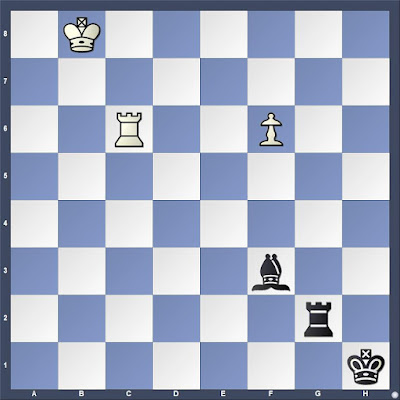
A substantial number of chess endgame books present a position said to have been from a drawn game between Willi Schlage (1888-1940) with White and Carl Oscar Ahues (1883-1968). The game was played in Berlin in 1921, but no event is listed. Nor has a complete game score appeared. Schlage missed a win, as later pointed out by Ilya Maizelis.

White to move
From this position, Schlage started well, but his second move demonstrated that he did not discover the critical idea.

1.Ke6 Kc3 2.Kd6 

Maizelis pointed out that 2.Kd5! would have won.

2...Kd4 3.Kc6 Ke5 4.Kb7 Kd6 5.Kxa7 Kc7 1/2-1/2

As this ending appears in Mark Dvoretsky, Dvoretsky's Endgame Manual (2003), the position is on one of my pawn ending flash cards. Many of my students have tried to find the solution and then had it shown to them. When I encountered it this morning in Paul Keres, Practical Chess Endings (1974), I wanted to know more about the game. Searching for a game score took me down a rabbit hole of book after book. If no game can be found, then perhaps I can trace the analysis back to first publication.

It certainly did not originate with Jesus de la Villa, 100 Endgames You Must Know Workbook (2019) that a Wikipedia editor referenced. To the credit of the Wikipedia editors, Keres is also credited with presenting this ending.

Keres does not credit Maizelis, but Dvoretsky does. Chess Informant's Encyclopedia of Chess Endings: Pawn Endings (1982) has the position as number 65 and credits Maizelis with the solution.

My next step is the inquiry was Pawn Endings (1974) by Yuri Averbakh and Ilya Maizelis. An editor added to the text: "Maizelis was the first to point out the correct solution. so position No. 78 must be credited to him. Rabinovich indicated this in the first edition of his book, Chess Endgames, 1927" (26).

Happily, Mongoose Press brought out an English edition of the second edition (1938) of Rabinovich's text: Ilya Rabinovich, The Russian Endgame Handbook, trans James Marfia (2012). Rabinovich credits "I.M.", which he calls a pseudonym, with mentioning in the Soviet magazine 64 (1925, No. 6) that White's king "should move according to the most twisted, broken route" (as quoted by Rabinovich). Perhaps someone has access to old copies of 64 and can read Russian. I still have questions.

19 December 2021

Notes on Berger

David Hooper states that Johann Berger, Theorie und Praxis der Endspiele (1890) is "the first comprehensive book in modern times devoted wholly to the practical endgame" (Golombek's Encyclopedia of Chess [1977], 101). In 2009, Google digitized a copy from Harvard Library, making it readily accessible to those interested in the history of the theory of the endgame. Although Hooper states Berger's text, "would not today be regarded as adequate for practical use", I am finding much that is instructive and interesting as I have been reading through it this morning.

Berger makes a point in the first pages to distinguish endgame theory from studies. The endgame, he asserts, "comprises only the battle of a few chess pieces against correspondingly low defensive forces" (2). Compositions leading to checkmate, stalemate, or a draw must be distinguished from endgame theory because, "the chess pieces have a completely different meaning and are used differently than in actual endgames" (2). He presents some illustrations of studies that are not endgames, beginning with a composition by Bernhard Horwitz.

White to move
Horwitz 1884 
White checkmates in six moves. Berger points out that the play of the pieces resembles the middlegame, and also that White's rook is superfluous. In the endgame, "the best possible use of the power of each individual piece should be expressed" (3), Berger opines. He offers:

White to move
1.Kc4 c1Q

Or 1...Ka1 2.Qd2 (to avoid an underpromotion threat)

2.Kb3 and checkmate in a few moves.

Berger's eighth example highlights two ways that a theoretical draw of rook vs. bishop is reached from the following position.

White to move
1.f7 Bd5 2.f8Q Rg8

Or 

1.Rc1+ Kh2 2.f7 Bd5 3.f8Q Rg8

Following this clarification of endgame theory as distinct from studies, Berger shows elementary checkmates--queen, rook, two rooks, two bishops, and then no less than five positions from which checkmate by bishop and knight can be executed.

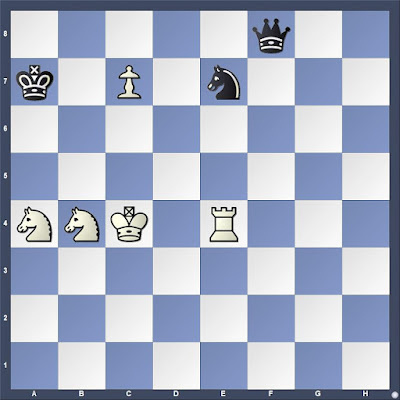
Then he turns to the knight. Two knights, as we know, can only stalemate. What about three knights? Berger presents a composition of his that was published in Osterreichische Lesehalle (1889).

White to move
When I played this position against the computer, it opted for a line given by Berger as a variation. I was able to coordinate my pieces and win easily.

1.Rxe7 Qd4+

1...Qxe7 leads to 2.c8N+ winning the queen and leading to checkmate. Berger finds a mate 15 moves from the diagram.


01 November 2021

Cultivating Error

Fast chess rewards weakness. Playing for cheap traps and succeeding stifles progress. Having spent many hours studying the games of Gioachino Greco, I have succeeded numerous times in replicating his best known miniature. This morning against a player with a Lichess rating near 2200, I found my opponent unprepared to meet the transparent threats offered in the not quite sound Greco Attack.

After this victory, and my postgame analysis, I decided that I have had enough. If I am to continue playing the Greco Attack, I must shift to the Aitken variation. Below is the game.

Stripes,J (2096) -- Internet Opponent (2153) [C54]
Rated Rapid game lichess.org, 01.11.2021
[Stripes,James]

1.e4 e5 2.Nf3 Nc6 3.Bc4 Bc5 4.c3 Nf6 5.d4 exd4 6.cxd4

6.e5 is better, according to William Lewis, Gioachino Greco on the Game of Chess (1819), which Lewis presents as a translation of a French collection of Greco's games.

6...Bb4+ 7.Nc3?!

7.Bd2 Nxe4 8.Bxb4 Nxb4 9.Bxf7+ Kxf7 10.Qb3+ is in the Ordini manuscript (1594) from the Polerio-complex. See "Greco Attack Before Greco".

7...Nxe4=/+ 8.0-0

Black to move
8...Nxc3

8...Bxc3 9.d5 is in Greco's Mountstephen manuscript (1623). It is the better move.

9.bxc3 Bxc3

The equalizing 9...d5 does not seem to appear among late-sixteenth century or seventeenth century manuscripts. It was played by Moller in 1902, according to ChessBase Mega 2020.

10.cxb4 dxc4 11.Re1+ Ne7 with equal chances: 0-1 (48) Piotrowski,O-Moller,J Hannover 1902.

White to move
10.Qb3?

I play this move because I get away with it. I have even told students, erroneously, that White is now winning.

10.Ba3 is Aitken's suggestion 10...d5 11.Bb5 Bxa1 12.Re1+ Be6 13.Qc2 Qd7 14.Ne5+-. See also Corte -- Bolbochán 1946 (2016).

10...Bxa1??

Now Black is lost. Black is also lost after 10...Bxd4, which also appears in Greco.

10...d5 11.Bxd5 0-0+/= (11...Bxa1?? 12.Bxf7+ Kf8 13.Ba3+ Ne7 14.Re1+- is credited to Don Antonio in the Doazan manuscript, which precedes Greco. Greco may have seen this manuscript.)

11.Bxf7+ Kf8 12.Bg5 Ne7 13.Ne5!

Greco's innovation, building on the work of Polerio and his associates.

Black to move

Greco analyzes several variations from this point. This game follows one of them.

13...Bxd4 14.Bg6 d5 15.Qf3+ Bf5 16.Bxf5 Bxe5 17.Be6+ Bf6 18.Bxf6 Qe8N

Black's move is the first new one.

White to move
19.Be5+ 

My last move misses checkmate in three. Nonetheless, Black resigned.

19.Bg5+ (or Bh4+) 19... Nf5 20.Qxf5+ Qf7 21.Qxf7#

I won because my opponent missed several well-known opportunities. 10.Ba3 avoids some of these.

22 October 2021

The Unknown Greco

ChessBase Mega 2020 contains 82 games credited to Gioacchino Greco, most dated 1620 (which seems an arbitrary date). At the time of this writing, Chessgames.com has 90 games credited to the famous Calabrese. In "Gioachino Greco on the Game of Chess" (2013), I wrote about the abundance of Greco's variations that can be found in William Lewis's 1819 text of that name. The better known and more accessible (the notation is standard English descriptive) 1900 text by Angelo Lewis, writing under the penname Professor Hoffmann, also has variations that are absent from databases.

Peter J. Monté, The Classical Era of Modern Chess (McFarland 2014), which I described in "Monumental Scholarship" (2020), offers far more detail from Greco's manuscripts, and also permits the diligent reader to separate Greco's contributions from lines he learned from others. In Part I of the book, Monté describes manuscripts and history from Lucena to Greco, concluding with a discussion of the development of castling and the pawn's leap. Part II. Openings and Games of the Classical Era of Modern Chess is a thoroughly documented move tree (439-530). The so-called Greco Attack is documented across four pages (462-465).

The Greco Attack begins with the moves 1.e4 e5 2.Nf3 Nc6 (In some of Greco's manuscripts 2.Bc4 Bc5 is played, and the knights deployed on the following move) 3.Bc4 Bc5 4.c3 Nf6 5.d4 exd4 6.cxd4 Bb4+ 7.Nc3.

Black to move

Play continues:

7...Nxe4 8.O-O Nxc3

8...Bxc3 is the mainline today, and offers a very good reason not to play the Greco Attack.

9.bxc3 Bxb3

9...d5 or 9...Be7 have been recommended.

10.Qb3

A fine miniature that I learned from Leonard Barden and Wolfgang Heidenfeld, Modern Chess Miniatures (1960) continued with 10.Ba3. See Corte -- Bolbochán 1946 (2016).

10...Bxa1

Greco also has games that continue with 10...Bxd4.

11.Bxf7+ Kf8  12.Bg5

Black to move

In the ChessBase database, Greco's games all continue with 12...Ne7. Chessgames.com, however, has one game that continues with the line I present below.

12...Nxd4

This move was played against me in a rapid game on Chess.com on Sunday, and I had faced it at least four times prior.

13.Qa3

13.Qb4+? is a blunder that appears in the ChessBase database in ten games played 1996-2016.

13...Kxf7 14.Bxd8

Black to move

In 1619, Greco had access to a manuscript known today as Boncampagno -3, which contains the following variations (Monté, 277, 463). This manuscript is among those classified as the Polerio Complex. Monté dates it between 1594 and 1619. Authorship is uncertain.

A.
14...Rxd8 15.Ng5+ Kf6 (or Kg6) 16.Rxa1 Kxg5 17.Qe7+

B.
14...Nxf3 15.Qxf3+ Bf6 16.Bxc7

Black to move

Greco's original contribution to this line begins from this position and appears in two manuscripts from his sojourn in England, the Mountstephen manuscript (1623) and the Grenoble manuscript, which is undated, but believed to precede Mountstephen.

16...Re8 Qh5+ Kf8 18.Bd6+

Mountstephen ends here.

Black to move

18...Be7 19.Re1 h6 20.Rxe7 Rxe7 21.Qe5 and Qxe7 follows.

Not everything credited to Greco was his own work, and yet much of his work remains unknown to most chess enthusiasts.