Showing posts with label forcing moves. Show all posts

01 February 2024

Maczuski -- Kolisch 1863

On Tuesday, I showed a short game to my young students that is the source for exercise 19 in Checkmates and Tactics (2019), a book that presents 150 exercises that I developed in 2006 for scholastic chess players. While doing so, my ignorance grated. I knew nothing about the players, although the name of the losing player was familiar enough that I thought I should know more.

While printing the game score before club, it surprised me that only two games played by Ladislav Maczuski appeared in ChessBase Mega (online was no different). This paltry selection was surprising particularly because the game data indicated it was part of a four game match between the players. ChessBase has 151 games played by Ignatz Kolisch, plus two consultation games. Maczuski's performance in the game against a strong master suggests that he should be better known. Kolisch was "one of the world's leading players from 1859 to 1867", according to David Hooper and Kenneth Whyld, The Oxford Companion to Chess (205).

It is not surprising that chessgames.com has more information than almost any where else that I searched. Edward Winter's Chess Notes is also useful. Note 2335 has an 1876 game played by Maczuski as part of a blindfold simul that does not appear in databases. Note 11728 recommends Fabrizio Zavatarelli, Ignaz Kolisch The Life and Chess Career (2015) for "a detailed discussion". Chessgames.com led me to the first publication of the game and a second the next month. ChessBase referenced David Levy and Kevin O'Connell, The Oxford Encyclopedia of Chess Games, Vol. 1 1485-1866 (1981), which also references Schachzeitung (1864). Levy and O'Connell get the date wrong, an error carried forward in ChessBase.

I know more than I did on Tuesday and know how to learn a bit more should I manage to acquire a copy of Zavatarelli's book.

Here is the game.

Maczuski,Ladislav -- Kolisch,Ignaz [C45]
Match Kolisch--Maczuski +2-2=0 Paris (1), 03.1863

1.e4 e5 2.Nf3 Nc6 3.d4 exd4 4.Nxd4 Qh4

The fifth most popular reply wins a pawn, but often a great cost

5.Nc3

5.Nb5 is an alternative 5...Bb4+ 6.N1c3 Ba5 7.Be2 a6 (7...Qxe4? 8.Nxc7+ Kd8 9.Nxa8 Qxg2 10.Bf3+-) 

5...Bb4 6.Qd3!?

6.Be2 and 6.Ndb5 are more frequently played

Black to move

6...Nf6 7.Nxc6

Also possible: 7.Nf5 Qxe4+ 8.Qxe4+ Nxe4 9.Nxg7+ Kf8 (9...Kd8) 10.Nh5 (10.Bh6 Nxc3 11.Nf5+ Ke8 12.a3 Ba5 13.b4 Bb6) 10...Nxc3 11.Bh6+ Ke7 12.Bg7 Ne4+ 13.c3 with equal chances.

7...dxc6 8.Bd2 Bxc3 9.Bxc3 Nxe4

9...0-0 seems prudent, but White does not yet have full compensation for the pawn with the line played.

10.Qd4

Black to move
10...Qe7

10...Bf5 has also been played here 11.Qe5+ Qe7 12.Qxe7+ Kxe7 13.Bxg7 Rhg8 14.Bd4 (14.Bh6 may be better) 14...Rad8 15.c3 c5 16.Be3 b6  and Black won in 60 moves Trabert,B (2285)--Tomescu,V (2436) Montecatini Terme 1999.

11.0-0-0 Qg5+??

A terrible blunder.

11...Nxc3 12.Qxg7 Nxa2+ 13.Kb1 Rf8 with a slight edge for Black, who went on to win in 65 moves Rizovic,S--Minic,M Vrnjacka Banja 2006.

White to move
This position could make a good exercise.

12.f4! Qxf4+

Black could also play 12...Qe7, but the game is lost in any case.

13.Bd2 Qg4

13...Qh4 14.Re1 0-0 15.Rxe4+-
13...Qf6 also prevents checkmate.

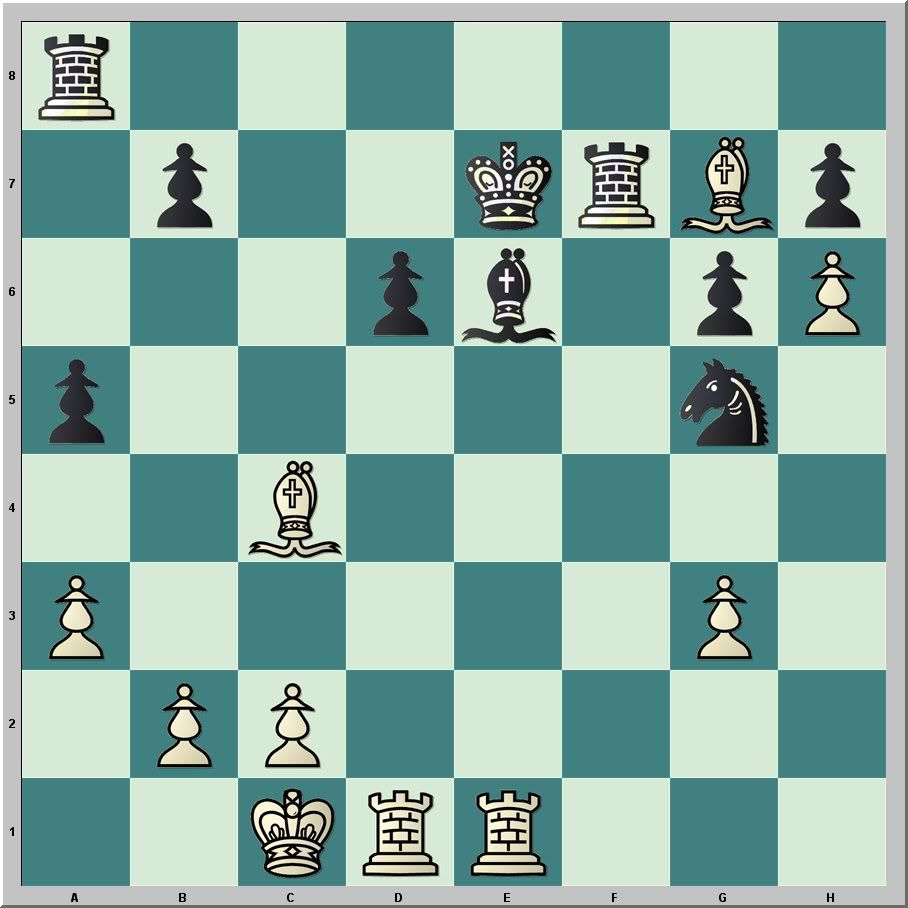
White to move
This position appears in my Checkmates and Tactics book. My students have been solving it, or failing to solve it nearly twenty years.

14.Qd8+ Kxd8 15.Bg5+

The game as it appears in La Nouvelle Régence (image above) would seem to indicate that the last move was not played.

15...Ke8 16.Rd8# 1-0


12 April 2015

Drawing a National Master

A day or two after I posted "Building Upon Morphy," I sacrificed a bishop on h6. As a consequence, I was able to force a draw against a young National Master (It is possible to play through the game at the link). NM Praveen Balakrishnan may become very strong in the next few years. His current world ranking for players under 14 is 129. Although my Chess.com correspondence rating is high, I have played very few games against titled players.

Stripes,J (2193) -- Balakrishnan,P (2238) [B11]
TMCL 2014 Playoffs Division C - Board 3 Chess.com, 06.03.2015

1.e4 c6 2.Nc3 d5 3.Nf3

This was my first correspondence game with the Two Knights variation against the Caro-Kann. I've been playing with it a bit after looking at a few games in Chess Informant 113.

3...Bg4 4.h3 Bxf3 5.Qxf3 e6 6.d4 dxe4

White to move

Decision time.

7.Qxe4

My move scores better than the alternative 7.Nxe4, although both have been played by Grandmasters.

7...Nf6 8.Qh4

8.Qd3 does not score as well.

8...Be7 9.Bd3 0–0N

9...Nbd7 has been played several times, although White has won most of these games.

I had been utilizing my database for the past five moves with hopes of getting a playable position for the middle game. One may copy others only so long in a correspondence game. Eventually, it is necessary to think.

10.Bg5 h6

White to move

This position was reached the week that I posted "Building Upon Morphy."

11.Bxh6!

Naturally! Blame Morphy if my move is unsound.

11...gxh6 12.Qxh6=

According to Stockfish 6, I might have tried for an advantage with  12.g4! However, I did not look at this move, or at least not with any serious intent. Rather, I saw that I could force a draw and reduce my game load.

12...Re8 13.Qg5+ Kh8 14.Qh6+ Kg8 15.Qg5+ Kf8 16.Qh6+ Kg8 17.Qg5+ ½–½

29 January 2014

Creating Knight Forks

Lesson of the Week

Young chess players this week have a challenging worksheet. The plan is for them to work through these eleven problems with a partner for no more than fifteen minutes. If need be, I give them the answer to the first problem. Number four is on the demonstration board for the purpose of going through it briefly at the end of the fifteen minutes.

A combination is a series of forcing moves that often begins with a sacrifice and that culminates in a gain of material or checkmate. These eleven problems all feature a knight fork that results in a decisive gain of material. In a few problems, the combination leads to simplification of a position where a material advantage is already present.

In most of these eleven, the player to move sacrifices a queen to fork the enemy's queen and king, while other pieces are gained in the process.

White to move (1-8)

1.


2.

3.

4.

5.

6.

7.

8.


Black to move (9-11)

9.

10.

11.

17 August 2009

Reinforcing Error

Unlike Michael de la Maza (Rapid Chess Improvement [2002]), who quit chess, and his minions, my chess improvement stems from a varied approach. My tactics training encompasses periodic commitment to playing from the key position to the computer's resignation (see "Where the Rubber Meets the Road") interspersed with working a website's system, such as Chess Tactics Server or the Tactics Trainer at Chess.com (see "Milestones"). I also use training exercises that Fritz or Hiarcs creates during its automatic analysis of games, or that users can create with the assistance of this software. Claude Kaber's training exercises are exemplary for illustrating the potential of this feature (see "Good Luck").

The exercises created automatically by Fritz, however, should be greeted with skepticism. The engines like drama.


Fritz Training Flaws

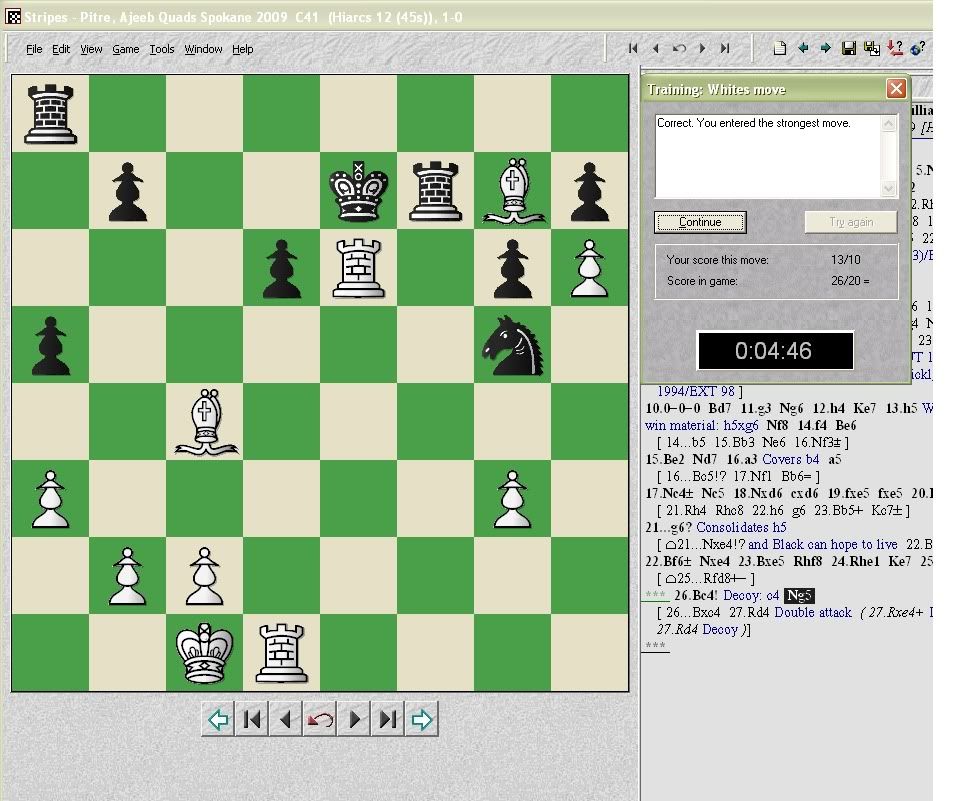
When I ran my game from last Thursday through full analysis by Hiarcs 12 (this engine uses the Fritz 11 interface), it created two training problems. The second is from this position awaiting my move 27.

White to move


During the game I looked at this position, found the dramatic 27.Rxe6+, and executed it. In my interior monologue I was telling myself that I was winning a piece through brilliant forcing play. Indeed, I was implementing that sage advice uttered by chess teachers everywhere, such as Peter Kurzdorfer, The Tao of Chess (2004).
The key to checking multimove combinations is to concentrate on the forcing moves: checks, captures, promotions, and the immediate threats to check, capture, and promote. By cutting it down to these forcing moves, you now have some manageable numbers to work with. The moves you look at are the ones that will likely affect the outcome of the game.
Kurtzdorfer, 108
Immediately after executing my "brilliant move," I found the antidote. My opponent had a defense that refutes my idea. Instead of winning a piece as I had thought, I would have a bishop and two pawns for a rook. My internal monologue became hypercritical, telling myself how I will never advance in chess if I keep making hasty moves that I have not fully calculated.

The rook check fails, and had I examined why it failed, I could have quickly found the much superior 27.Bd5. A fundamental element in tactical training and calculation is the process that Paata Gaprindashvili calls "reciprocal thinking" in his challenging Imagination in Chess: How to Think Creatively and Avoid Foolish Mistakes (2004).
After noticing an idea and briefly familiarizing ourselves with it, we proceed to its detailed examination. What do we do if we find that it doesn't work? ... If we fail to make an idea work, we need to stop and ascertain the cause of failure (i.e. answer the question "why?"), and then attempt to correct our design.
Gaprindashvili, 40
Without detailed examination, the failure goes unnoticed.

I was lucky. Under the pressure of my forcing move, my opponent cracked and offered the game losing blunder on move 28. It's no wonder that Hiarcs likes forcing moves. Carbon-based lifeforms capitulate to such deceptions with regularity. But the engine knows better, so why did it create this training exercise?


After executing the same move that I played in the game, I read, "Correct! You entered the strongest move." But this feedback is wrong. My move is not among the half-dozen best choices. Although forcing, and although successful in this case, it might have cost me the game.

According to the quantitative assessment of Hiarcs 12 from the problem position, White's advantage is greater than two pawns. 27.Bd5 is assessed at +2.29 with a depth of 16, and is slightly inferior to +2.39 for Re3. After executing the move from the game, the assessment drops to +0.85. When I annotated this game in the wee hours of Friday morning (see "Last Night"), I gave my move a single ?; I might have given it two, calling it an egregious blunder.

Tactics training with these automatically generated exercises, if they have not been checked for accuracy, will cultivate one's vision for forcing moves. Rather than improving the necessary abilities for calculation, however, such problems may reinforce error.