01 June 2018

Alekhine-Chatard Attack

In the past, I have struggled against the Alekhine-Chatard Attack, which only seems to get deployed against me in blitz. I have neither faced it over the board, nor in correspondence play. Nor have I spent as much time studying the books than on other variations for White against the French Defense. Consequently, I rely on my instincts and often falter.

Last night, I faced it in a blitz game against a National Master. I won!

Anonymous NM (2075) -- Stripes,J (1922) [C14]
Live Chess Chess.com, 31.05.2018

1.e4 e6 2.d4 d5 3.Nc3 Nf6 4.Bg5 Be7 5.e5 Nfd7 6.h4

Black to move

Black has many choices here.

Accepting the gambit has been my usual response, but I have tried all or most of the main options. I have lost more than I have won. A year or so ago, while discussing this opening with a friend who has played the French longer than I have and is higher rated, he mentioned that Black can simply castle.

Viktor Moskalenko recommends castling in The Even More Flexible French (2015).

6...0–0 7.Bd3

According to Moskalenko, 7.Qg4 is the "most aggressive option" (339). According to PowerBook 2016, however, 7.Bd3 has a better scoring percentage for White.

7...f5?!

7...c5 is the recommended move.

8.exf6

8.Nh3!

8...Nxf6 9.Nf3

Black to move

9...Nc6!?

I have two prior games from this position. Both are losses.

9...c5 is the only move in PowerBook 2016.

10.0–0

10.Qe2 was played in those two prior games. One ended quickly: 10...Ng4 11.O-O-O Nb4 12.Bxh7+ Kxh7 13.Bxe7 Qxe7 14.Ng5+ Kg8 15.Qh5 and missing 16...Bf5, I was mated two moves later.

10...Bd7 11.Qe2 Nb4

White to move

Perhaps Black has equalized. Both players have several options for the struggle. Having castled kingside, White's thematic pawn storm is less of a threat. My opponent quickly lost his way.

12.Bxf6?! Bxf6 13.Ne5? Nxd3 14.Qxd3 Bxe5 15.dxe5 Qxh4

White to move

With a one pawn advantage and no problems, I went on to win.

31 May 2018

12 April 2018

Quest for Advantage

This morning's blitz session ended after two games, a win and a loss. In the second game, the win, I found the only move that maintains a slight edge from this position. My opponent then failed to find a move that kept it close and his position deteriorated rapidly. He resigned three moves later.

Black to move

24...e5

What should White do?

11 April 2018

Winning Advantage?

Stockfish and other engines give White an advantage of 1.7 to 2.3 pawns, but cannot suggest an approach superior to that played in the game.

White to move

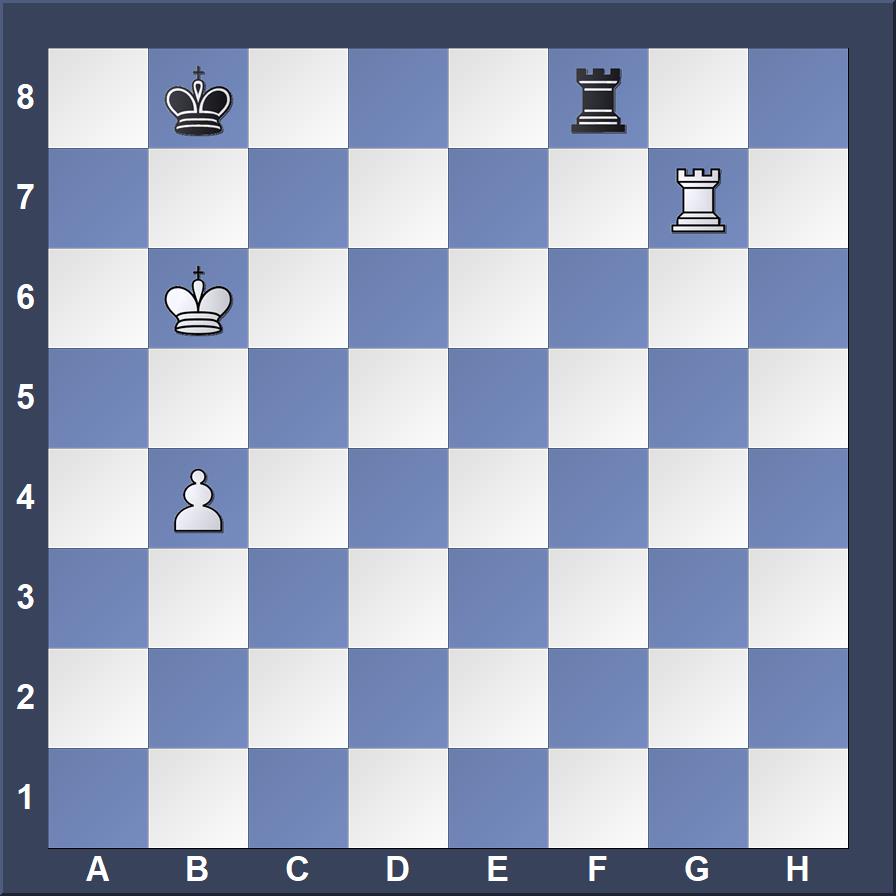
52.Rh7 Kb6 53.Kb3 Ka6 54.Rc7 Rg8 55.Ka4 Kb6 56.Rg7 Rf8 57.Rg6+

Black to move

57...Kxa7 58.Ka5 Kb7 59.Rg7+ Kb8 60.Kb6

Black to move

Black saw that he had reached a Philidor Position and easily held the draw with mere seconds remaining on the clock.

Did White have another means for securing a win that the engines might suggest if allowed to "think" longer?

09 April 2018

Finishing

During Inland Chess Academy's Spring Break Chess Camp last week, I presented four sessions. My topics were weakness, patterns, coordination, and finishing. The following is an outline of the fourth, finishing. Click on the links for some of my previous posts that expound upon some of these techniques.

Finishing


To score well consistently in chess competition, you need to have the skill to convert an advantage into a win. Often, also, you need to hold a draw when you have a slight disadvantage.

To develop this skill, learn (in approximately this sequence):

Checkmate with heavy pieces—two rooks or rook and queen
Checkmate with one heavy piece
Winning and drawing positions and techniques when one side has a single pawn (opposition and outflanking)

Black to move
Black draws with best play
Winning techniques when one player has a pawn majority on one flank and an equal number of pawns on the other flank
Use of opposition and outflanking to secure the win or hold the draw when both sides have the same number of pawns
Some stalemate ideas when kings and pawns are all that remain
Checkmate with two bishops
Holding the draw with Philidor’s idea in rook and pawn against rook
Winning from the so-called Lucena position (building a bridge)
Queen versus advanced pawn—winning techniques and positions, drawn positions and techniques
Tactical tricks in rook endings (and the corresponding drawing ideas)
Checkmate with knight and bishop*
Queen versus rook—elementary winning positions and ideas

Of course, these skills are only a beginning, but they are a very important beginning. These skills are called fundamental because they are the foundation upon which you can build lasting skill. Without this foundation, your success in the opening and middle game will often crumble in disappointment.


*Jeremy Silman does not agree that this skill is necessary

08 April 2018

Winning?

Does Black have a winning advantage?

Black to move

This position is from an online blitz game where White made an obvious blunder in time pressure. I am not certain that Black could have broken down White's effort to construct a fortress without the error.

29 March 2018

Deflection

Checkmate is forced from the first position on the worksheet called Bishop Award: Checkmate and Tactics that I give to my students. The position comes from Maczuski -- Kolisch, Paris 1864. That exercise asks students to find White's fourteenth move and the idea that girds it.

The position below is before White's move 12 in the same game. The forced checkmate is not yet on the board, but White has a winning idea.

White to move

Leave your answer in the comments.

21 March 2018

Speed Kills

Flawed ideas that look clever work only when an opponent is blind due to inexperience or lack of time for calculation. I saw a checkmate pattern from the following position, but relied on my opponent's time pressure.

Black to move

My idea was 27...Rxh3 28.gxh3 Bg1+ 29.Kxg1 Qxh3 with checkmate threatened. White's moves had been forced, but now White has several good moves that ruin Black's idea. Eliminating the pawn on e3, for example, demonstrates that Black's sacrifice of two pieces was rooted in an illusion.

Analysis diagram--White to move
After 29...Qxh3
I focused on 30.Qxc6 and didn't like facing two rooks and two bishops with a rook and queen. Hence, I played 27...Rc8.

27...Rxe5 maintains a clear advantage.

My opponent played 28.Qd4 and was down to 1:13 in a fifteen minute game with no increment.

28...Rxh3+?

I begin the unsound combination with 6:20 remaining on the clock.

29.gxh3 Bg1+ 30.Kxg1 Qxh3

Black is completely lost, except for the time. White has 45 seconds; Black 6:16. A good blitz played easily wins from White's position with 45 seconds, but he or she must avoid checkmate.

White to move

White used 25 seconds to play the losing move.

31.e6?? Qh1#

Sometimes, it seems, the clock is my strongest chess piece.