22 August 2008

Damiano's Mate

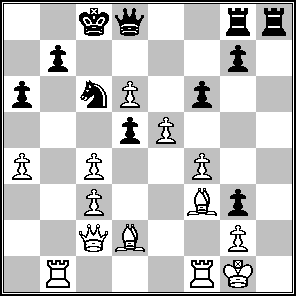
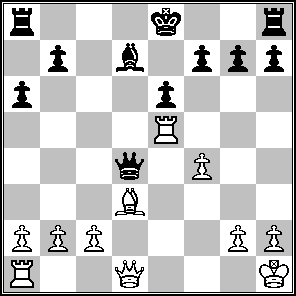
Black to move


It was a blunder, objectively speaking, that put a black pawn on g3. Black staked the whole game on setting up a checkmate that White could have stopped fairly easily. But White greedily grabbed first a pawn that was en prise, then grabbed with his own cleric the bishop that had taken the knight on f3. Now it's Black's move and checkmate in seven.

12 August 2008

Kramnik's Endgame

White to move


In this position against Veselin Topalov, Wijk aan Zee 2003, Vladimir Kramnik played 50.f4. He indicated in his annotations to the game in Informant 86 that the move was a mistake.

What move was better?

11 August 2008

La crème de la crème

Last December I passed along an email Informant sent out announcing their one hundredth issue. Shortly after publishing Informant 100, Šahovski Informator released The Best of the Best 1000—the ten best games from each of the first one hundred volumes, published with their original annotations. Joel Benjamin wrote a review of this book for his New York Times Chess Blog. With the prize money I earned from playing in the Spokane City Championship I was able to shell out the $60 for a paperback book and have been poring over some of the games.
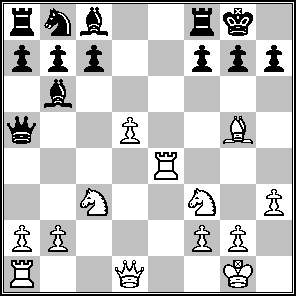
Black to move
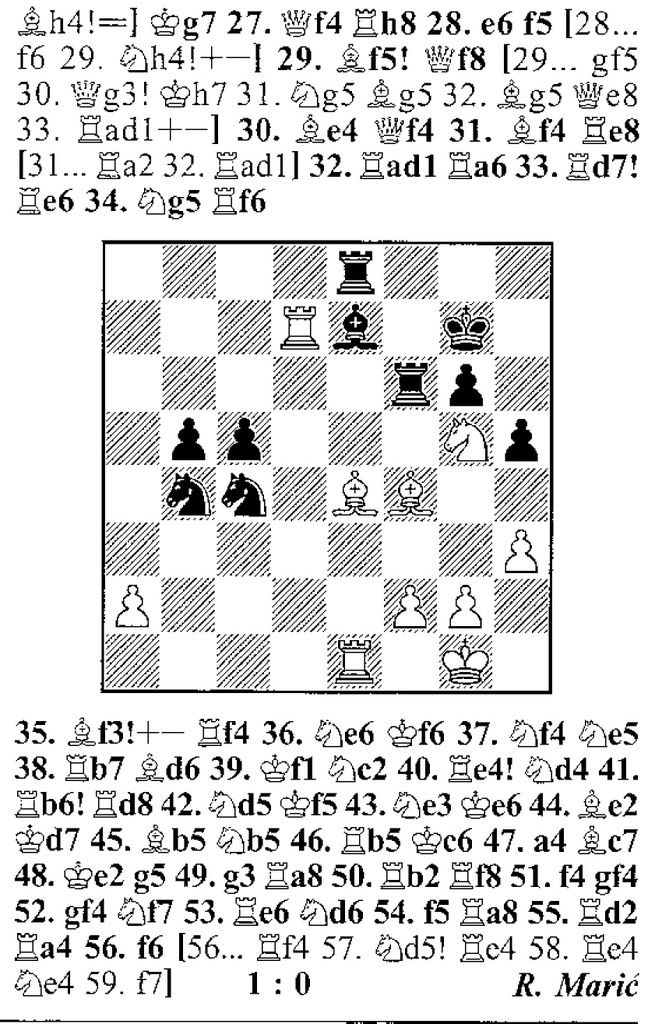
What happens if Black captures the knight on h7?
The position above did not occur in a game, but in the annotations by Rudolf Marić to Bobby Fischer’s win over Leonid Stein in the 1967 Interzonal in Sousse, Tunisia, an event Fischer did not complete. The game was voted the best of Informant 4.
Interzonal 1967
[T]his is the first instance in the history of chess, when a player has withdrawn from a tournament when he was leading.”
Paul Keres, Chess Life 1968
Among the accommodations for the guests at the Sousse-Palace Hotel, where the Interzonal was held, were use of a “camel, donkey, speed boat, and small yacht” (Brady, Bobby Fischer: Profile of a Prodigy, 134). Frank Brady observes that several problems emerged due to inadequate event organization, including poor lighting, intrusions of a photographer from the Soviet Embassy of Tunisia, and unfair scheduling. Fischer had been granted a day off to observe the Sabbath, postponing his eighth round game with Victor Korchnoi. According to Brady, his ninth round game with Efim Geller unnecessarily also had been postponed, resulting in six consecutive days without a break. When Fischer sought to remedy this error, he was refused without being offered an explanation.
Fischer withdrew from the tournament and left for Tunis. His withdrawal led to forfeit of his tenth round game with Aivar Gipslis. Diplomatic work on the part of the Tunisian organizers convinced Fischer to return to the tournament a few minutes before the one-hour deadline in his game against Samuel Reshevsky, who blundered quickly after play began. Fischer pressured the FIDE official to resolve whether the forfeit against Gipslis would stand: “At the moment when I was supposed to have lost a game by default I had already withdrawn from the tournament. How can a player lose a game when he is not even in the tournament” (Brady, 137)? Fischer wished to have the matter resolved prior to the event’s midpoint because if he withdrew before then, his entire score would be voided. If he withdrew after that point, all unplayed games would show forever in the record as losses.
While this issue was pending, the Soviet players threatened to withdraw en masse if Fischer was permitted to play his game against Gipslis. The committee caved to this pressure and ruled against Fischer, who then withdrew for the second and final time. Fischer then was forfeited against Vlastimil Hort. Still, Fischer “did want to play” (Brady, 138) and efforts were made to bring him back. Fischer’s next scheduled game was Saturday, 4 November 1967, against Bent Larsen. From his hotel in Tunis, Fischer sent this message.
I request to re-enter the 1967 Interzonal Tournament without prejudice to my claim that the forfeited games were decided illegally. I acknowledge that I have been declared forfeit against Gipslis and Hort; if the forfeits are ruled legal and were decided upon according to the rules of FIDE, I shall accept them. I request to play with Mr. Larsen tonight as soon as I can arrive in Sousse, I presume between 9-9:30 P.M.
As quoted in Brady, 138.
This message arrived to the committee at 7:25 p.m., but Fischer’s clock had been started twenty-five minutes earlier. Fischer had no way to get to the tournament by 8:00 p.m., was forfeited from the game, and per FIDE rules, the event. His road to the World Championship became longer. Although Fischer scored 8 ½ in the ten games he played, he was out of the event before the mid-point and does not appear in the crosstables. Bent Larsen won the event.
Beating Leonid Stein
Garry Kasparov writes in My Great Predecessors, Part IV that after losing to Leonid Stein in a casual game at the 1966 Olympiad in Havana, Fischer challenged him to a match: “You are the USSR Champion, I am the USA Champion” (Kasparov, 323). Fischer spoke to Fidel Castro, who agreed the match could take place in Cuba, but Stein had to play in the USSR Championship to qualify for the next year’s Interzonal. In Sousse, then, Kasparov writes “the two players had to demonstrate all that they were capable of, in one single game” (325).
Kasparov’s annotations to the game run seven pages in My Great Predecessors. He references comments on the game by Hans Kmoch, Paul Keres, Robert Hübner, Svetozar Gligorić, and Fischer. The game was a terrific fight. It appeared in Informant thus.
C 92
Fischer, R. Stein, L.
Sousse (izt) 1967
Ñ
4/336


10 August 2008

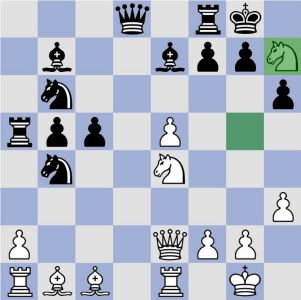
Play like Loek

After the move he played in this position, Loek van Wely gave the evaluation that White has a decisive advantage. His annotations can be found in Informant 86.

White to move


09 August 2008

Pure Fun

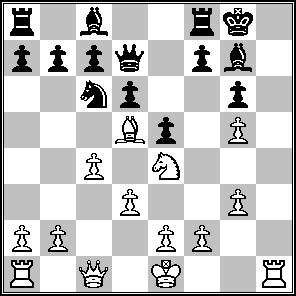
I like having this sort of position.

White to move


04 August 2008

Reinfeld Busts

Many of the solutions to Fred Reinfeld's tactical puzzles hinge upon suboptimal moves. Problem 297 in 1001 Winning Chess Sacrifices and Combinations is slightly atypical.

White to move


The problems in this text are organized by theme, so the solver immediately knows that a discovered attack figures into the solution. In this position, the only conceivable discovery is against the queen, so the bishop must be able to move with check. Thus, 1.Rxe6+! If 1...Bxe6, then 2.Bb5+ wins the queen for a bishop and rook, and Black's pawn structure is compromised. If 1...fxe6, then Bg6+. However, the king can move. To Reinfeld's credit, he gives the lines just mentioned and offers, "Black must move his king, remaining with a decidedly inferior game" (213).

The next problem in the text is more typical of the sort of suboptimal moves that pepper the solutions.

White to move


There is a discovery after Reinfeld's line: 1.Be7 Re8 2.Bb4 threatening both checkmate and the queen. But Black has other options. When I played this position against Hiarcs 10 a few months ago, the engine replied to 1.Be7 with Bxf2+. After 2.Kxf2 Re8 3.Bb4 Qb6+ saves the queen at the cost of a bishop. White still has a winning advantage, but the position is less one-sided than in Reinfeld's solution. Against the engine, I was able to achieve only a draw.

This morning I played the position again, but against a newer version of Hiarcs. Hiarcs 12 played 1...f5. That game continued 2.Ra4 Bxf2+ (still the bishop sacrifice) 3.Kxf2 Qb6+ 4.Kf1 Rf7 and this time I went on to win, showing improvement on may part.

22 July 2008

Posers and Provocateurs

Of making books there is no end, and much study is a weariness of the flesh.
Ecclesiastes 12: 12

Some writers pump out books and articles as if writing is as easy as breathing. But not all these prolific writers put out good quality. It is well known in many circles, for example, that the great quantity of texts put out by Eric Schiller could use improvement in quality. His reputation is such that John Watson prefaced positive comments regarding a Schiller authored CD with the phrase, “At the risk of being controversial” (Chess CDs: Coming of Age?). Edward Winter’s criticism is more strident: he lists a Schiller text (written with Raymond Keene) among the “five worst chess books” (ChessBase News), and in “Copying” documents evidence of plagiarism in his books. Schiller’s The Big Book of Combinations (1994) not only originates almost in its entirety from The Encyclopedia of Chess Middlegames (1980), it reproduces errors from the original.

Bill Wall is another prolific writer whose work in chess history is nearly endemic in cyberspace. In the Endless Quiz at chess.com, for example, one of the top scorers has a mediocre percentage of correct answers, but has submitted a great many questions that appear to originate from Bill Wall’s Geocities site. Tryfon Gavriel asked about the accuracy of Wall’s “Correspondence (Postal) Chess” at The Correspondence Chess Message Board and received from Tim Harding the reply, “i would warn all readers that the byline on that page is not a guarantee of quality, rather the reverse in my opinion.”

Another category of “poser” might include the one book wonder, Michael de la Maza. His Rapid Chess Improvement (2002) is regularly stocked in bookstores, and has stimulated numerous clubs, blogs, and forum discussions. Jeremy Silman points out the grandiose nature of some of the claims of MDM (as he is often called in online forums), and notes that there is nothing new in MDM’s point that “tactical skill acquired by hard work will make you much stronger” (Review of Rapid Chess Improvement). It doesn’t take long looking at Michael de la Maza’s Member Details page at the USCF to notice a couple things. His claim that he started in the 1100s is misleading. His initial established rating was 1344, and he had some results that would suggest he might be stronger than that to start out. Many of his losses were to unrated or provisionally rated players that quickly rose into the B and C classes. De la Maza, for his part, rose quickly it would seem not only because he worked at chess an average of three hours per day, but because the level of his competition taught him many things. There’s no reason to believe he had acquired the bad habits that most adult players must correct in order to improve (the sort that online blitz reinforce, further hindering progress). Moreover, de la Maza no longer competes at chess—this fact alone should give pause to all those that wish to imitate his rise.