31 October 2015

Bad Blitz

Blitz chess can be fun. It also can serve as part of a training regimen that develops chess skills. For several years, during the questions after IM John Donaldson's annual lecture in Spokane, he was asked whether blitz was helpful to a player's improvement. His answer was that he did not play blitz, but that another IM friend of his who plays a lot recommends limiting play to five games at a time and following the playing session with analysis of the games.

Sometimes I limit my blitz (see "Improving through Blitz").

When life is stressful, on the other hand, blitz serves to refocus my thoughts and work out some frustrations. It also becomes a self-fueling source of additional frustration as unfocused play is often substandard. Through the past ten days, I have had several multi-hour blitz marathon sessions and have played several hundred games of blitz. The following game is illustrative both of the poor quality of play in these sessions and of some of the lessons that can be gleaned from such games.

Stripes, J (1696) -- Internet Opponent (1702) [C41]
Live Chess Chess.com, 29.10.2015

1.e4 

During my blitz marathon, I alternated between 1.e4 and 1.d4 with the White pieces, occasionally playing 1.Nf3 or other moves. Some 1.e3 or 1.d3 moves were played due to mouse slips (or touch screen errors). "The First Move", posted last week, offers data concerning my opening patterns.

1...e5 2.Nf3 d6 3.Bc4 h6?!

This unnamed opening move might be dubbed the Anti-Fried Liver.

3...Be7 is the most popular move in Philidor's Defense.

4.d4

The third most popular move scores best among games in the database.

4.Nc3 is slightly more popular; 4.0–0 also scores well. Is one move better than the others? It seems to me that 4.d4 is a principled response to Black's time wasting 3...h6.

4...Nd7

With this move, the game transposes into an obscure line of the Hanham variation of Philidor Defense. It was Black's early h6 that renders it obscure.

White to move

5.Nc3

5.0–0 leads to two reference games worthy of further study.

5...Ngf6 6.Nc3 c6 7.a4 Qc7 8.a5 g6 9.h3 Bg7 10.dxe5 Nxe5 11.Ba2 0–0 12.Nh4 Kh7 13.f4 Ned7 14.Be3 Qd8 15.Qf3 Nxe4 16.Nxe4 d5 17.Bf2 dxe4 18.Qxe4 f5 19.Qd3 Bxb2 20.Rad1 Qf6 21.Rfe1 Qg7 22.Qg3 g5 23.fxg5 hxg5 24.Nf3 Bf6 25.Be6 Ne5 26.Bxc8 Nxf3+ 27.Qxf3 Raxc8 28.Qxf5+ Qg6 29.Rd7+ Bg7 30.Qxg6+ Kxg6 31.Rxb7 Rf7 32.a6 Rcc7 33.Reb1 c5 34.Bg3 Bd4+ 35.Kh2 Rce7 36.Bb8 c4 37.R1b4 Re1 38.Rxf7 Kxf7 39.Rxc4 Bg1+ 40.Kg3 Kg6 41.Kg4 Re6 42.Ra4 Re2 43.g3 Rxc2 44.h4 gxh4 45.gxh4 Be3 46.h5+ Kf7 47.Rb4 Ra2 48.Bxa7 Bxa7 49.Rb7+ Kf6 50.Rxa7 Ra4+ 51.Kf3 Kg5 52.Ra8 Rf4+ 53.Ke3 Rf7 54.Rb8 Ra7 55.Rb5+ 1–0 Kotronias,V (2628)--Dervishi,E (2543), Cappelle la Grande 2008.

5...c6 6.dxe5 dxe5 7.Bxf7+ Kxf7 8.Nxe5+ Kf6 9.Qd4 Ke6 10.Ng6 b5 11.Nxh8 Qf6 12.Qxf6+ Kxf6 13.b3 Bd6 14.Bb2+ Be5 15.Bxe5+ Nxe5 16.f4 Ng4 17.e5+ Ke6 18.Nc3 Ne3 19.Rf3 Nxc2 20.Rd1 Ne7 21.Rd6+ Kf5 22.Ne2 c5 23.h3 1–0 Peng Xiaomin (2590)--Du Shan (2399), Xiapu 2005.

5...c6 6.dxe5 dxe5 7.O-O

Another reference game: 7.Bxf7+ Kxf7 8.Nxe5+ Ke6 9.Qg4+ Kxe5 10.Qf5+ Kd6 11.Bf4+ Ke7 12.0–0–0 Ngf6 13.Rd6 Qb6 14.Qe6+ Kd8 15.Rd2 Bb4 16.Rhd1 Re8 17.Qf7 Bxc3 18.bxc3 Qc5 19.Rd6 Qxc3 20.f3 Re7 21.Qf8+ Ne8 22.R1d3 Qa1+ 23.Kd2 Qxa2 24.g4 Qf7 25.Qxf7 Rxf7 0–1 Nadal Garcia,L (2048)--Munoz Pantoja,M (2499), Barcelona 2008.

7...Qc7

White has a development advantage with more minor pieces mobilized and the king safely castled. Now, White must find a plan for developing pressure through the course of the middle game. In blitz, these plans are a matter on instinct.

8.a4N

Aimed at preventing b7-b5. Two other games had reached the prior position. The players were well below master. Both moved the light-squared bishop. One to d3 and the other to b3.

8...Be7 9.Be3 Ngf6 10.Qd2

Maybe a sacrifice on h6 to expose the king. Maybe a queen and rook battery along the d-file.

Black to move

10...0–0 11.Rad1 a6 12.Nh4 b5 13.axb5 axb5 14.Bb3 b4 15.Nf5 Bd8

15...bxc3 16.Nxe7+ Kh8 17.bxc3

White to move

Threats have been made and parried by both players. Now, White must determine how to address the threat on his knight.

16.Ne2?

With this error, my game began to deteriorate.

16.Na4 was acceptable. 16...Nxe4 17.Qxb4±.

16.Nxh6+! should have been seriously considered. I recall glancing at it briefly. 16...gxh6 17.Bxh6 Nh7

The alternatives:
17...bxc3 is worse. 18.Qg5+ Kh8 19.Qg7#.
17...Ne8 gives White a clear material advantage.

18.Nb5 cxb5 19.Bxf8±.

16...Nxe4 17.Qc1 Ndf6

White to move

18.Bxh6?? 

Amaurosis scacchistica!

18.Nxh6+ gxh6 19.Bxh6 Re8 20.Ng3
     (20.f3 Qb6+ 21.Kh1 Nf2+? 22.Rxf2
        [22.Kg1?? Nxd1+ 23.Kh1 Nf2+ 24.Rxf2 Ne4–+]
     22...Nd5
        [22...Qxf2 23.Qg5+]
     23.Rff1±)

18...Bxf5–+

I could resign.

19.Bg5 Be7 20.Ng3 Bg6 21.f3 Bc5+ 22.Kh1 Nf2+ 23.Rxf2 Bxf2 24.Bxf6 gxf6 25.Ne4 Bxe4 26.fxe4 Rad8 27.Rf1 Qb6? 28.Qh6 Qe3 29.Qg6+ Kh8 30.Qxf6+ Kh7 

I was looking for a perpetual, but Black's queen covers h6. Moreover, decoying the queen there does not net the bishop due to a back rank weakness.

White to move

31.Qxe5

31.Qf5+ Kg7 32.Qxe5+ f6 33.Qe7+ Kg6 34.Qxb4.
31.Bxf7! Qxe4 32.Qxf2 with an advantage for Black.

31...f5 32.Qe7+ Kh6 33.Qe6+ Kg5 34.Qe7+ Kh6 35.Qe6+ Black lost on time 1–0

So many blitz and bullet games are won by the player who made worse moves. Sometimes it seems that the clock is more the game than what happens on the board.

29 October 2015

Patterns

Lesson of the Week

With my beginning students this week, I went over one of my favorite miniature games. I.O. Howard Taylor in Chess Brilliants: One Hundred Games (1869) presents this position that he says he had against "a stranger" at the Philidorian Chess Rooms, London, February 1862 (121). He proceeded to deliver checkmate in eight moves.*

White to move
After 5...f6

Some of these beginning students have trouble recognizing check and checkmate, so we carefully went through each position in the game finding all of the possible checks. For each possible check, we looked at Black's possible replies. Most of Taylor's moves leave Black one legal reply.

Taylor -- "A Stranger" [C27]
London, 1862

1.e4 e5 2.Nf3 Nf6 3.Bc4 Nxe4 4.Nc3 Nc5 5.Nxe5 f6 6.Qh5+ g6 7.Bf7+ Ke7 8.Nd5+ Kd6 9.Nc4+ Kc6 10.Nb4+ Kb5 11.a4+ Kxb4 12.c3+ Kb3 13.Qd1# 1–0

My advanced students saw this game, as well as Legall -- St. Brie, Paris 1750 (See "A Familiar Pattern" for the game score). Advanced students also saw a third game. This was a bullet game played in less than twenty seconds.

Stripes -- Internet Opponent [C41]
Chess.com, 2015

1.e4 e5 2.Nf3 d6 3.Bc4 h6 4.d4 Nc6 5.Nc3 Bg4 6.dxe5 Nxe5

White to move

7.Nxe5! Bxd1 8.Bxf7+ Ke7 9.Nd5#

The patterns in Legall's famous game include his checkmate pattern, which could have occurred in Taylor's game had Black played 5...d6. White's pressure against f7 was also emphasized.

To emphasize learning and remembering patterns, all of the games were written on the white board without reference to notes while the students executed the moves on chessboards in from of them. The diagram in my game was presented with the challenge to find the conclusion. Happily, the students did so instantaneously and correctly.


*The one hundred games in his book are games played by the leading masters of his day. Taylor offers positions from his own games in an appendix in the back of the book.

25 October 2015

The First Move

How do you begin a chess game? Do you aim for a tactical game or a positional game?

I tell beginners that they should begin with 1.e4 the first one hundred times that they have White. After they have gained an understanding of the types of positions that they encounter after 1.e4, they should switch to 1.d4 for another one hundred games. Only with a thorough understanding of openings that begin with these two moves can a player competently explore the English, Bird's, Reti, Sokolsky, Benko, or innumerable other.

From time to time, I am asked how I begin.

With many thousands of games saved in several databases, I am able to offer a detailed answer.

Under the name I used when I was active on ICC from 1999-2003 and Playchess for several years after that, I favored 1.e4 slightly over 1.d4. These games include blitz, longer standard (mostly game 15), and correspondence games. These statistics are based on a data set of over 46 thousand games.


These days I play more often on Chess.com under a name that I did not use until 2007. This data set includes a little more than 16 thousand games.


My play continues to reveal an abundance of games where I opened with 1.e4, but also that my preference has shifted to queen pawn openings.

I have played something over 500 games in over the board competition during the past two decades. In these games, my preference for opening with the queen pawn is much stronger than with the king pawn. Also, I venture forth with some other move a higher percentage of the time.


My higher scoring percentage with 1.e4 may reflect my tendency to employ that move against lower rated opponents. Even so, my highest rated tournament win came on the White side of the Spanish Opening.

Perhaps I should begin with 1.Nf3 more often in blitz to develop that aspect of my game more.

23 October 2015

Problem of the Week

My advanced chess students this week made efforts to solve this position from Botvinnik -- Capablanca, AVRO 1938. Botvinnik's win over Capablanca's resourceful defense has been judged by many masters since as one of the best chess games ever played.

White to move

Mikhail M. Botvinnik wrote in One Hundred Selected Games that his move from this position was "forced". Nonetheless, it has proven difficult for my students. In the famous position ten moves later, however, where A.J. Goldsby states that his students have never found the winning move, several of my students succeeded.

20 October 2015

Rooks and Bishops

Beginner to Advanced

While teaching chess in classrooms several years ago, I searched my database for an instructive position in which each side had one rook and one bishop. I introduce one or two pieces in each classroom session and then let the children play with those pieces. For several years, I would introduce the rook and bishop during the third session.

I like this position from Leonhardt -- Mieses, London 1905. Although Black has a two pawn advantage, White has some tricks that could result in a draw. This position formed the core of the lesson for my beginning students this week.

White to move

51.Ra6+

Beginners need to understand why Black cannot block this check and must move the king.

51...Kc5 52.Bd3!

We reach the critical position. Black faces the loss of an exchange, reducing the material advantage to point-count equality.

Black to move

Black played 52...Kd4, which turns out to be the only winning move.

Saving the rook gives White the opportunity for a theoretical draw.

If 52...Rf4, then 53.Rxe6 Bxe6 54.Kxe6 Kd4 55.Bxf5

A rook against a bishop is a draw with best play. It is relatively easy to find moves that are good enough.

If 52...Re1 53.Bxf5 exf5 54.Kxf5

A rook and bishop against a rook is also a draw with best play, but the stronger side is capable of torturing the weaker. See "Rook and Bishop versus Rook".

The game's conclusion is also instructive, although we did not go through it in chess club.

53.Bxe4 fxe4 54.Kg5 e3 55.Kf4 e2 56.Ra1 e5+ 57.Kg3 Ke3 58.Rb1 e4 59.Kg2 Kd2 60.Rb2+ Kd1 61.Rb1+ Kc2 62.Ra1 Kd2 0-1

15 October 2015

One Position, Two Games

Heinrich Wolf won an instructive miniature from this position in 1910.

Black to move
After 16.Qh3
16...Ng3+ 17.Qxg3 Qxg3 and White resigned in the light of 18.hxg3 Rh8#.

However, White could have played 17.hxg3, leading to 17...Rg6 18.Bxd5! Bxd5 19.Nc3 Bc6 20.Rxf2 Rh6 21.Kh2 and White has a slight advantage.

This same position appeared in another game in 1958. Denis Victor Mardle had Black and found the move that today's chess engines confirm is the best move, leading to checkmate in seven moves.

What was Black's improvement?

I have been presenting this question to my advanced students this week.


Bonus Position

One of the keys to White's defense after 16...Ng3+? stems from understanding when it is best to give up one's queen for pieces other than the opponent's queen.

A recent game between two players among the world's elite illustrates the exchange of queen for two rooks. This position arose in Grischuk -- Aronian, Stavanger 2015. I found this game while reading Chess Informant 125.

White to move

22.Qe4!

Grischuk understood Aronian's plans and took countermeasures.

22...Rxg2! 23.Kxg2 Rg8+ 24.Qg4!

Putting the queen in the line of fire is the only defense. After 24.Kf1 Qh2, the queen must go to g4 anyway, but now Black's threats are more serious.

Black to move

24...Rxg4+ 25.fxg4 Qxg4 and Black opted to force a draw by repetition.

13 October 2015

Cutting Off

Beginning chess players prefer direct attacks. In order to become adept at finishing a game with an advantage of overwhelming force, players need to learn to restrict the opponent's choices. Instead of endless checking, which leads nowhere, a beginning player must learn to first cut off the escape.

My beginning students this week were presented with a worksheet that has six diagrams. I asked them to set up each position on a chessboard and find the checkmate that required the fewest moves. After they had spent ten minutes on the worksheet, we went over all of the correct solutions on the demonstration board.

For readers needing to develop these skills, several of my previous posts my be helpful: "Checkmate with Heavy Pieces" links to a video that I made; "Lesson of the Week" (November 2011) and "Teaching Elementary Checkmates" offer instruction with static diagrams.


09 October 2015

Lesson of the Week

Chess students are divided into two groups: beginners and advanced. Beginners range from those who do not know how to move the the pieces, but want to learn, to those who have been playing chess a year or more, but have not yet played in tournaments. Advanced players competed in scholastic tournaments last year. Most qualified for and played in the Washington State Elementary Chess Tournament. Some of these students won trophies at state.

The lesson of the week differs for these different groups.

Beginners

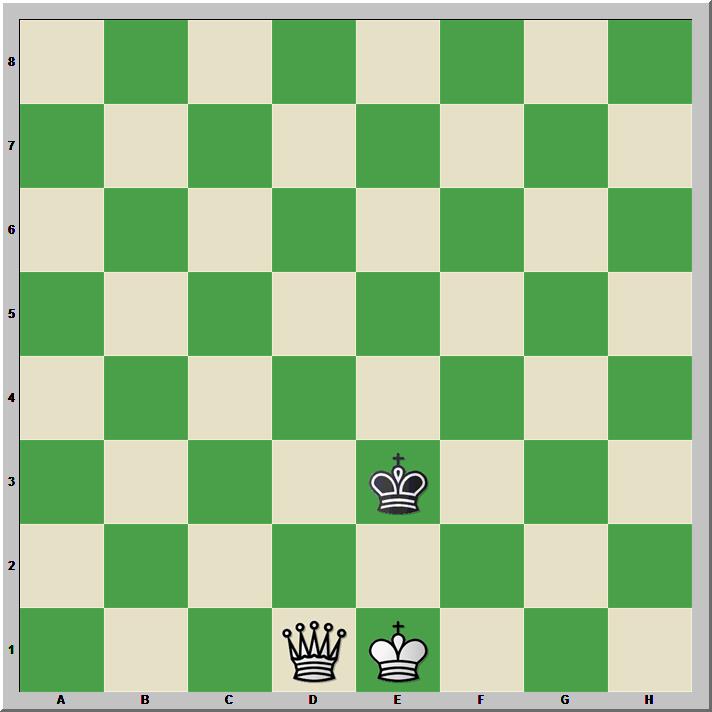
We began by understanding the chessboard as ranks, files, and diagonals. Each square has a name. The students learned these names. We then discussed two pieces: king and rook. Even those who had never played chess before should now know how the king and rook move. They should understand check and checkmate. We looked at checkmate from two positions. Some of the students will need additional work.

Cutting off the defending king's escape is essential to finishing the game from both positions.

White to move

White's is able to checkmate Black in two moves. First, one of the rooks moves to the seventh rank, cutting off the Black king's escape from the edge. After Black moves the king to one side of the other, the other rook moves to the eighth rank with checkmate.

White to move

Moves that put Black in check delay the end of the game. For example, 1.Rf8+ forces the defending king off the edge of the board, which is what Black wants. Cutting off the king's escape, on the other hand, ends the game quickly.

1.Rc5 Ke8

Black had only one legal move.

2.Rc8#.

Checkmate.

Advanced

Advanced students were presented with a position from a game between masters, Skembris -- Gouloutis, Anogia 2015. The core of the lesson comes from a variation that might have been played. This variation is presented in the notes to the game in Chess Informant 125, which was published last week.

Black to move

The first lesson from this position is understanding that despite superficial appearances, Black's b-pawn is not protected. The a-pawn is pinned because White's queen and a1 rook both eye the rook on a8. The rook on b8 also fails to protect b4 because moving the rook would leave the a8 rook unprotected.

In the game, Black played 26...e5. The game concluded 27.Nxb4 exd4 28.Nc6 Rf8 29.Ne7+ Kh8 30.Re4 Nf6 31.Rh4+ Nh7 32.Qe4 Qc5 33.Ng6+ and Black resigned.

Although we looked at the game's actual moves, we concentrated upon the variation in the notes by Spyridon Skembris, the game's winner.

26...a4 27.Nxb4 Ra7 28.Nc6 Rxb3

White to move

How should White respond to the threat upon his queen?

The in-between move is best. This concept of an in-between move--doing something else that is forcing before taking necessary action against an opponent's threat--is often expressed by chess players with the terms zwischenzug (German) or intermezzo (Italian). This concept is the second lesson for advanced players.

We see the in-between move Ne7+ in the actual game, as well as in the variation. In the variation, however, this tactic and the multiple pins do not give White a decisive advantage as they do in the game.

The variation continues:

29.Ne7+ Kf8

We also looked at the consequences of 29...Kh8, which is not discussed in the notes, to wit, 30.Re4 Rxf3 31.Rh4#.

30.Nxg6+ Kg8 31.Qe2 Qb7+ 32.d5 Nf6 and Black has counterplay that balances against White's attack.