25 August 2022

En Passant

One of my students requested a lesson on en passant, so I created one. We did not need to go over the rule as he had shown that he understands that much. So, what was I to do? The first position that came to mind was the game that provides the position for the banner at the top of the page. This game was a 3 0 blitz game that finished in under two minutes. I played it on my iPad while waiting for my lunch in the Classic Cafe in Deer Park, Washington. I had spent a couple of hours in the morning teaching chess at a homeschool resource center and had another couple of hours teaching chess in classrooms at Deer Park Elementary. I recall showing the game to the students that afternoon because it illustrated en passant and checkmate, two vital rules beginners need to learn.

White to move
Black played 13...f5+. An en passant capture is White's only legal move. 14.exf6 and then the d-pawn advanced with checkmate. It was a memorable game with errors on both sides, but some interesting tactics that have instructive value.

I followed this position with a couple from Roman Pelts and Lev Alburt, Comprehensive Chess Course, vols. I and II (1986). Then some mates in one culled from several sources. The student blazed through these very quickly. We then spent a couple of minutes on his successful effort to find the moves that had to be played to reach this position, which appears both in Ilya Maizelis, The Soviet Chess Primer (2014) and in Pelts and Alburt.

Black to move
I found two short games in the Lichess forums that were composed in answer to the question: what is the shortest possible game that ends via checkmate with an en passant capture? Both White and Black are able to checkmate in this manner on the sixth move.

We finished with an endgame exercise and a mate in four that I composed an hour before the lesson.

White to move and win

White mates in four


24 August 2022

Stalemate

This morning in a desperate position I "blundered" away a rook. My opponent fell for the ruse.

White to move
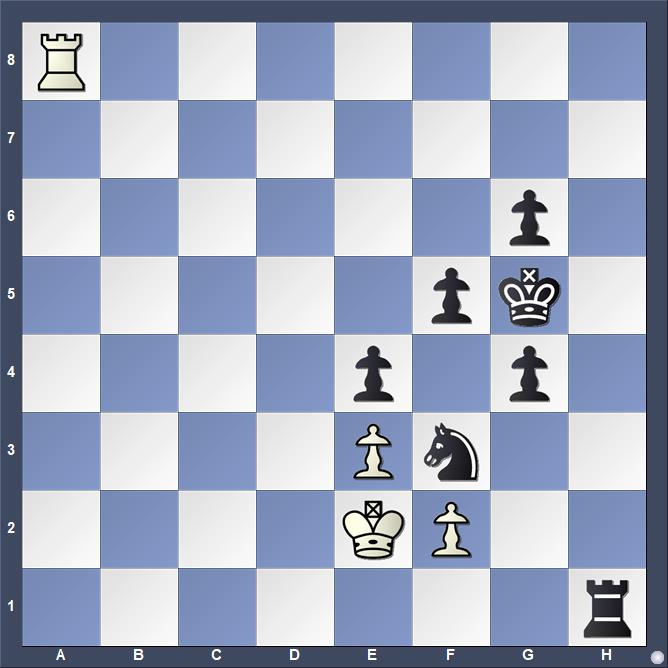
I played 53.Ra1 after which Black wins easily with 53...Nd4+ and taking the rook the next move. However, 53...Rxa1 fails to win, as my opponent learned after ending the game with that move.

A search of my online games database shows nearly 1100 games that have ended in stalemate. A portion of these were provoked in the manner of this morning's offer of a rook, and were preventable. 

This position arose on the Internet Chess Club in 1999. Black to move.

Black to move
I played 65...Rd5+ and my opponent took the rook. If they would have played Ke6, the next check could be met with Kf7. The engine needs some depth to realize that White's king has no shelter from the rook's sacrificial efforts. White's 65.Bf5 was the error that led to this position. The bishop had been on g4. 65.Re8+ would have eliminated the stalemate prospects.

Something similar and simpler arose in an OTB game in 2006.

White to move
My opponent played 54.h7?? Naturally I played 54...Rxb7 and we agreed to a draw after I took the other pawn, too.

And again in 2000 on ICC.

White to move
55.a7+?? allowed me to start checking with my rook. 55.Ka8 56.Ka5 Ra1+ 57.Kb6 Ra6+ 58.Kxa6. White has some work to do to win this ending, but pushing the pawn made Black's efforts simple.

This position arose more than two decades ago on the Internet Chess Club.

Black to move
I threw away the win with 55...Rg2. My opponent forced stalemate.

Even worse on my part was this position five months later.

Black to move
56...Bf8 leads to checkmate on the following move, but I played 56...Be5. No effort was needed by my opponent, except the stubborn refusal to resign in a hopelessly lost position.

No stalemate threats seem evident in this position from a five minute game.

Black to move
Nonetheless, 45...Kg4 surrendered the win. 46.Rxe5 f3 47.Re4+ Kf5 48.Rb4 h2+ 49.Kh1 and now White will try to eliminate his rook and succeeded another dozen moves later.

Black could have played 45...f3 and then used the e-pawn as shelter from rear checks.

I did not suspect this opponent of cheating, but he was banned a few hours after we played on Chess.com yesterday. 

White to move
As a final act of desperation, I played 55.a5. My opponent obliged with 55...bxa5 when 55...b5 would have won. I offered a draw. He refused. I told him it was a dead draw. He replied that he did not agree. We played until stalemate.

However, I have suspicions about my opponent in a game that reached this position.

White to move
42.Rd6+

Although inferior to 42.Rc1+, White has so far kept the win in hand.

42...Kc5 43.Rxe6 Kd4 44.Rxb6

Grabbing pawns seems sensible if you are not skilled and have turned off the engine because you are confident of securing victory on your own. I began to maneuver for the opportunity to swindle half a point. 

45.e6 Kxf4 46.e7 Rxe7 47.Ra6 Kg3!

White to move
48.Rxa5?!

48.Rf1 Rd7 49.Rf3#

48...Re2 49.Rxf5??

49.Rf1 still wins.

49...Re1+

Stalemate is forced in two moves. I was surprised how easy it was to swindle this player.


20 August 2022

The Wrong Move

Several days ago I was watching a recent PowerPlay video by Danny King. He featured a game that had an impact on the final standings at the Chess Olympiad in Chennai: Muzychuk,M. -- Kashlinskaya,A. After 27.Qd6+, black faced two possible legal moves.

Black to move
The safer looking move, which was played in the game, was the wrong move. It was the "losing" move, according to King.

Later that day, I was reading a book that had recently arrived: Jacob Aagaard, A Matter of Endgame Technique (2022). The first exercise at the beginning of the first chapter takes a position from Concio,M. -- Tin, Jingyao, 2021 played online in an Interzonal qualifier for the 2021 World Cup. Again, Black has two legal moves.

Black to move
Again, the move played in the game, and the one I might have chosen on impulse, was the wrong move. With Aagaard's book, however, I knew it was wrong, but failed to find the reason. Reading the book made it clear that I needed to calculate more deeply.

11 August 2022

Two Pigs

Edward Winter has published several entries in Chess Notes over the years inquiring into the origins of the checkmate pattern often called blind swine. The term "blind swine" for two rooks on the seventh that cannot find checkmate was credited to Dawid Janowsky by Vladimir Vukovic (see CN 5160). Winter seeks a primary source that confirms Janowsky used the term. None have been found. The phrase has been credited to Aron Nimzowitsch as well (CN 3525).

This morning I had two rooks on the seventh and was playing for a draw because I failed to see a resource: my f-pawn could advance to support one of the rooks and produce a different two rook checkmate. In my defense, it was early morning, my first game of the day, and the game was one minute plus one second increment. Such a time control does not produce accurate play.

Stripes,J. -- Internet Opponent [D06]
Live Chess Chess.com, 11.08.2022

White to move

27.b4?! d4 28.exd4 cxd4 29.Rc7+ Kg8??

29...R8e7=

30.Rxa7 Re2+ 31.Kg3 Rd8

31...R2e7 32.Rxe7 Rxe7 33.Rc8+ Kf7 34.Rd8+-

32.Rcc7

White has two rooks on the seventh, but how is this enough to win?

32...d3

White to move

33.Rxg7+ Kf8 34.Raf7+

34.Rxh7 threatens mate.

34...Ke8 35.Rc7 Kf8

White to move

36.Rcf7+

I could have played: 36.Rxh7 Kg8 37.f5! The key move that escaped my notice.37...d2 38.Rcg7+ Kf8 39.f6 and mate comes soon.

36...Ke8 37.Rc7 Kf8 38.Rxh7 Kg8 39.Rcg7+ Kf8 40.Rf7+ Kg8 41.Rfg7+ Kf8 42.Rf7+


White seems to be playing for a draw. I was because my fear of Black's d-pawn rendered the power of my f-pawn invisible.

Black to move

42...Ke8?

42...Kg8 White must find 43.f5, which White has already shown is beyond his capacity.

43.Rc7 Re7

White to move

44.Rh8+

White finds a tactic to create the opportunity that was already on the board. It is not the rooks that are blind.

44.Rcxe7+ Kf8 45.Rb7 Kg8 46.f5

44...Kf7 45.Rh7+ Kf6 46.Rcxe7 d2 47.Rd7 White won on time 1-0

04 August 2022

King Safety

Working through the games in Kevin Wicker, 200 Modern Brilliancies (1981), I came upon this mess from a postal game between Toni Cipolli and Semen Gubnitsky played in 1977.

White to move
Cipollini did not find the right idea. Nor did Wicker.

31 July 2022

Think

It was my hope that after one full week of playing bishop endings against Stockfish on Chess.com, I would be able to report success. I had a completely winning position in the fifth and last exercise in the set yesterday morning when a single hasty move threw away the win. I can blame the distraction that caused me to look away from my iPad, but by now I should know to look at the board before moving when I look back.

This morning, the computer threw me several curves in exercise number three and I failed each time. This was one instance.

White to move

I played 1.a4?? and after 1...Bd8+ 2.Kc6 Bxa4, there was no way to prevent the loss of the g-pawn, too.

Later, I set the position up in the Stockfish app and won easily.

Several times this week, I have played 1.a5 in the position below. The resulting draw is a position that I should recognize by now.

White to move


29 July 2022

Overworked Piece

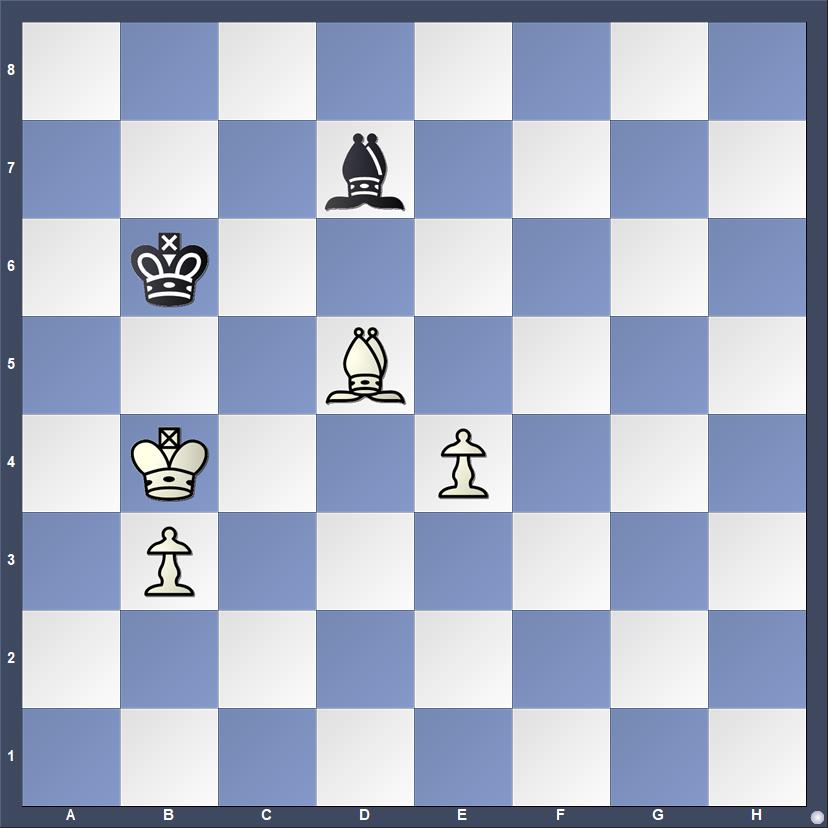
I failed my bishop endgame this morning. It was number two in the series described in "The student should work this out". I was doing fine until I reached this position. Then, I went from winning to losing.

White to move
What would you play?

28 July 2022

"The student should work this out"

In Chess Fundamentals by José Raúl Capablanca, the author frequently states that a given position, "should be worked out by the student", and other comparable phrases. This assertion vexes some readers and some coaches are loath to recommend the book. If the student does not understand something, how will they come to an understanding without assistance?

In some cases, especially with simple pawn endgames in chapter 1 of Chess Fundamentals, I believe that Capablanca provides the necessary resources in the explanations that he offers. Still, I have seen others struggle. They need more help. Capablanca recommends a teacher.

When Capablanca wrote Chess Fundamentals (he was checking the proofs in England in 1920 while negotiating conditions for the World Championship Match that took place in March and April 1921--see "WCC Havana 1921" in this site's index), there were fewer resources than we have today. I believe the standard endgame book then was Johann Berger, Theorie und Praxis der Endspiele (1890), a book in the German language that was probably not readily available or accessible to the majority of Capablanca's readers.

Today, however, we have an abundance of books, websites, YouTube, ready access to engines, and even tablebases. The danger to the student stems not from lack of help, but rather too much help. Easy access to answers cause many to fail to develop self-reliance. Capablanca's call to develop the habit of working things out may offer a more certain formula for strengthening a player's skills.

I often claim that I have zero natural ability at chess, but that I have learned a modest amount from books (see "My First Chess Book"). Many years ago when I started reading chess books, I found much that was confusing. The book I remember most clearly is Irving Chernev, The 1000 Best Short Games of Chess (1955). Often it was not evident to me why a game ended. Sometimes Chernev explained the reason, but even then I had questions. I sought answers to my questions by moving the pieces on a chess board, exploring variations. Certainly, with so little skill at the time, most of my fantasy variations were rubbish. Even so, the effort developed a habit of thinking for myself about chess.

The past few days I've found myself back in the classroom, seeking understanding. I started playing some bishop endgames against the computer on chess.com. Failure in my first effort got me hooked. My time struggling through five positions against the silicon monster engages me for hours every day. At the Learn/Endgames/Minor Pieces/Bishops tab on chess.com, there are five practice positions. To see the second one, you must checkmate the computer in the first. The first is simple and takes me from 12 to 24 seconds most times. 

The second one varies in difficulty, depending on how the engine plays.

White to move
Number Two
1.Bf5

I always play this move. It might be best.

1...h5 2.f3

Now the engine has played 2...a5, 2...Ke7, and 2...Kc6 most regularly. 2...Kc6 has proven most testing but I am reliably winning most of the time. Success grants me the opportunity to see number three.

White to move
Number Three
I found the pawn sacrifice quickly and now get to my seventh move in two seconds or less. Sometimes I reach this point with considerably less than two minutes total time elapsed for checkmating the computer in the first two and playing these seven moves.

1.c5 dxc5 2.Bc4 Bg4 3.Kxe5 Ke7 4.Kd5 Kxf7 5.Kxc5 Ke7 (the computer threw me a curve with 5...Kf6 at least once) 6.Kxb4 Kd6 7.Bd5

Black to move
The computer has played at least five different moves here.

a) 7...Bf3 proved challenging the first time I saw it. That line now often continues 8.Ka5 Be2 9.b4 Bg4 10.Kb6 Bh3 11.b5 Bg4 12.Ka7 and the computer must give up the bishop for my b-pawn.

Black to move
12...Kc5 has given me trouble when I am moving too fast, which the exercise encourages by tracking total time for the series and making me play simple checkmates all the way to the end. Sometimes I underpromote to practice bishop and knight or two bishop checkmates.

13.Bc6 Bc8

Here, 14.b6?? fails, but both 14.Kb8 and 14.e5 succeed.

I have seen most of the computer's responses several times, but this morning's effort presented me with a position I did not recall seeing before. 

b) 7...Bd7 8.Ka5 Kc7 9.Kb4 Kb6

White to move
10.Kc4!

There is more than one way to get rid of Black's bishop.

10...Be8 11.Kd4 Kb5 12.e5 Kb4 13.Ke4 Kc5

White to move
14.Bg8 Bc6+ 15.Kf5 Kb4 16.Kf6 Kc3 17.Bc4 Bd7

This move is Stockfish surrendering it seems.

White to move
18.e6 Bc6 19.Kf7 

Black must give up the bishop for the e-pawn. A few moves later, I underpromoted the b-pawn to a bishop. When I was nine or ten moves from mate, I made a hasty move that stalemated the engine. Now, I must start over at number one. I've played number five half a dozen times and have some ideas how to proceed. My current problems are two: 1) the engine lures me into a pawn ending that is lost foe me, and 2) I fail two, three, and four too often.

Have you tried these exercises? How did you do?