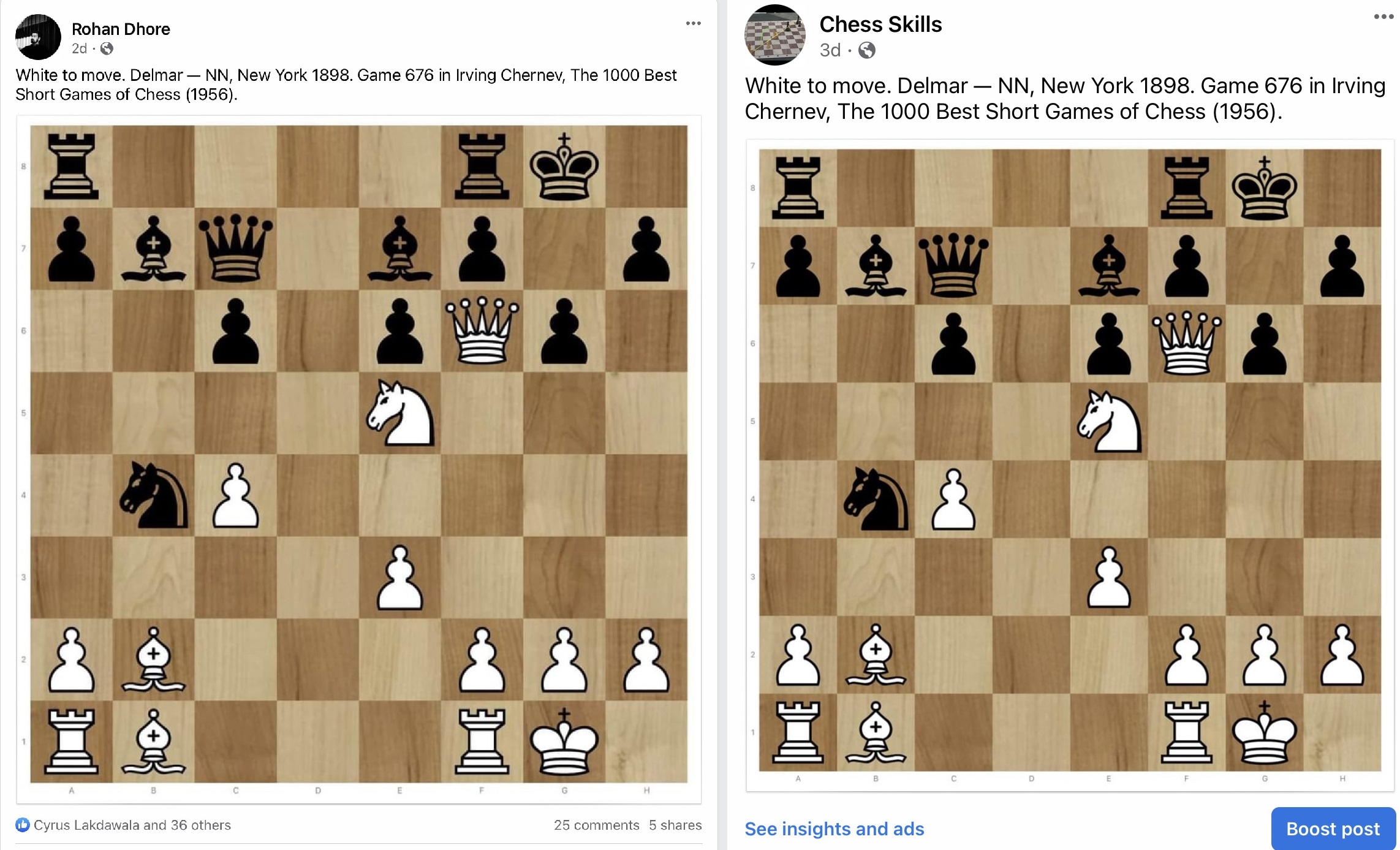
In November 1996, I played in the Washington Class in Federal Way. There was a book seller set up in one of the rooms near the playing hall. I spent a bit of time there talking with David Weinstock, owner of
ChessMate. In our discussions, he recommended a book to me. I was skeptical. The title sounded more basic than my own self-assessment of my needs. Nonetheless, when I found the book at Auntie’s Bookstore when I was back in Spokane, I bought it and started to read it. It was transformative.
Consider my list of ten, pictured above and described below, as a provisional suggestion rooted in experience. What worked for me may or may not work for you. Read all recommendations with skepticism, but also with openness to trying something that might help. There are no magic books guaranteed to improve your chess, but only a few will fail to teach you something of value.
1) Georges Renaud, and Victor Kahn,
The Art of the Checkmate (1953) was the book David suggested, and is my first recommendation. Having spent many hours in the 1970s learning the basic checkmates with heavy pieces and even two bishops, and having delivered many fine checkmates in many games, it was hard to believe there was much I could learn from such a book. Reading it, however, exposed me to new checkmate patterns, including some that I had seen, but not absorbed, from a book I studied in 1975: Irving Chernev,
The 1000 Best Short Games of Chess (1955). Renaud and Kahn not only taught me new patterns, but they gave me a framework for thinking about checkmate and checkmate threats.
As David Weinstock had, I began to recommend
The Art of the Checkmate to any and all who would listen, and also to many who ignore what I say. I still do. This book helped me, and it can help you. But there are other books that could substitute, and might be even better. Victor Henkin,
1000 Checkmate Combinations (2011) takes a slightly different approach. It also teaches an abundance of vital checkmate patterns and greatly exceeds Renaud and Kahn in the amount of study material. Antonio Gude,
Fundamental Checkmates (2016) is another option. It is comprehensive and to an extent combines the approaches of Henkin with that of Renaud and Kahn. One can find dozens of other books on checkmate patterns, but these three stand above the others. Get one of them, or even all three.
 |
| Vital |
2) For a year or longer, Lev Alburt, Chess Training Pocket Book: 300 Most Important Positions and Ideas, 2nd ed. (2000) was my bedside reading. I read it cover-to-cover twice. Alburt’s book was the only tactics book I finished prior to early 2023 when I finished all 1320 exercises in Sergey Ivashchenko, The Manual of Chess Combinations (1999). It is not an ordinary tactics book for practicing basic ideas, but rather, a small set of carefully chosen positions with tactical and positional concepts. It also has a small number of vital endgame positions.
Many grandiose claims have been made by different authors about the legendary 300 positions, but there should be no doubt that careful and deliberate study of a small number of carefully selected positions will take your game up a notch. Alburt’s book helped me. A few years after completing it, I began study of another book focused on 300 carefully selected positions: Rashid Ziyatdinev, GM-RAM: Essential Grandmaster Knowledge (2000). More recently, Thomas Engqvist has gained my attention, now with a trilogy of books containing 300 in the title.
 |
| An Idea Worth Considering |
3) Quantity matters, too, when it comes to tactics training. A classic that has lifted the skills of generations of chess players has also been part of my training. Fred Reinfeld,
1001 Winning Chess Sacrifices and Combinations (1955) deserves a place in every chess player’s library. In 2008, I spent quite a bit of time playing these positions against the computer. Often I could find the tactic, achieve a clearly superior position, and yet still fail to defeat HIARCS (see "
Where the Rubber Meets the Road"). Reinfeld organizes the chapters by themes—forks, pins, double attacks, and so on. I set my database containing these positions to open randomly so I did not know which theme to look for. But I also use the book, either solving from the diagrams or sometimes setting up the positions on a board.
Endgames have been vital to my success. In 2007-2008, I invested a lot of time teaching some elementary rook endings to my top student, the strongest third grader in my city. That summer, in the Spokane City Championship, I played two rook endings against FM David Sprenkle, drawing one game.
Currently, I’m on a collector’s quest to have 64 endgame texts in my personal library. The quest stems from my enjoyment studying positions with few pieces, my conviction that endgame knowledge is vital for all skill levels, and my involvement in an online community of book lovers,
Chess Book Collectors on Facebook. During my rise from the 1500s in 2002 to high-1900s in 2012, much time was invested in endgame study.
4) The endgame book that did the most for me was Mark Dvoretsky,
Dvoretsky’s Endgame Manual (2003). As one of ten books to recommend to class players, Dvoretsky is a controversial choice. Many players find it too difficult for anyone below master. Poppycock! Chess books are not novels. One does not read every word. Read the part that makes sense and push through a bit that stretches and challenges you. I have read the long chapter on pawn endings in
Dvoretsky’s Endgame Manual several times and have flash cards containing the 48 blue diagrams that I use for review, study, and teaching (see "
Pawn Endings Flash Cards"). I’ve struggled through perhaps half of the chapter on rook endings and made flash cards for the first 24 blue diagrams. Other chapters I have dipped into from time-to-time.
During the years spent studying
Dvoretsky’s Endgame Manual, other books have also supplemented my work. These include, Bruce Pandolfini,
Pandolfini’s Endgame Course (1988); Jeremy Silman,
Silman’s Complete Endgame Course (2007); Karsten Müller and Frank Lamprecht,
Fundamental Chess Endings (2001); and several others. My top recommendation for those looking to begin endgame study is Yury Averbakh,
Chess Endings: Essential Knowledge (1993). There are many choices. Choose that one that you like, but do not neglect the endgame. Make endgame study a priority if you want to play better chess.
 |
| Splurge |
5) Jacob Aagard,
Excelling at Technical Chess (2004) also concerns the endgame. However, it is distinct from the endgame manuals listed above. The core of the book focuses on “seven technical tools”—schematic thinking, weaknesses, domination, do not hurry, passed pawns, how to arrange your pawns, and freaky aspects. Aagaard develops each of these ideas with compelling prose and detailed game analysis. As he states in the beginning, this book follows an approach that has made Mikhail Shereshevsky,
Endgame Strategy so highly regarded. The technical tools are worthy of detailed attention, and I hope to find time to explore them in more detail. I blazed through this book is a couple of days, reading all the prose and glancing superficially at the game analysis. However, this superficial reading was enough to transform my game. My endgame play became more resilient. Formerly, I would often offer or accept a draw in seemingly equal positions. After reading the book, I play out most positions to the end, often lone kings. If there is any reason to play on—an imbalance, a weakness of any sort in my opponent’s position, even a better king position—a draw is anathema unless it secures a tournament victory.
Annotated games have always been a regular part of my chess study. In my youth, I spent many hours playing through games from three GM tournaments that resulted in books that I purchased: San Antonio, 1972; Leningrad, 1973 (the 42nd Soviet Championship); and Wijk aan Zee, 1975. In addition, I bought and still have two books by David Levy that were collections of games by specific players:
Karpov’s Collected Games: All 530 Available Encounters, 1961-1974 (1975); and
Gligoric’s Best Games, 1945-1970 (1972). All these books influenced my play as a teenager as I sought to imitate the play of the world’s elite.
6) In my 40s, I had many more chess books to choose from and studied annotated games from many of them. One source of such games that I returned to frequently is Garry Kasparov,
My Great Predecessors, 5 vols. (2003-2006). Kasparov culls some of the best insights from many years of chess literature and presents many of the most important games of every world champion before him, as well as many contenders for that title who fell short. Chess history offers a reliable foundation for the development of chess skill. Although Kasparov does a poor job of documenting his sources (see my
Patriots and Peoples blog for examples of sourcing problems in the writing of US history), the series remains an important practical overview of chess history.
7) Paul Morphy’s games are particularly useful to chess players who want to play well. Perhaps one day I will be able to report that I have played through every one of his available games. So far, I have been through at least one-third of them, some of them many times. His eighteen tournament games have been imposed by me on some two dozen students, who have been through all of them. I’ve shown the Opera game to students at least one hundred times and of course know it fully. For insights into Morphy’s play, few books are in league with Valeri Beim,
Paul Morphy: A Modern Perspective (2005). This book has enriched my study.
8)
Chess Informant was long the indispensable source for current master games from before I took up the game in the 1960s into the twenty-first century. Now, of course, these games are readily available from many sources. In 1996, as I was coming back to chess with some seriousness of purpose, I was curious about
Informant, which I had seen only in the USCF sales catalog. At the Washington Class, however, David Weinstock had some on the table. He allowed me to look at them and we talked about how they were organized. A month or so later, I included
Informant 64 in an order of books from USCF sales. It aided my correspondence play in a concrete way (see "
Playing by the Book"). More importantly, learning the Informant system of codes changed my thought processes during play. There are so many things that one contemplates during a chess game while looking for the right moves or the correct plan. Sometimes these thoughts are noise that interferes with clear focus on what matters. To an extent, the limited analytical possibilities in the Informant codes distills chess down to things that really matter in the quest for advantage.
As I grew as a player,
Chess Informant was a useful tool. Today’s
Informants are changing with the information explosion and are oriented more towards the needs of class players than they were in the past. Give them a try.
Of course, I did not rise from C Class to strong A Class without studying the works of Jeremy Silman. His endgame book is already listed above, although it was less useful to me than Dvoretsky. In fact, the day I bought it, I read everything through the section on B Class, finding very little that I did not know. Silman’s endgame book has done more for my teaching than for my own progress as a player. That’s plenty! His writing is compelling and many of his metaphors and personal anecdotes are unforgettable.
I bought and read (partly, of course) How to Reassess Your Chess, 3rd. ed. (1993); The Reassess Your Chess Workbook: How to Master Chess Imbalances (2001); The Amateur’s Mind: Turning Chess Misconceptions into Chess Mastery, 2nd ed. (1999); and The Complete Book of Strategy: Grandmaster Techniques from A to Z (1998). When it finally came out, I added How to Reassess Your Chess: Chess Mastery through Chess Imbalances, 4th ed. (2010), but my rating had risen above 1800 before then.
9) Of these books, Reassess Your Chess and the companion workbook were most useful in helping centralize imbalances in my thinking. When I need to win a tournament game, seeking imbalances from the very first move often proves vital.
The Complete Book of Strategy did nothing for my game and very little for my teaching. Its usefulness has been so slight that I struggle to show proper supportive enthusiasm when a young student has shown me that they just acquired it. I must remind myself that there is a difference between this book’s presence in a chess library of more than 400 volumes that includes several dictionaries and encyclopedias, and a chess library for which this book is the first book acquired. It is a good book, even though it does not meet my needs.
What about the Opening?
In high school, I spent many hours studying lines in I. A. Horowitz, Chess Openings: Theory and Practice (1964). In the 1990s, Walter Korn, and Nick DeFirmian, eds. Modern Chess Openings, 13th ed. (1990) took its place. Even more time was spent on opening monographs, including several on two related variations of the Sicilian Defense that feature an early e5 push by Black. There is some evidence this study hurt my game, or at least retarded my improvement. I tried to memorize lines and often faltered when my opponents deviated from the lines that I knew.
In 2003, I began to switch from the Sicilian to the French as my primary defense against 1.e4. The French Defense is not superior to the Sicilian. It might even be a worse choice, but for me it marked a shift in how I approached opening study. Rather than grinding through lines in a book, I sought understanding of the principles, of basic concepts, such as one finds articulated clearly in José Capablanca, Chess Fundamentals (1921), of the ideas behind the moves. Unquestionably, I learned many lines, but when my opponents deviated from these, I was prepared. My play improved.
Detailed opening study and learning concrete lines has aided my preparation for specific opponents in several cases. At a crucial moment while still a B Class player, I won the Spokane Contender’s tournament, earning a shot at the title of Spokane City Champion. Expectations of victory were nearly non-existent. No one expected a B Class player rated in the 1730s to prevail over FM David Sprenkle, rated in the 2250s, down considerably from his peak. As preparation, I spent close to 40 hours on two semi-obscure variations: the Raphael variation against the Dutch Defense for when I had the White pieces, and a seemingly risky Nh6 idea for Black in the French Advance. It took Sprenkle 72 moves to compel my resignation in the French, and I drew my second game with White. It was a very good day.
Most of the time in tournament play, however, such extensive opening preparation is more of a crap shoot. Unless an opponent walks into your pet line, where is the benefit? Tactics win and lose games. Endgames keep chances alive as players grow weary or hungry.
10) Hence, my tenth recommended book is one that I’ve read very little, but that exemplifies how I have come to believe opening study should be pursued. Reuben Fine, The Ideas Behind the Chess Openings (1943) is out of date in terms of the line presented, as should be expected. But, players of the French Defense well-know that White’s pawn on d4 is always a target. The Sicilian Defense is always grounded in creating pawn imbalances and active piece play in the quest for equality and even winning chances.
Other Books
Many other books helped me in my successful quest to reach A Class, and remain there for fourteen years so far, as well as my quest to rise into Expert Class, falling just short and less a goal in my 60s than it was in my mid-50s. Learning drives me. My knowledge continues to grow even as my performance in competition is less consistent.

.JPG)
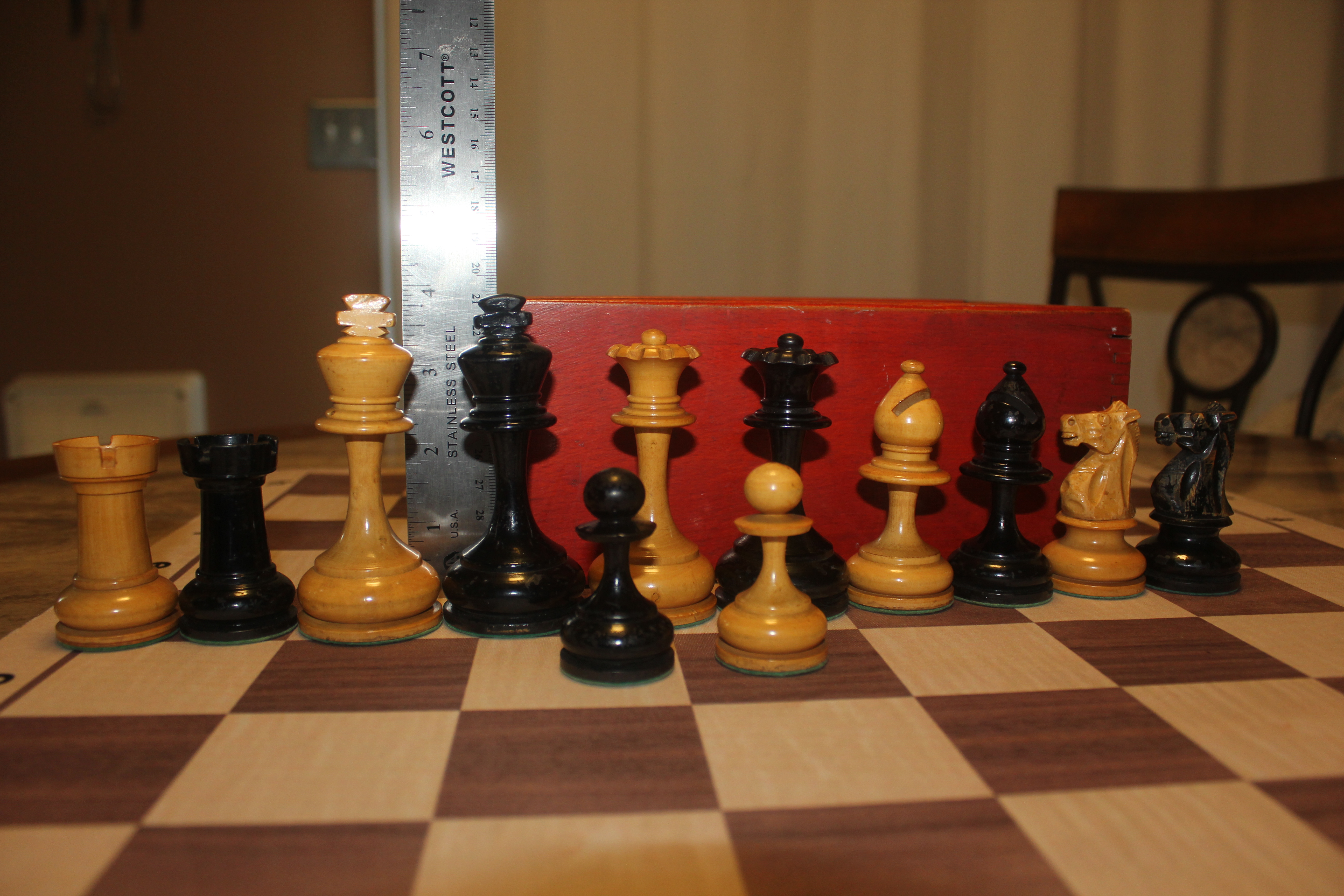
.JPG) It seems reasonable to conclude that someone who owned this chess set clipped and saved these games, which all seem to me worthy of study. Likely, it was the set’s first owner. I believe the set may have been sold new in 1937 in New York City. The set had been imported from France. Of course, there is plenty of uncertainty.
It seems reasonable to conclude that someone who owned this chess set clipped and saved these games, which all seem to me worthy of study. Likely, it was the set’s first owner. I believe the set may have been sold new in 1937 in New York City. The set had been imported from France. Of course, there is plenty of uncertainty..JPG)
.JPG)
.JPG) Most Chavet knights clearly differ from those in my new set, but one thread has a 1932 catalog from Chavet with a similar knight. There are a small number of others known to be Chavet sets with similar knights. The poster with a set close to mine drew attention to the relative heights of the base and the carved head. Lardy sets have a higher base, he wrote.
Most Chavet knights clearly differ from those in my new set, but one thread has a 1932 catalog from Chavet with a similar knight. There are a small number of others known to be Chavet sets with similar knights. The poster with a set close to mine drew attention to the relative heights of the base and the carved head. Lardy sets have a higher base, he wrote..JPG)