29 September 2023

Stafford Complications

I blame Eric Rosen for my interest in playing the Stafford Gambit. His Lichess study and accompanying YouTube video gave me a ready-made tactics and opening lesson for my students in an online group class in winter 2022. It has been an occasional weapon ever since. most notably giving me three quick wins in a nine-round OTB blitz tournament in May 2022. This morning my opponent played a move that I last faced almost a year ago. That game was a learning experience.

Internet Opponent -- Stripes,J.
Chessdotcom 29.9.2023

1.e4 e5 2.Nf3 Nf6 3.Nxe5 Nc6 4.Nxc6 dxc6 5.d3 Bc5

White to move
From this position 6.Be2 is most common and best. I have no less than 6 identical wins after 6.Bg5?? This error is met with 6...Nxe5 when the bishop must retreat to e3. Taking the queen gives Black a mate in two.

6.c3

Three prior games in my personal database have this move, all in 2022. 

6...Nxe4!

Previously, I played 6...b5?, managing two wins and a loss. White is objectively better after this foolishness.

7.d4

7.Qe2 is better.
7.dxe4?? loses the queen. That's what I learned after my game in October 2022.

7...Bd6 8.Bd3 Qe7 9.O-O O-O 10.Re1?

10.Nd2 is best.

Black to move
The fun begins now.

10...Bxh2+!

Played without hesitation. Next time, I'll try 10...Qh4 with some of the same ideas as in the game plus a wrinkle if White goes for 11.g3.

11.Kxh2??

11.Kf1 is approximately equal.

11...Qh4+-+ 12.Kg1 Qxf2+ 13.Kh1

Black to move
13...Qh4+?

Sometimes a combination that one has seen many times brings out routine play, oblivious to an additional resource.

13...Bg4! was the move I should have played.

14.Kg1 Nf2?=

There was still a chance to play 14...Qf2+ 15.Kh2 Qg3+ 19.Kg1 Bg4-+

15.Bxh7+! Kh8

15...Kxh7 16.Qc2++-

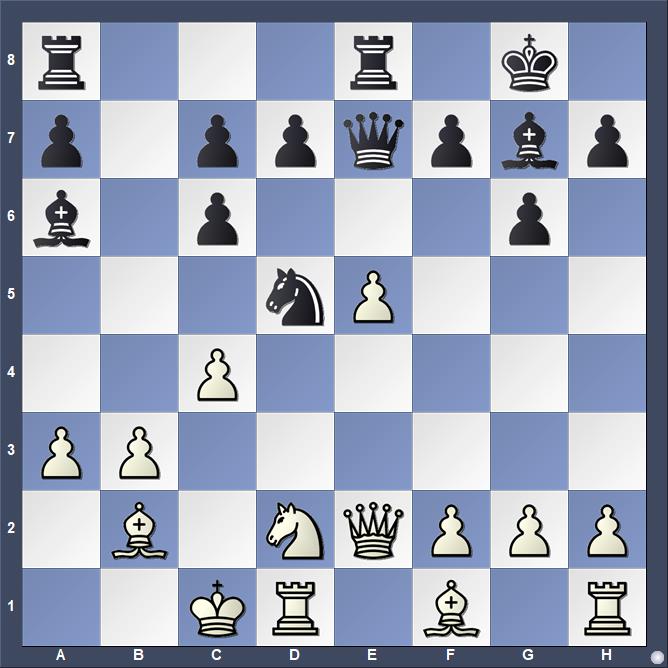
White to move
16.Qc2??

16.Qe2 is the only move to maintain equality.

16...Ng4-+ 17.Be4

I expected 17.Rd1, planning 17...Qh2+ 18.Kf1 Re8 with mate threats and a dominating position.

17...Qxe1#

I missed some things. My opponent missed more.


21 September 2023

My Chess Journey

When I was eight years old, my sister, a year younger, returned from the neighbor's house and taught me what she had learned there. This became my first lesson in a game neither of us would understand for several years to come. Chess joined Parcheesi, Monopoly, Go Fish, Connect Four, Life, Scrabble, and many other games that we played with our siblings, neighbor children our age, and sometimes with adults.

Seven years later, I was visiting a friend and saw a book on chess, Chess in 30 Minutes. The idea that someone would write a book on a game that children played was revolutionary to my thinking. Our family regularly visited the library. On the next visit, I found the chess books and borrowed a few. First step was learning to read: 1.P-K4, P-K4 2.N-KB3, P-Q3 3.B-B4, P-KN3 4.N-B3, B-N5 5.NxP BxQ?? Once these codes were deciphered with help from one of the books, reading began. There were several books, but the one that I remember most clearly was Irving Chernev, The 1000 Best Short Games of Chess (1955).

I played a game or two with the friend who had the chess book. We decided that we would play a match of twenty games or so. The year was 1975 and we had some sort of vague understanding of the battles then raging between Bobby Fischer and FIDE regarding his World Championship Defense against Anatoly Karpov. By the end of our match, I was much better than my friend. I’ve mentioned this story before (see “My First Chess Book”).

Over the next few years, I played a lot of games with a couple of friends. We played war games like Panzer Blitz, Luftwaffe, Highway to the Reich, Russian Campaign. The majority were World War II simulations. We also played Risk, of course, and we played chess. Matt Jessick liked 3D chess and always destroyed me. I preferred the classic game and increasingly favored it over other games. My sophomore year of high school, a group of students formed a chess club. I was near the top in strength. Jim Van Epps was clearly the best. He loaned me his copy of I.A. Horowitz, Chess Openings: Theory and Practice (1965). I studied the four pawns attack and finally beat his Pirc Defense. He introduced me to the Spokane Chess Club.

Our school’s chess club sent letters to all the other schools in the district, resulting in matches against the other schools that have clubs. My opponent in the match against Gonzaga Prep, Patrick Kirlin, remembers our game much better than I do. We played that team match in 1977 and he told me in 1995 that I had played the Sicilian Defense. None of these events were rated. I played in one tournament at the Spokane Chess Club, also not rated. Not everyone wrote their moves. I remember feeling almost embarrassed when I beat an older man with a bank rank checkmate. He was crushing me until leaving himself vulnerable to a mate in one.

As I was finishing high school and starting college, I played a USCF correspondence tournament. The game scores I have from this event are the oldest games in my personal database. There is a position in one of them that I use in teaching.

White to move

In college, there was a guy on my floor who liked to play chess with me. Sometimes we would start a game in the late morning and I would end up skipping my Philosophy of Religion class at 11:00. I won most of these games. Gradually, other priorities displaced chess. Occasionally I would play through some games in a book, but none of my friends were at my level and I did not seek out a chess club.

Interest in chess was revived almost ten years later when I bought my first computer and with it Chessmaster 2100. I was in graduate school.

I rejoined the Spokane Chess Club in late 1995 and played in my first rated OTB event in March 1996. In October, I played my sixth event and no longer had a provisional rating. By the end of the year, my rating had risen to 1495, but it would be several years before rising over 1500 in 2002. In early 1998, my worst event ever (I lost all five games) dropped me from 1472 to 1378 and it took me three events to bring my rating back into C Class.

In November 1996, I played in the Washington Class in Federal Way. I nearly won my section. I was on board one in round four tied with one other player, my opponent, 1/2 point ahead of the others. A win would secure at least a tie for first place. I had a winning position. I faltered, losing that game and the next, finishing the event with 3.0 and tied for 8th place.

Black to move

From my return to active play in the mid-1990s, active study of chess books has been a constant in my life. I also played correspondence chess (postcard, then email, and then websites like ChessWorld.net and Chess.com) continuously from 1996 through 2018, but only a few games since. Beginning in 1998, live play online also became a norm. I estimate that I have played more than 160,000 games.

My rating remained in C Class for nearly a decade, but in the 1500s for the second half. I was getting better, gaining both knowledge and skills, but progress was slow. Too much online blitz may have held me back.

In the summer of 2006, Curt Collyer gave me some lessons. He was my third round opponent in that terrible 0-5 event in 1998. Now in college and with a rating near 2200, he was the top player from my city and offering chess lessons during his summer break. In fall 2006 after this work with Curt, I crossed into B Class for the first time.

In 2008, I won the Spokane Contenders and played a four game match against FM David Sprenkle for the City Championship, losing 2 1/2 - 1/2. He beat me fairly quickly in the first game played on Thursday night. In the second game, I lost in 72 moves, learning while entering the game in my database that we had a three-fold repetition as I had suspected during the game. In the third game, he offered a draw when a repetition appeared best.

White to move

I was rated in the mid-1700s during the match with Sprenkle having risen rapidly through B Class. The Washington Open in May 2009 lifted me into A Class. I tied for fourth in the Premier section 1/2 point behind the top three.

My rating continued to rise, peaking after an astounding run of eleven consecutive wins.

My journey from wholly ignorant beginner in the late-1960s, to competitive high school player in the late-1970s, to active C Class club member in the mid-1990s involved a lot of book study. The journey from C Class in my 30s to high A Class in my early 50s (I peaked at 1982) included books, active play, private lessons, chess videos.

After peaking in 2012, I have struggled to stay in A Class. Through four events in 2016, my rating fell from 1886 to 1750. My last 2016 event lifted me back to 1791 and then I won the Winter Club Championship, my first event of 2017, lifting me back up to 1845. See "Home Preparation" for my win against the top rated player in the event, Michael Cambareri.

Since then, my rating has fallen and risen again within the range 1809 to 1875. Now in my 60s, the effects of aging impacts my ability to maintain focus during tournament games. Ambitions to reach expert no longer motivate me. However, I study chess regularly and continue to gain knowledge and experience. In the past year, I have solved more than 12,000 puzzles and exercises, including 7,262 on Chess.com alone.

During the Inland Empire Open in May and two events since then, I am enjoying the game whether I win or lose. After misplaying the opening in one game, I was enjoying watching how my opponent capitalized on his advantage while I struggled to put up resistance (see "The Saving Fork?"). Of course, I enjoyed even more pressing my advantage when my opponent missed the forced checkmate and then blundered two moves later.

Appended is a list of my best tournaments.

Weekend Swiss Events
2006 Washington Challenger’s Cup
Reserve 4.0/5 first—tie
2009 Washington Open
Premier 4.0/6 fourth—tie (1/2 point behind winners)
2012 Collyer Memorial
                4.5/5 second
2015 Spokane Falls Open
        4.5/5 first
2018 Eastern Washington Open
        4.5/5 first—tie
2023 Inland Empire Open
        4.5/5 first

Club Events
1996 Taxing Quads
        Quad 2 3.0/3 first
2006 Koz’s Quick Chaos
                3.0/3 first
2007 June Quick
                3.5/4 first
2008 Spokane Falls Action
        3.0/3 first
2008 Christmas Chaos
                3.5/4 first
2009 March Madness
        3.5/4 first
2009 Ajeeb Quads
        Quad A 2.3/3 first—tie
2009 Chaos
                4.0/4 first
2010 July Robin
                5.0/7 first—tie
2011 Turkey Quads
        Quad B 3.0/3 first
2011 December Quick
                3.0/3 first
2014 Blazing Heat Blitz
                8.0/9 first—tie
2016 Quick Night
                3.5/4 first
2016 Turkey Quads
        Quad B 3.0/3 first
2017 Winter Championship
        4.5/5 first

Closed Events

2008 City Championship Contenders
2.5/3 first
2010 City Championship Contenders
4.0/5 first—tie
2012 City Championship Contenders
4.5/5 first

Online Events

2016 US Chess Blitz on Chess.com (5-23)
4.0/5 first—tie
2016 US Chess Blitz on Chess.com (5-30)
4.5/5 first—tie
2016 US Chess Blitz on Chess.com (10-24)
4.5/5 first
2020 Morning Membership (8-14)
        4.0/4 first—tie
2020 Morning Membership (11-6)
        4.0/4 first
2020 Morning Membership (12-4)
        3.5/4 first
2020 Morning Membership (12-18)
4.0/4 first


20 September 2023

Speed Kills

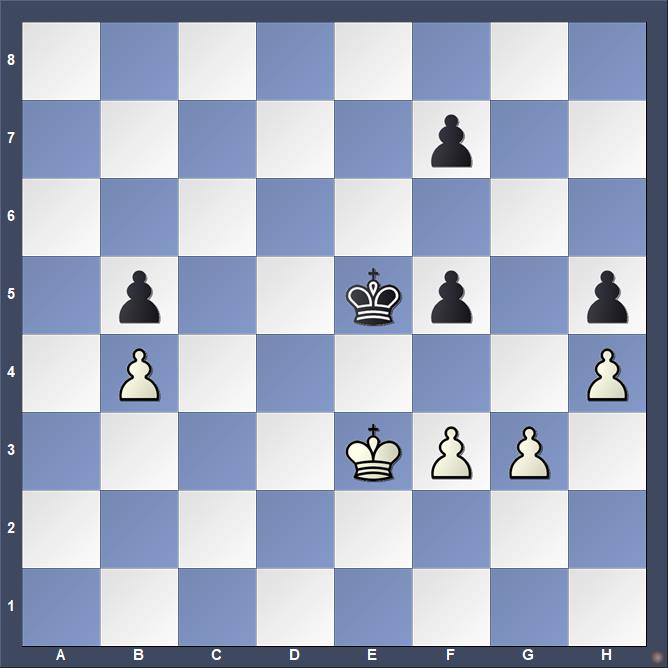
While playing this ending, I first thought that we had reached a simple drawn position. Then, my opponent erred. I sensed (correctly) that I was now winning, but managed to throw it away. Later analysis showed that it should have been drawn until my error gave my opponent a winning opportunity, but perhaps not an easy one to find.

Black to move
41...f6??

I rejected hastily 41...f4+, although it should have been clear to me that 42.gxf4+ Kf5 43.Kd4 Kxf4 leads to a pawn race where both players promote on the same move--a draw.

Stepping back with 41...Ke6 also allows Black to regain the opposition if White tries to advance his king.

42.Kd3

My first clue that I had missed something instructive in this ending was the website's game analysis calling this move a miss. Using the retry function, I found the idea, but further analysis showed that it was more intricate than I then thought.

White's winning idea is to transfer the king to h3, then create a passed pawn.

42.Kf2! Kd5 43.Kg2

Black to move
Analysis diagram
43...Ke5

If Black tries 43...Kc4, White's breakthrough takes place instantly for Black's king cannot get back into the square of the pawn. The pawn on f6 blocks the diagonal route after 44.g4 fxg4 45.fxg4 Kd4 46.gxh5.

44.Kh3

Without some calculation, I assumed that Black's b-pawn would promote before White's kingside pawns could break through, but the variation just above shows that is not true. Instead. Black's king must stay on the kingside. This also fails.

a) 44...Ke6 45.g4! f4 46.gxh5 Kf5 47.h6

Black to move
Analysis diagram
47...Kg6 48.Kg4 Kxh6 49.h5 f5+ 50.Kxf4 Kxh5 51.Kxf5+-

b) 44...f4 45.g4 f5 46.g5 and now Black's king is tied down to stopping the passed g-pawn allowing White's king to run to the b-file.

42...Kd5

I was thinking that we would shuffle our kings back and forth and agree to a draw.

43.g4??

Black to move
43...fxg4 44.fxg4 hxg4 45.h5 f5??

I hallucinated that my king could stay in the square.

45...Ke6 leads to an easy win.
45...g3 also leaves Black with a decisive advantage

46.h6+-

I blitzed out a few more moves because my opponent was low on time, but resigned when it became clear that my opponent would finish easily with the 20 seconds or so remaining.


23 August 2023

The Saving Fork?

In a game today, I played 24...Nd5 in a position that had been difficult for an hour.

White to move
How should White proceed?

20 August 2023

The Appeal of Informant

A question was raised in social media: does anyone still use Informant? As the question was in response to me, having claimed that Informant is the chess periodical that I read more than any other, I took the question as a personal challenge. I like the books, but now am more likely to read them on my computer screen while jotting notes in the print edition.

In the early days of Chess Informant, it was a vital source of games for readers. It no longer serves that purpose. We can watch them as they are played and have several ways to access them after they finish. What, then, is the appeal of Informant today?


My first Informant was number 64. I acquired it as I was getting into correspondence chess after a brief effort two decades earlier. One of the games in that issue gave substance to the concept of flexibility.* That game helped my planning and positional judgement in a correspondence game that I won (see the game at "Playing by the Book"). Of course, there are many ways to get access to games that will help one play correspondence chess. That Informant did this for me may have been no more than coincidence. It was what I was using for study. Is there anything inherent in the publication that makes it more useful than other resources for such a purpose?

More recently in another correspondence game I had Black in the French Defense and was facing a frightening appearing pawn storm. We were still in book, so I did a search of my database containing all games published in Informant for the position before me. There were more than one hundred games. Over the course of the weekend, I played through all of these games on my computer screen. Our game diverged from the databases a couple of moves later, and yet ten moves later I was developing plans based on a game I had seen that weekend. My memory of the game had errors—I incorrectly remembered had been played by Viktor Kortschnoj. Even so, I went on to win. Of course, a search of ChessBase Mega that controlled by rating would have given me most of these games and more, along with the same benefits.

Less is More


Chess Informant's
system of signs and language-less annotations contribute both to its appeal and limit its usefulness to many players. Chess players looking to improve often crave annotations expressed in words more than variations. These are vital for explaining concepts that must be absorbed in order to play well. However, words can distract as well.

When I was trying to improve as a C-Class player in the late-1990s and early 2000s, I became aware that my interior dialogue while playing tournament chess reflected a great deal of confusion. I did not lack ideas. Rather, I spent much of my thinking time on ideas that were unproductive. I examined lines that a master would immediately reject, but that seemed good to me. Learning the Informant system of signs and investing time reading through annotated games in that periodical helped me to quiet this internal dialogue. Chess analysis in Informant offers less, not more. Only critical lines at important moments are offered. The ideas that can be expressed through the system of signs are few, but they are important. If an idea cannot be expressed through these symbols, perhaps it should be discarded. Through the first decade of this century, my rating rose over 400 points. I was in my 40s. Informant was not the only tool that facilitated my rise, of course, but it was important. Several memorable successes are tied to Informant.

Informant today offers less in another way that maintains its appeal to me. It contains only quality games and analysis. Each Monday, Mark Crowther releases another issue of The Week in Chess with recent games from important tournaments. The last issue of 2022, number 1468, contained 7201 games. Number 1469, the first of 2023, set a record for quantity with 10,627 games. TWIC is a terrific resource and I keep my database of all TWIC more or less up-to-date. I don't know who, if anyone, succeeds in going through all of these games. Some selection is necessary. 

Informant culls a small sample from this mass of data, but every game merits attention. Usually the annotations are light, but some of the lines go deep. For a substantial number of games in each issue, several other recent games or game fragments are embedded in the annotations.

Aesthetics


Chess Informants are attractive books. Through something more than the first 100 issues, little changed on the cover except the colors. The design was spare, economical, and highlighted the global nature of chess culture. The "new Informants", however, each have a unique cover design. Sometimes these are colorful and whimsical. Sometimes the connection to chess is not explicit, such as the Spaghetti Western influenced cover of Informant 128 (see "Determination"). Sometimes, there is a puzzle quality to the cover. I won a copy of Chess Informant Paramount (a software package with Informants 1-123 and indices) by correctly identifying the image and context of the cover of Informant 125--the issue title was "Enigma" and the image was of part of the hardware used by the Bletchley Park codebreakers who cracked Nazi Germany's Enigma code. The most recent, CI 156 Mesmerized, has an image of the sky and clouds with shades of blue, orange, and white. It provokes the imagination.


*The notion of flexibility as an important strategic principle entered my thinking more soundly when I read Dan Heisman, Elements of Positional Evaluation, rev. ed. (1999) several years later, but the foundation was built by productive study of Informant 64.


09 August 2023

One from Cozio

Position 132
Carlo Cozio (c. 1715 -- c. 1780) is best known for a book published in two volumes, Il Giuoco degli Scacchi o sia Nuova idea di attacchi, difese e partiti del Giuoco degli Scacchi (1766), and for an offbeat variation for Black against the Spanish opening. An original of his book is dated 1740, and was in the collection of Lothar Schmid, according to A. J. Roycroft in his article, "Cozio!, Part I", in the magazine EG (July 1973). Roycroft asserts, "occasionally the play is either atrocious or incomprehensible." Nonetheless, some of his work has been deemed to be of value. Roycroft published 9 of Cozio's studies in Test Tube Chess: A Comprehensive Introduction to the Chess Endgame Study (1972) and 18 more in his article in EG.

After a game that I played yesterday, I went looking in Yuri Averbakh, Rook v. Minor Piece Endings (1978) for some guidance regarding my errors. The position Averbakh gives is credited to Cozio.

After reaching an endgame of bishop vs. rook and pawn that I thought I could draw, I managed to throw the draw away no less than ten times in 31 moves. I drew because my opponent did not know how to exploit my errors. More likely, neither of us recognized the errors for the blunders that they are.

White to move
This position, which occurred in my game yesterday, is identical to Cozio's number 132 as it appears in Harold van der Heijden, Endgame Study Database VI (2020). If you read the Italian in the screenshot above, you will see that it mirrors diagonally the one in Cozio's text, but changes nothing vital. Colors are reversed and the defending king is in in the opposite corner. In Averbakh's book, Cozio's colors are maintained with Black defending, but the position is flipped vertically.

White's defense is relatively simple. Keep the bishop on the b8-h2 diagonal. Averbakh makes this technique clear. I had been reading this book last week, preparing lessons for my students on rook vs. bishop endgames, but had not yet gotten to the point where Cozio's study is presented (28). Otherwise, I would have known what I was doing. However, my confidence that I could draw stemmed from this study and practice with my students of similar endings--rook vs bishop without a pawn.  I reasoned correctly that a rook pawn did not change much. After some unfavorable developments, I raced my king to the "safe corner". My opponent should have prevented this journey.

77.Bc7 Kf3 78.Bb6??

78.Bb8 or 78.Kg1 hold the draw.

78...Rf1+ 79.Kh2

Black to move
79...Rb1??

79...Rc1 is the only move that wins here. Black must understand White's defensive idea and prevent the bishop's return to the critical diagonal. The direct attack on the bishop forces the bishop back where it belongs.

80.Bc7 Kg4 81.Bd6 Rf1 82.Bc7 Rf2+ 83.Kh1

We have returned to the position after my 77th move.

83...Rg2 84.Bd6 Kf3 85.Bc5??

This was the ninth time that my bishop wandered away from its duties.

85...Ke2 86.Bb6??

The tenth and last.

Black to move

86...Kf1

Again, Black should have prevented the bishop's immediate return to the correct diagonal with 86...Rg7.

87.Bc5

Knowing what I do now, I would play 87.Bc7. But in this position, it is not critical. Black's king should be seeking to go to h3 after the pawn advances. That becomes possible if I keep leaving the key diagonal.

87...Rc2 88.Bb6 Rg2 and the game was drawn by repetition.

The moves Cozio gives in his book are less instructive, but he keeps the bishop on the correct diagonal.


White to move

1.Rc8+ Ka7 2.Rc7+ Ka8 3.Kb5 Bd4 4.Kc6 Be3 5.a7 Bxa7 6.Rc8 Bb8

We reach a position that I have been teaching to my students the past two weeks.

White to move
7.Rh8 Ka7 8.Kb5 Ka8

White cannot make progress.

9.Kb6 Stalemate.


08 August 2023

TWIC 1500!

Yesterday, Mark Crowther released the 1500th issue of The Week in Chess. His database now contains 3,581,971 games. Kudos to Crowther for dedication and consistency for 29 years! A couple of years ago, I filled in gaps in my own collection through a donation to TWIC. Crowther sent a link to download his personal copy. Now is a good time to do this if you have not already.

My copy exceeds Crowther's number by almost 3000 because I do a poor job of clearing duplicates. If my settings are wrong in the "find duplicates" feature of ChessBase, I could lose some of the sixteen games mentioned in "A Glass of Scotch". The moves may be the same, but the players, dates, and a events differ. Duplication is part of the historical record. I've also corrupted enough databases to be wary of changing large databases beyond simply adding more games.

I've been using The Week in Chess since I first discovered it twenty years ago. Crowther gathers all the games from the most important tournaments. These are then made available free. Someone who purchases ChessBase and pays an annual fee for updates should be able to get the same games. ChessBase is getting them from Crowther, I suspect.

I prefer keeping ChessBase Mega as it came from ChessBase without modification, and then use TWIC for games played in the past few years.

04 August 2023

A Glass of Scotch

Isn't this a forced draw?
Ryan Ackerman

Computer moves.
Cam Leslie

Black to move
After 10.Ba3

After a game at the Spokane Chess Club where this position arose, there was some discussion among the top players, experts Ryan Ackerman and Cam Leslie. I looked up the position in ChessBase's iPhone app, finding quite a few games that followed Ackerman's recommendation.

10...Nb4! 11.Bb2

11.g3 has been played. The computer says Black is better, but White has managed to draw at the top levels.

11...Bg7 12.a3

12.f4 is another try the engine finds dubious where White managed to draw among players rated over 2400.

12...Nd5 13.Nd2 O-O 14.O-O-O Rfe8

White to move

15.Qf3 Nb6 16.Ne4 Bxe5

16...d5 would be a novelty, but also leads to a draw if players can find the engine's moves.

17.Bxe5 Qxe5 18.Nf6 Kf8 19.Nxe8 Qa1+

White to move

Checking The Week in Chess finds fifteen games that have followed this line, all drawn. This line may be a forced draw at the top levels, but a few inaccurate options for White could serve to complicate matters at the club level.

In my game from the diagram at the top of the post, my opponent played 10...Qe6. He resigned after 11.cxd5 cxd5 12.Qxa6

After returning home, I drank a glass of Scotch.