09 March 2012

King Safety

A nice win by Judit Polgar in last year's European Individual Championship highlights the importance of king safety. The game Pantsulaia -- Polgar,J, Aix-les-Bains 2011 was published as Chess Informant 111/3 and was voted the best game of that edition of Informant. It scored a remarkable three first place and three second place votes from the seven judges. The lone skeptic, Zoltán Ribli scored it in tenth place. The tournament bulletin also published an annotated version of the game.

Pantsulaia,L (2595) - Polgar,Ju (2686) [A13]
Aix-les-Bains 111/3, 2011

1.c4 e6 2.Nf3 Nf6 3.g3 d5 4.Qc2 c5 5.d4 cxd4 6.Nxd4 e5 7.Nb3 Nc6 8.Bg2 Nb4 9.Qd1 dxc4 10.N3d2 Bf5 11.Na3 b5 12.Bxa8 Qxa8 13.Nf3 

Black to move

13...Nd3+ 14.exd3 Bxd3

Polgar sacrificed a knight to trap the White king in the center. But she was already down an exchange, and so, as the tournament bulletin notes, "Judit is a rook down at this moment!"

15.Nxb5 Bb4+ 16.Nc3 0–0 17.Rg1 

In Polgar's Informant annotations, this move is given a box (only move). She offers a line where White castles, but with a king far less secure than in the game. Black gets a bishop on f3 and a queen on c8 with intent to move c8-h3-g2.

17...Ne4 18.Bd2 Rd8 19.Rc1 Nxc3 20.bxc3 Ba3

White to move
Still down a rook, here Polgar wins back the exchange.

21.Be3 Bxc1 22.Bxc1 Rb8 23.Nd2 Qd5 24.Qa4 a5 25.Qd1 h6 

White to move

Polgar gives White's next move a question mark, but it is no easy matter to suggest something useful here. The White rook is neither helping defend the vulnerable king, nor contributing anything to a counterattack. Although down material, Black is ahead where it matters: the field of battle.

26.Qf3 Rb1 27.Kd1 e4 28.Qf4 Ra1 29.Qb8+ Kh7 30.g4 Qd7 31.Qe5 e3 

See tomorrow's post for a comment of the importance of this move, or see the tournament bulletin.

White to move
32.fxe3 Qa4+ 33.Ke1 Rxc1+ 34.Kf2 Rxg1 0–1


Training

For many years, I have started my work where a Grandmaster game ends. Grandmaster resignations and Grandmaster annotations reveal their perceptions of a clear and decisive advantage in a position where I might yet falter. One such position in this game occurs in Polgar's annotations. Instead of 27.Kd1, as in the game, White might have returned the queen to d1.

Judit Polgar gives 27.Qd1 Ra1 28.a3 e4-+.

White to move
6k1/5pp1/7p/p2q4/2p1p3/P1Pb2P1/3N1P1P/r1BQK1R1 w - -

I played from this position with Black against Rybka 4. After more than an hour, and several take-backs, I saw the welcome words on the screen that the Silicon Monster gave up.

My best line, stripped of all the dead ends and detours:

Rybka 4 x64 - Stripes,James
Blitz 25m Spokane, 08.03.2012

29.Nf1 Ra2 30.Ne3 Qe5 31.Bd2 Qb5 32.Bc1 Qb1 33.a4 Ra1 34.Kd2 Ra2+ 35.Ke1 Be2 36.Qxe2 Qxc1+ 37.Qd1 Qb2 38.Qc2 Qa1+ 39.Qd1 Qxc3+ 40.Kf1 Ra1 41.Kg2 Rxd1 42.Rxd1 Qb3 43.h4 Qxa4 44.Rd4 Qb3 45.Nxc4 f5 46.Nd2 Qc3 47.Rd8+ Kh7 48.Nf1 a4 49.Ne3 a3 0–1

Perhaps you could do better.

08 March 2012

Chess Informant Innovations

Thanks to some prize money* rewarding recent tournament success, I have caught up my collection of Chess Informants. The latest editions have a new look and new features. CI Labs is one of the new features. Described as "latest trends from a Grandmaster's point of view," CI Labs offers several brief articles for several openings.

A new section, "Modern Chess Theory," began appearing with CI 104. A theoretical survey of a recent trend had been an occasional feature in prior issues, but now it appeared in every issue. Offering a less comprehensive survey, CI Labs appeared for the first time with CI 110. CI 110 had five articles in CI Labs, CI 111 had six, and CI 112 has seven. These articles tend to discuss innovations or renewed interest in opening moves far deeper than I am likely to encounter at the level my opponents and I play. I can count on my fingers the number of games that I've played OTB that go through more than a dozen book moves. Even so, the articles are interesting for their strategic and tactical insights.

Part of what I learned to appreciate since my introduction to Chess Informants via ChessMate's booth at the 1996 Washington Class Championships (before the USCF negotiated an exclusive US distribution contract with the publishers, a contract now held by ChessCafe) was its simple expression of key chess concepts. In rendering the publication readable in any language, their system of signs stripped away the noise of verbose expression to present the essentials. Now, as they produce articles which must be translated into many languages, the analysis remains blissfully short and focused.

Bojan Vučković contributed an article concerning Philidor's Defense for CI 112 in which Black releases the central tension with 8...exd4.

White to move
He notes:
Should White recapture on d4 with his queen, Black can exploit the relative exposure of her Majesty in the centre. ... The recapture with the knight is more standard, whereupon Black reacts in a very similar way.
Several examples of play proceeding from each of these two choices form the substance of the article.

After 9.Qxd4 Ne5! White either retreats the bishop to e2 or snaps off the knight. Snapping off the knight might lead to exchange of queens and equality or more complex efforts that give Black plenty of chance for advantage. For example, 10.Nxe5 dxe5 11.Qxe5?! Ng4 12.Qf4 Bd6 13.e5 Nxe5 looks good for Black.

White to move


*I started buying Chess Informant print publications in the late-1990s. See "Playing by the Book" for an explanation of the immediate benefits. In 2001, or thereabouts, I purchased my first electronic editions. The cost of such publications remained daunting and my collection grew slowly. Then, in 2008, I used the prize money gained from losing the City Championship (prize money gained from winning the Contender's Tournament was deferred until after the Championship match) to purchase The Best of the Best 1000. Owning a copy of this $60 paperback rendered me eligible for a contest, and I placed fifth! The prize of 500 Euros worth of CI goods allowed me to complete my collection of Informants 1-103, as well as acquire other products, such as the electronic edition of the Encyclopedia of Chess Openings.

07 March 2012

When Diagrams are Wrong

An interesting study caught my eye on the blog Brooklyn 64 yesterday: "A Problem Worth Solving." I worked on it a few minutes, then read the rest of the post where an elegant solution was presented. Then I went on to reading other blogs. Later, on the way to a school's chess club, I was haunted by the solution. I remembered the position, and a quick mental reconstruction of the diagonal a6-f1 while driving the Jeep revealed that the White king on g1 was outside the square of the pawn on a6.

The diagram as presented on Brooklyn 64.

White to move
White must have a pawn on the a-file, but not on a2.

The position as I found it in my database.

White to move
The solution given at Brooklyn 64 was played in the game.

Kosikov,Alexey I (2440) - Bezman,Vadim [C69]
URS-ch1 Soviet Union, 1986

50.Rf2 Rxb3 51.Rg2 Rb1+ 52.Kf2 Rb2+ 53.Kg1 Rxg2+ 54.Kxg2 Ng6 55.Kf2 Nf8 56.Ke3 Ne6 57.Kd3 d5 58.Ke3 1–0

After 50.Rf2, Black cannot take the knight. 50...Re7+ gives him a chance to fight on.

I made a similar copying error on one of my flash cards from Dvoretsky's Endgame Manual. Alas, I failed to set the card aside for replacement, and must find it the hard way again.


Thursday Edit

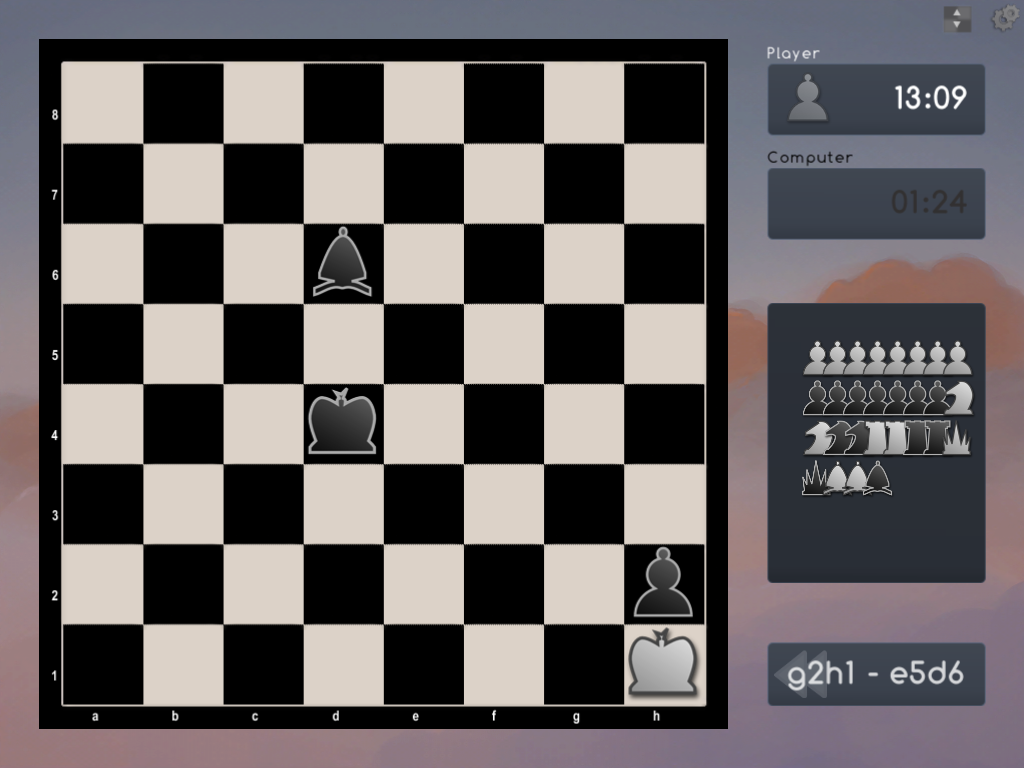
After an email exchange Tuesday evening and Wednesday morning, Brooklyn 64 corrected their diagram. I used this problem with some of my students yesterday. Winning with White after the exchange of rooks requires watching out for knight forks, as well as two notable stalemate dangers. Capturing the Black knight on f8 with White's king after eliminating Black's d-pawn = stalemate. Promoting the a-pawn to a queen (or rook) with the knight already on f8 = stalemate. It was an instructive position for elementary chess students. In one catastrophic effort, one of my chess students managed to lose all White's pawns, gaining my knight and two Black pawns in the process. He concluded that he was lost, only to learn that the White king could race to h1 in front of Black's remaining pawn = another draw.

06 March 2012

Chess Pro V for iPad: Review

Chess Pro V has large pieces and pink and yellow squares that may appeal to the aesthetic sensibilities of some chess enthusiasts. If not, other colors and sets are available. Unlike most computer applications, it spends a long time thinking for each move, even on the lower levels. This element, while irritating for those seeking a quick game at lunch, may render Chess Pro V a good choice for impulsive players who fall into the habit of making ill-considered moves when the opponent--carbon or silicon based--moves instantly.

I tested the iPad version, but the app is available for Android and Symbian devices. A earlier version is available for iPhone and Windows Mobile.

This app has six basic levels: beginner, novice, amateur, intermediate, difficult, and expert. An additional six levels are set by the number of seconds per move, from one to thirty. These levels might suit the player looking for a quick game between other daily tasks. Another ten levels range from one minute to 180 minutes per game. Chess Pro V tracks the user's statistics at each level, although it lacks the option to save games.

Arrows beneath the playing board permit full review of a game in progress, or of a game just finished. From any position, it is possible to resume playing. This review feature renders the app far more useful than Ohm Chess HD (reviewed yesterday) for the player who aspires to improve. It also facilitates post-game recording.

Stripes, James - Chess Pro V, Amateur [A50]
iPad, 06.03.2012

1.d4 Nf6 2.c4 b5 3.e3 bxc4 4.Bxc4 d5 5.Bd3 Be6 6.Nf3 Nbd7 7.0–0 Bg4 8.Nbd2 e6 9.e4 Nxe4 10.Nxe4 dxe4 11.Bxe4 Rb8 12.Bc6 Bd6 13.h3 Bf5 14.Qa4 Bd3 15.Re1 Rb6 16.d5 Bf5 17.Nd4 Rb4 18.Bxd7+ Qxd7 19.Qxd7+ Kxd7 20.dxe6+ Bxe6 21.Nxe6 fxe6 22.a3 Rb7 23.Re2 Rhb8 24.b4 Rg8 25.Be3 Re8 26.Bd4 e5 27.Rae1 Bxb4 28.axb4 Kc6 29.Bc5 Reb8 30.Rxe5 Rxb4 31.Bxb4 Rxb4 32.Re7 Kb7 33.Rxg7 h6 34.Ra1 Rb6 35.h4 Rc6 36.g4 Rc4 37.Kg2 Rd4 38.Kg3 Rd3+ 39.f3 Rd6 40.h5 Rb6

Time for White to Simplify
41.Rxa7+ Kxa7 42.Rxc7+ Kb8 43.Rg7 Rc6 44.Rg6 Kb7 45.Rxc6 Kxc6 46.g5 hxg5 47.h6 g4 48.Kxg4 Kd6 49.h7 Kd7 50.h8Q Ke6 51.Qd4 Ke7 52.Kf5 Kf8 53.Qd7 Kg8 54.Kg6 Kf8 55.Qd8# 1–0

Advertisements are distracting, but a $1.99 upgrade offers to remove these.

Chess Pro V is no different than other free chess apps in lacking features that I consider essential: ability to save games, resignation and draw offer functions. Rotation appears limited to portrait mode. The menu did not make it immediately evident how I could change chess sets. The options button in the upper left corner brought up menus that allowed me to choose my preferred notation style, but I had to press an arrow in the lower right to access the menu that would cause notation to appear. Playing with the images at the bottom of the screen brought forth the six chess sets, and multiple color choices. It enabled showing the game clock and the notation. The notation lacks move numbers, an irritating omission.

All in all, Chess Pro V is an app worth considering for players looking for a sparring partner on the iPad. It is available in many other mobile device formats as well. For $1.99, it may represent a good bargain.

05 March 2012

Ohm Chess for iPad: Review

White will lose his queen
A daunting array of free chess playing apps have become available in Apple's App Store for iPads/iPhones and similar devices. Ohm Chess HD is another that fails to implement a resign feature--an issue that I noted in my initial review of iPad chess programs in January 2011. I had hoped for a higher level of professional standards from this program because it is based on the chess program Faile, a program with which I was familiar from several years of running engine tournaments several years ago.

The program is simple and struck me as intuitive. It has four levels: novice, intermediate, expert, and grandmaster. It has three time controls, 40 moves in 5 minutes, 10 minutes, and 30 minutes. For my first game, I selected intermediate and five minutes. The program's opening demonstrated beginner level play, but it was able to exploit an egregious tactical error (see screenshot). In subsequent games, defeating its intermediate level was simple. On expert level, it plays a challenging game.

I was unable to find a way to save games played, which certainly limits this app for players seeking improvement through post-game analysis. Uncompleted games permit takebacks via the arrow under the move notation, given in unambiguous long algebraic.

The app store description claims that the program rotates as one should expect from an iPad app. It does indeed flip from one landscape to its opposite, but it does not rotate into portrait mode. The developers address this issue on their blog. When touching a piece, it places a dot on all legal squares. That's a nice feature for beginners, but one I prefer to turn off.

The developers claim that it varies its opening. In intermediate mode, it played Alekhine's Defense is more than half of the games. On expert level, it played the Berlin Defense in the Spanish every game, although it varied its fifth move.

For casual play, Ohm Chess HD is an option for entertainment. The distinctive graphics may appeal to some users. I expect that I will use the app with some regularity until I defeat its expert level, and then it will join others among the mediocre chess apps that I ignore. When storage space becomes a factor, I will delete it.

I avoided losing in this game.

Stripes, James - Ohm Chess HD, Expert [C56]
iPad, 05.03.2012
1.e4 e5 2.Nf3 Nc6 3.Bc4 Bc5 4.0–0 Nf6 5.c3 d6 6.d4 exd4 7.cxd4 Bb6 8.e5 dxe5 9.dxe5 Qxd1 10.Rxd1 Ng4 11.Nc3 Nxf2 12.Rf1 Ng4+ 13.Kh1 Nf2+ 14.Kg1 Ng4+ 15.Kh1 Nf2+ ½–½


Evening Addendum

The take-back feature is useful. As there is no way to save a game, unless either remembering every move or writing it during play, once the game is lost, I simply roll the game back to a point of equality and try something different. Playing slower, however, will eliminate this option as the clock does not turn back to what it was at the earlier move.

I keep losing to the expert, except for an occasional draw. The last draw revealed another problem with the app. As was the case with PC software a decade or more ago, and with many amateur engines after that date, the engine fails to recognize certain textbook draws. We played enough moves in the position to the right that I began to anticipate a draw by  the fifty move rule. I had no idea how many moves because the app shows only the last move played, and no move numbers.

I suspect we had reached forty-nine moves because Ohm Chess promoted its pawn to a queen on the next move. We then played many more senseless moves before the game was drawn by repetition.

04 March 2012

Lesson of the Week

Take the free pieces

This week's youth chess clubs are looking at the first few moves a game played by two trophy winners at the Winterfest Scholastic. I previously offered a lesson from one of the games submitted in this event on January 24.

In this week's model game, both players engage in a fight for the center. Both use pieces in coordination to create threats. The decisive difference was that White left pieces vulnerable, and Black took the free gifts. The names have been changed.

Santa (754) - Every Good Child (681) [C62]
Winterfest Deer Park, 21.01.2012

1.e4 e5 2.Nf3 d6 3.d4 Nc6 4.Bb5 Bd7 5.Qe2?!

Black to move

5. Nc3, O-O, and even d5 are better.

5...exd4 6.e5? 

6.Bxc6 Bxc6 7.Nxd4 was played in Russia in 2009. See the bonus game below.

6...dxe5 7.Nxe5

It still seems sensible to try 7.Bxc6 Bxc6 8.Nxe5 Qe7 9.Nxc6 bxc6

7...Nxe5 8.Qxe5+ Qe7

White to move

9.Bf4??

Now Black has a decisive advantage.

White should have tried 9.Bxd7+ Kxd7 10.Qxe7+ Bxe7 or 9.Qxe7 Bxe7 10.Bxd7 Kxd7 both leading to the same position where Black is ahead by one pawn.

9...Bxb5 10.Na3 Qxe5+ 11.Bxe5 Bxa3 12.bxa3 Ne7 13.Bxg7 Rg8 14.Rb1 a6 15.Bxd4 Rxg2 16.Rb4 0–0–0 17.a4 Bd7 18.Bf6 Re8 19.Re4 Bc6 20.Rxe7 Rgg8 21.Re2

If 21.Rf1

Black to move


Black has a pin 21...Rxe7+ 22.Bxe7 Re8


21...Bxh1 22.f4 Rg1+ 23.Kf2 Rg2+ 24.Kf3 Rgxe2+ 25.Kg3 Rg8+ 26.Kh3 Reg2 

A possible finish: 26...Re3+ 27.Kh4 Bg2 28.Bg5 f5 29.Kh5 Rh3+ 30.Bh4 Bf3+ 31.Kh6 Rxh4#

27.Be5 R8g6 28.f5 

28.Bg7 does not save White R2g4 29.Be5 Bg2#

28...Rh6# 0–1


Bonus Game

Ivanov,Ivan Josifov (2095) - Kokorin,Ivan [C62]
Dimitrovgrad-ch Dimitrovgrad (9), 2009

1.e4 e5 2.Nf3 Nc6 3.Bb5 d6 4.d4 Bd7 5.Qe2 exd4 6.Bxc6 Bxc6 7.Nxd4 Bd7 8.c4 Be7 9.Nc3 Nf6 10.f3 0–0 11.h4 Nh5 12.Qf2 g6 13.Bh6 Ng7 14.0–0–0 Re8 15.g4 a5 16.Rdg1 a4 17.a3 Ra5 18.Nd5 Ne6 19.Nf5 Bf6 20.Nxf6+ Qxf6 21.Bg5 Nxg5 22.hxg5 Qxg5+ 23.f4 Qf6 24.g5 1–0

02 March 2012

Spanish Opening, Steinitz, Bronstein Variation C76

Despite more than 50,000 online blitz games, my first game in ECO code C76 was Sunday's round 5 game in the 20th Dave Collyer Memorial tournament. I opted for the Spanish Opening (Ruy Lopez) as White. My opponent, Expert Tim Moroney, played a deferred Steinitz Defense, Bronstein variation. I was on my own without any book knowledge on move 4, a fairly uncommon experience in the Spanish Opening. Nevertheless, the game's novelty came on my opponent's move 9.

We chose an unusual move order, but ended in an opening system played with success by David Bronstein as Black in the 1950s, employed by Boris Spassky in the 1980s also with success, and in the years 2006-2008 by Shakhriyar Mamedyarov but with a negative score, although he drew Viswanathan Anand in one game. In game 22 of the 1929 World Championship, Alexander Alekhine won with Black against Efim Bogoljubov using this system.

1.e4 e5 2.Nf3 Nc6 3.Bb5 a6 4.Ba4 d6 5.c3 Bd7 6.d4 g6

White to move

My game Sunday reached this position via the move order 1.e4 e5 2.Nf3 Nc6 3.Bb5 g6 4.c3 a6 5.Ba4 d6 6.d4 Bd7.

7.O-O is the most popular move and is the main line give in ECO.
7.Bg5 was my move, and is the other ECO line.

Bogoljubov played 7.Bg5.

That game continued 7...f6 8.Be3 Nh6

White to move

Here, Bogoljubov castled, 9.O-O. I played 9.dxe5, a move appearing in Big Database 2011 in five games.

My opponent's 9...Nxe5 rendered our game unique.

Bogoljubov -- Alekhine continued 9...Bg7 10.h3 Nf7 11.Nbd2 O-O 12.dxe5. Here Alekhine comments:
White--rightly--recognises that a further maintaining of the tension in the centre would be rather to Black's advantage and aims at simplification. The problem of the defence has been solved in this game in quite a satisfactory way.
Alekhine, My Best Games of Chess, 1924-1937 (1965), 63.
My opponent commented after our game that his opening choice must be deemed a success because he very easily achieved equality.

Had Moroney played 9...dxe5, our game would have transposed to a line with some history, including Bronstein -- Sakharov 1960, played in the 27th Soviet Championship. Bronstein -- Sakharov began with the move order 1.e4 e5 2.Nf3 Nc6 3.Bb5 a6 4.Ba4 d6 5.c3 Bd7 6.d4 g6 7.dxe5 dxe5 8.Bg5 f6 9.Be3 Nh6.

Black's opening choice does appear to offer good prospects for equality.

I was playing for a draw with White. In the late middlegame, my opponent and I repeated a position once. Instead of extending the draw offer that I invited by this repetition, my opponent broke open the game into an endgame that made a draw unlikely. Lucky for me, he incorrectly assessed the resulting pawn endgame and I won. See "Pawn Wars" for the endgame critical position.

ECO Code is a trademark of Chess Informant

01 March 2012

Thursday Tactic

Chess Informant 1.1 is a 1966 correspondence game between Vladimir Simagin and Alexey Sokolsky, two old men. Simagin had served as a trainer to Vasily Smyslov, preparing him for his successful world championship match. Both players are known for opening innovations (1.b4 is sometimes called the Sokolsky Opening).

As is common, even in games between titled players, the end of this game was decided by a tactical shot.

White to move
3n3k/p2Br1bp/1pp5/1q4p1/3Pp3/1P2P1P1/PBQ2RKP/8 w - -