14 March 2012

Opposition and Outflanking

A seemingly simple problem with five chess pieces, and for which I had a vague recollection of the solution, managed to occupy half an hour of my time on Monday. That half hour was spent solving and verifying, mostly by looking at a chess board with the position, and without moving the pieces. Another half hour was spent testing my solution against tChess Pro and Shredder on the iPad, then against Rybka 4 on the notebook.

The position is one of the blue diagrams in Dvoretsky's Endgame Manual (2003).

White to move
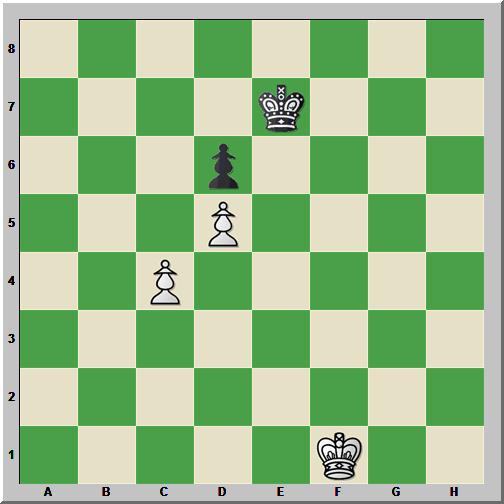
I have converted all of the blue diagrams from Dvoretsky's chapter on pawn endgames to flash cards for study and review. The answers are not on the cards, so I must keep a copy of Dvoretsky's text handy when I need an answer. I purchased the first edition of the book in paperback, and the second edition as a Kindle edition for access on my iPad. When I am on the road teaching chess in schools or giving private lessons in homes or cafes, I always have my deck of pawn endgame cards and the Kindle edition of Dvoretsky's Endgame Manual. With some students, we pick a card at random and try to solve it. Of the 48 cards, I instantly know the solution to 35-40. My plan (see "2012 New Year's Resolutions") is to know all 48.

On Monday, the diagram above was on the card that I randomly picked for my own training. I eventually solved it. I remembered that Dvoretsky had emphasized the importance of the f-file, and that grabbing the distant opposition with 1.Ke1 led only to a draw. After a few minutes, I remembered the first move 1.Kg2! Working out why this move was correct and the main variations took some time.

As it turned out, the key ideas were part of my teaching curriculum.


Elementary Instruction

In How to Reassess Your Chess, 3rd ed. (1993), Jeremy Silman presents an exercise that I find useful enough that I have incorporated it into my Scholastic Chess Awards curriculum. For the Bishop Award, the student must force his or her king to f8 or h8 against my efforts to prevent.

White to move

The process is simple when the student understands opposition and outflanking. Simply having the opposition is not enough. Silman explains, "the opposition is only a means to an end, not the end itself" (6).

This king vs. king exercise develops some of the requisite skills for prevailing over a skilled opponent in the next diagram.
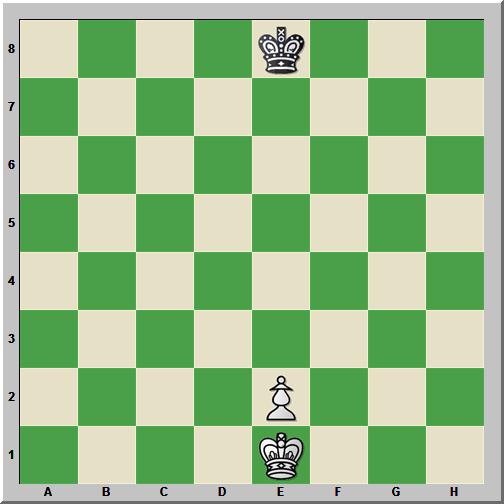
White on move wins
Place the Black king on e7, and White must be the player on move for this position to be a win. After some practice and understanding, the student should become capable of winning this next position.

The player with the move wins

Training with Dvoretsky

Back to the problem that I wrestled with on Monday.* Swinging the king to the queenside to win Black's pawn was among the ideas that cropped up in my initial analysis of the position. But the immediate dash in that direction permits Black to defend successfully by maintaining the opposition in the battle for the key squares on the sixth rank. White cannot penetrate. But, some maneuvering on the kingside and then a transfer to the queenside works.

I found this key position in my analysis.

White to move

Reaching this position with Black to move draws. With White to move, the king runs around his pawns, using the a-file to outflank the Black king, and wins the Black pawn.

White to move

White must move to the a-file. These last two positions occurred in my battles with tChess Pro and Shredder, but Rybka kept its king on the eighth rank. Nevertheless, White's moves were the same in similar positions.

I was impressed by the need to play the whole board from the g-file to the a-file in order to win this game. On Monday, I posted my battle with Rybka 4 in a replayable format on my Chess.com blog.


*The problem from Dvoretsky's text appears in the Encyclopedia of Chess Endings as No. 846 in the Pawn Endings volume. Dvoretsky credits Jan Drtina as the composer, but in ECE it is attributed to František Dedrle.

13 March 2012

Rules of Chess: Castling

Lesson of the Week

Note: The main lesson for all students this week concerned a rules violation. In addition, some of the advanced students received instruction in pawn endgames. See "Opposition and Outflanking."
This position was reached in a recent scholastic tournament that I directed. Players at these tournaments range in skill from those who compete with success against strong club players (over 1400 USCF) on the one hand, to players just beginning the game and sometimes unfamiliar with such rules as castling and en passant.

Black to move
 
The player recording the moves wrote 11...O-O (castle kingside), which is an illegal move. The FIDE Laws of Chess explain the rule clearly.
There are two different ways of moving the king:
by moving to any adjoining square not attacked by one or more of the opponent’s pieces or by ‘castling’. This is a move of the king and either rook of the same colour along the player’s first rank, counting as a single move of the king and executed as follows: the king is transferred from its original square two squares towards the rook on its original square, then that rook is transferred to the square the king has just crossed.

The right to castle has been lost: if the king has already moved, or with a rook that has already moved.Castling is prevented temporarily: if the square on which the king stands, or the square which it must cross, or the square which it is to occupy, is attacked by one or more of the opponent's pieces, or if there is any piece between the king and the rook with which castling is to be effected.
FIDE Handbook
In this youth game, neither the king nor rook has moved. The king is not in check, nor is moving into check. But, the square the king crosses over (f8) is attacked by the bishop on d6. Castling is not permitted.

In this case, the player recording the moves knew about castling, and even knew how to write the move in chess notation. However, this player either did not know one key element of the rule, or failed to see that it was violated in this instance.

12 March 2012

Intuitive Tactics

Does anyone calculate brilliant moves that computers fail to find, or does an intuitive sense drive the play? In "Shirov Test" I presented a position where Alexei Shirov found the correct move, but where engines fail. Study of that position and Shirov's idea reveals the tactical ideas that are simply beyond the search horizon of computers, but within the conscious possibilities of human players.

Shirov's move here, from the best game of Chess Informant 110, may be more complex. As in the endgame in "Shirov Test," engines fail to suggest the move. Once it is shown to these silicon monsters, however, they concur that it was best.

White to move
Find Alexei Shirov's Winning Plan

11 March 2012

Training Log: Chess Skill Study Plan

Perhaps I will be able to maintain habitual logging of my training progress on a weekly basis. If so, this post shall be the inaugural effort. More than two months ago, I set out part of my study plan in "New Year's Resolutions." Seven weeks later, I noted my failure in "Accountability". Despite this failure, my initial rating goal for the year was achieved (with interest!) in my first event of 2012. My desire to do well in the 20th Dave Collyer Memorial motivated certain efforts. My astounding success taking second place drives me to redouble efforts to aim higher through more consistent, better focused training.

The past week has been difficult for chess training as I was suffering from a late-winter cold. I missed no work and was productive blogging. But, the discipline to sit at a table with a chess book or chess board proved beyond the level of motivation that I was able to muster. I focused reasonable efforts in some games against several computer adversaries. See my "Ohm Chess for iPad: Review," "Chess Pro V for iPad: Review," and "King Safety." The last of these may have been the most useful: battling unsuccessfully, and then after take-backs with success, against Rybka 4 from a position that Judit Polgar evaluated as having a decisive advantage. It is vital to develop the skill of gaining the full point from a technical win due to positional domination while a piece down.

This past week, I spent no time with Imagination in Chess nor Chess Training Pocket Book II. The Resolution for 2012 had been:
Spend thirty minutes once per week solving problems in Lev Alburt, Chess Training Pocket Book II and Paata Gaprindashvili, Imagination in Chess.
I spent no time with my pawn endgame flash card project, but did spend time reviewing some positions therein while teaching from my unexpected win in the last round of the Collyer. I explained the difference between these two zugzwang positions to some elementary students.

The player to move must lose a pawn, but still draws the game.
The player to move loses the game

Teaching the benefits of my training regimen is no substitute for following it.

I fell short of my goal of 50 tactics exercises this week, but did not closely track the total. Weekly reports on my progress may improve this tracking. Hence, my current tally in the Shredder iPad app's puzzles:
1331 puzzles: 10445/13310 points 78%
last 10 puzzles: 76/100 76%
This week some recent purchases arrived in the mail. I plan to incorporate Michael Stean, Simple Chess (1978) into my training. Chess Informants 107-112 also arrived. Among my initial use of these CDs, I easily found the breakthrough from this position, but faltered a bit in the resulting queen ending.

White to move

The past week was neither an abysmal failure nor a clear success.

10 March 2012

Perpetual Check

I often hear it stated that one of the ways the rules of chess facilitate a draw, or result with no winner is perpetual check. In fact, there is nothing in the rules about this option. Rather, the rules of chess provide for a draw by repetition.
9.2 The game is drawn upon a correct claim by the player having the move, when the same position, for at least the third time (not necessarily by a repetition of moves):
a. is about to appear, if he first writes his move on his scoresheet and declares to the arbiter his intention to make this move, or
b. has just appeared, and the player claiming the draw has the move.
FIDE Handbook, http://www.fide.com/fide/handbook.htm
US Chess Federation Rules, under which I play, are similar.

Perpetual check is not a rule, but a means to draw by repetition. When a player is unable to avoid endless checks, he or she has no way to avoid draw by repetition.

In one of the variations given in Judit Polgar's annotations to her brilliant win against Levan Pantsulaia in the eighth round of the European Individual Championship, she offered this position after an oversight by Black. See yesterday's "King Safety" for the game.

In the game, Polgar played 31...e3. This position arises after the alternative 31...Qa4+ 32.Nb3, and then instead of the necessary 32...e3, the blunder 32...cxb3.

White to move

White can endlessly check the Black king from f5 and c8. A beautiful attack ran aground because the Black king, too, was vulnerable.

09 March 2012

King Safety

A nice win by Judit Polgar in last year's European Individual Championship highlights the importance of king safety. The game Pantsulaia -- Polgar,J, Aix-les-Bains 2011 was published as Chess Informant 111/3 and was voted the best game of that edition of Informant. It scored a remarkable three first place and three second place votes from the seven judges. The lone skeptic, Zoltán Ribli scored it in tenth place. The tournament bulletin also published an annotated version of the game.

Pantsulaia,L (2595) - Polgar,Ju (2686) [A13]
Aix-les-Bains 111/3, 2011

1.c4 e6 2.Nf3 Nf6 3.g3 d5 4.Qc2 c5 5.d4 cxd4 6.Nxd4 e5 7.Nb3 Nc6 8.Bg2 Nb4 9.Qd1 dxc4 10.N3d2 Bf5 11.Na3 b5 12.Bxa8 Qxa8 13.Nf3 

Black to move

13...Nd3+ 14.exd3 Bxd3

Polgar sacrificed a knight to trap the White king in the center. But she was already down an exchange, and so, as the tournament bulletin notes, "Judit is a rook down at this moment!"

15.Nxb5 Bb4+ 16.Nc3 0–0 17.Rg1 

In Polgar's Informant annotations, this move is given a box (only move). She offers a line where White castles, but with a king far less secure than in the game. Black gets a bishop on f3 and a queen on c8 with intent to move c8-h3-g2.

17...Ne4 18.Bd2 Rd8 19.Rc1 Nxc3 20.bxc3 Ba3

White to move
Still down a rook, here Polgar wins back the exchange.

21.Be3 Bxc1 22.Bxc1 Rb8 23.Nd2 Qd5 24.Qa4 a5 25.Qd1 h6 

White to move

Polgar gives White's next move a question mark, but it is no easy matter to suggest something useful here. The White rook is neither helping defend the vulnerable king, nor contributing anything to a counterattack. Although down material, Black is ahead where it matters: the field of battle.

26.Qf3 Rb1 27.Kd1 e4 28.Qf4 Ra1 29.Qb8+ Kh7 30.g4 Qd7 31.Qe5 e3 

See tomorrow's post for a comment of the importance of this move, or see the tournament bulletin.

White to move
32.fxe3 Qa4+ 33.Ke1 Rxc1+ 34.Kf2 Rxg1 0–1


Training

For many years, I have started my work where a Grandmaster game ends. Grandmaster resignations and Grandmaster annotations reveal their perceptions of a clear and decisive advantage in a position where I might yet falter. One such position in this game occurs in Polgar's annotations. Instead of 27.Kd1, as in the game, White might have returned the queen to d1.

Judit Polgar gives 27.Qd1 Ra1 28.a3 e4-+.

White to move
6k1/5pp1/7p/p2q4/2p1p3/P1Pb2P1/3N1P1P/r1BQK1R1 w - -

I played from this position with Black against Rybka 4. After more than an hour, and several take-backs, I saw the welcome words on the screen that the Silicon Monster gave up.

My best line, stripped of all the dead ends and detours:

Rybka 4 x64 - Stripes,James
Blitz 25m Spokane, 08.03.2012

29.Nf1 Ra2 30.Ne3 Qe5 31.Bd2 Qb5 32.Bc1 Qb1 33.a4 Ra1 34.Kd2 Ra2+ 35.Ke1 Be2 36.Qxe2 Qxc1+ 37.Qd1 Qb2 38.Qc2 Qa1+ 39.Qd1 Qxc3+ 40.Kf1 Ra1 41.Kg2 Rxd1 42.Rxd1 Qb3 43.h4 Qxa4 44.Rd4 Qb3 45.Nxc4 f5 46.Nd2 Qc3 47.Rd8+ Kh7 48.Nf1 a4 49.Ne3 a3 0–1

Perhaps you could do better.

08 March 2012

Chess Informant Innovations

Thanks to some prize money* rewarding recent tournament success, I have caught up my collection of Chess Informants. The latest editions have a new look and new features. CI Labs is one of the new features. Described as "latest trends from a Grandmaster's point of view," CI Labs offers several brief articles for several openings.

A new section, "Modern Chess Theory," began appearing with CI 104. A theoretical survey of a recent trend had been an occasional feature in prior issues, but now it appeared in every issue. Offering a less comprehensive survey, CI Labs appeared for the first time with CI 110. CI 110 had five articles in CI Labs, CI 111 had six, and CI 112 has seven. These articles tend to discuss innovations or renewed interest in opening moves far deeper than I am likely to encounter at the level my opponents and I play. I can count on my fingers the number of games that I've played OTB that go through more than a dozen book moves. Even so, the articles are interesting for their strategic and tactical insights.

Part of what I learned to appreciate since my introduction to Chess Informants via ChessMate's booth at the 1996 Washington Class Championships (before the USCF negotiated an exclusive US distribution contract with the publishers, a contract now held by ChessCafe) was its simple expression of key chess concepts. In rendering the publication readable in any language, their system of signs stripped away the noise of verbose expression to present the essentials. Now, as they produce articles which must be translated into many languages, the analysis remains blissfully short and focused.

Bojan Vučković contributed an article concerning Philidor's Defense for CI 112 in which Black releases the central tension with 8...exd4.

White to move
He notes:
Should White recapture on d4 with his queen, Black can exploit the relative exposure of her Majesty in the centre. ... The recapture with the knight is more standard, whereupon Black reacts in a very similar way.
Several examples of play proceeding from each of these two choices form the substance of the article.

After 9.Qxd4 Ne5! White either retreats the bishop to e2 or snaps off the knight. Snapping off the knight might lead to exchange of queens and equality or more complex efforts that give Black plenty of chance for advantage. For example, 10.Nxe5 dxe5 11.Qxe5?! Ng4 12.Qf4 Bd6 13.e5 Nxe5 looks good for Black.

White to move


*I started buying Chess Informant print publications in the late-1990s. See "Playing by the Book" for an explanation of the immediate benefits. In 2001, or thereabouts, I purchased my first electronic editions. The cost of such publications remained daunting and my collection grew slowly. Then, in 2008, I used the prize money gained from losing the City Championship (prize money gained from winning the Contender's Tournament was deferred until after the Championship match) to purchase The Best of the Best 1000. Owning a copy of this $60 paperback rendered me eligible for a contest, and I placed fifth! The prize of 500 Euros worth of CI goods allowed me to complete my collection of Informants 1-103, as well as acquire other products, such as the electronic edition of the Encyclopedia of Chess Openings.

07 March 2012

When Diagrams are Wrong

An interesting study caught my eye on the blog Brooklyn 64 yesterday: "A Problem Worth Solving." I worked on it a few minutes, then read the rest of the post where an elegant solution was presented. Then I went on to reading other blogs. Later, on the way to a school's chess club, I was haunted by the solution. I remembered the position, and a quick mental reconstruction of the diagonal a6-f1 while driving the Jeep revealed that the White king on g1 was outside the square of the pawn on a6.

The diagram as presented on Brooklyn 64.

White to move
White must have a pawn on the a-file, but not on a2.

The position as I found it in my database.

White to move
The solution given at Brooklyn 64 was played in the game.

Kosikov,Alexey I (2440) - Bezman,Vadim [C69]
URS-ch1 Soviet Union, 1986

50.Rf2 Rxb3 51.Rg2 Rb1+ 52.Kf2 Rb2+ 53.Kg1 Rxg2+ 54.Kxg2 Ng6 55.Kf2 Nf8 56.Ke3 Ne6 57.Kd3 d5 58.Ke3 1–0

After 50.Rf2, Black cannot take the knight. 50...Re7+ gives him a chance to fight on.

I made a similar copying error on one of my flash cards from Dvoretsky's Endgame Manual. Alas, I failed to set the card aside for replacement, and must find it the hard way again.


Thursday Edit

After an email exchange Tuesday evening and Wednesday morning, Brooklyn 64 corrected their diagram. I used this problem with some of my students yesterday. Winning with White after the exchange of rooks requires watching out for knight forks, as well as two notable stalemate dangers. Capturing the Black knight on f8 with White's king after eliminating Black's d-pawn = stalemate. Promoting the a-pawn to a queen (or rook) with the knight already on f8 = stalemate. It was an instructive position for elementary chess students. In one catastrophic effort, one of my chess students managed to lose all White's pawns, gaining my knight and two Black pawns in the process. He concluded that he was lost, only to learn that the White king could race to h1 in front of Black's remaining pawn = another draw.